Bitcoin Tests $80,000 as Hashrate Recovery Meets Key Resistance
Key Takeaways
- •Bitcoin traded near $79,055 on September 1, below the $79,400-$80,000 resistance zone identified by trader That Martini Guy, with $77,000 marked as key support.
- •Bitcoin gained roughly 23% in August, rising from about $62,763 on August 1 to close above $80,000 in the final week of the month, per CoinGecko data.
- •Bitcoin's seven-day average hashrate rose 3.3% to 915 exahashes per second by August 31, recovering from earlier weakness partly attributed to seasonal power curtailment among miners.
- •Luxor's Hashrate Index projects Bitcoin's next difficulty adjustment around September 5, with a model-estimated 0.67% increase, after the August 23 adjustment reduced difficulty by 1.31%.
- •Total Bitcoin futures open interest stood near $54.31 billion with about $25.37 billion in 24-hour futures volume, according to CoinGlass, indicating elevated leverage that could amplify price moves once the range resolves.
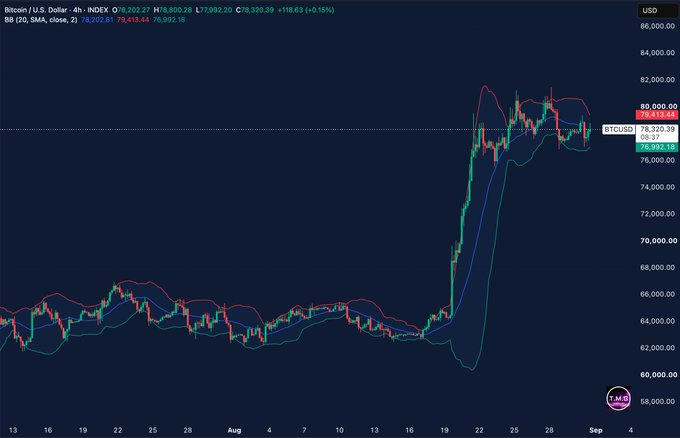
Bitcoin traded near $79,000 on Sept. 1 after spending several sessions below the $80,000 resistance zone. The setup drew attention because traders watched a tightening four-hour price range while network data showed Bitcoin's hashrate recovering. The combination matters because hashrate reflects the total computing power securing the network, and shifts in it can signal changes in miner participation and operating conditions even when they do not directly move price.
CoinMarketCap placed BTC near $79,055, with roughly $33 billion in 24-hour volume, keeping the cryptocurrency below the key resistance area identified by trader That Martini Guy. The setup also followed a strong August advance from early-month levels near $62,763. CoinMarketCap historical data showed Bitcoin entered August near that level before climbing toward the upper-$70,000 range.
Bitcoin Price Holds Below $80K Resistance
That Martini Guy wrote that Bitcoin had traded around $78,300 beneath $80,000. He identified $79,400 as the four-hour upper Bollinger Band and said a break above the $79,400-$80,000 zone could reopen $81,000-$82,000. The same chart placed the four-hour mid-band near $78,200.
The trader treated $77,000 as the lower structural level, and a loss of that area would weaken the near-term setup.
Live pricing later moved above his cited spot level. CoinMarketCap showed the price of bitcoin around $79,055 during Sept. 1 trading, leaving BTC close to his upper resistance zone. However, price still needed sustained trade above $80,000 to confirm his scenario.
CoinGlass placed total Bitcoin futures open interest near $54.31 billion, with about $25.37 billion in 24-hour futures volume. Those figures showed leveraged positioning remained large around the range, though they did not by themselves indicate breakout direction. Elevated open interest near a tight range is worth monitoring because it can amplify price moves in either direction once the range resolves, as happened in past episodes of large derivatives positioning.
Bitcoin Price Structure Reflects Strong August Advance
CoinMarketCap historical data showed Bitcoin at $62,763.32 on Aug. 1. CoinGecko later recorded closes above $80,000 during the final week of August. The move represented roughly a quarter increase from the start of August and placed September trading near a level that repeatedly capped short-term upside.
DeFiTracer wrote on X that August had gained about 23%, comparing the move with 2017, when Bitcoin also posted a positive August. That comparison remains descriptive rather than predictive; one historical month cannot establish a repeatable forward-return pattern.
EliZ separately wrote that Bitcoin's broader structure remained constructive above a charted support zone. The post did not publish a precise numeric level in the supplied text, which limits direct verification of the support threshold. The broader claim still aligned with the market's higher August trading range.
Bitcoin Price Meets Recovering Hashrate Data
Luxor's Hashrate Index showed Bitcoin's seven-day average network hashrate rose to 915 exahashes per second by Aug. 31, a 3.3% increase from 886 exahashes per second one week earlier. The recovery matters because a separate on-chain observation had flagged falling hashrate during the earlier rally, raising questions about miner participation during rising prices.
Luxor also reported network difficulty at 125.81 trillion after an Aug. 23 adjustment that reduced difficulty by 1.31%. Difficulty, which adjusts roughly every two weeks to keep block production near ten minutes, directly affects miner economics: rising difficulty raises the cost of producing each bitcoin when equipment efficiency and energy prices stay constant. The same report estimated the next adjustment for Sept. 5, with its model projecting a 0.67% increase based on prevailing block production.
CryptoQuant's Puell Multiple offered additional context for miner economics. The indicator compares daily issuance value with its 365-day moving average, and CryptoQuant's latest reading stood near 1.08. That placed miner issuance revenue close to its longer-term average rather than at an extreme. Readings well below 1.0 have historically coincided with compressed miner revenue, which analysts often watch for signs of miner stress, though issuance is only part of miner income and excludes transaction fees.
Hashrate Index had reported weaker network conditions earlier in August. Its Aug. 10 update placed seven-day hashrate at 911 exahashes per second, down 2.3% weekly. That followed July difficulty reductions totaling 5.71%, based on Luxor's monthly review, which linked the July decline partly to power curtailment among miners. Seasonal power curtailment is a recurring factor for industrial-scale mining operations, particularly in regions where electricity demand and pricing fluctuate across summer months.
The late-August rebound therefore reversed some recent weakness, though it did not erase the broader variability seen across summer network data. The recovery in hashrate weakens the earlier divergence argument, but one week of improvement does not establish a durable network trend.
Bitcoin Price Faces $77K Support and $80K Trigger
The immediate market test remains the same technical range. That Martini Guy placed resistance between $79,400 and $80,000 and support near $77,000. A sustained move above resistance would keep $81,000-$82,000 in focus, while a break below $77,000 would weaken the current four-hour structure.
Network data adds a second verifiable milestone: Hashrate Index expects Bitcoin's next difficulty adjustment around Sept. 5. Traders can therefore watch two separate signals this week, as price must resolve the short-term range while the network tests another difficulty increase. The difficulty adjustment also offers a concrete checkpoint for assessing whether the late-August hashrate recovery extends into September or proves transitory.
The post Bitcoin Price Tests $80K as Hashrate Recovery Meets Resistance appeared first on The Market Periodical.
