Bitcoin Price Stalls at $85K as Polymarket Odds of $100K Hold Near 34%
Key Takeaways
- •Glassnode places the largest cluster of long-term-holder supply between $84,000 and $85,000, marking the resistance area that has capped Bitcoin's recovery near $83,500.
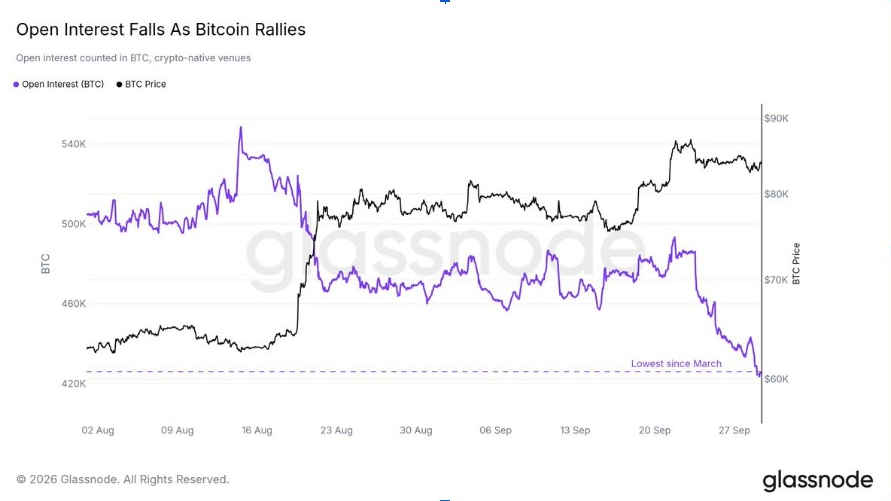
- •Bitcoin-denominated open interest has fallen almost 20% to its lowest level since March, meaning the roughly 35% rebound from the August low occurred without the futures buildup seen in earlier rallies.
- •Polymarket prices a 34% chance that Bitcoin reaches $100,000 by Dec. 31, an outcome that would require an approximately 20% advance from current levels.
- •Crypto companies contributed $206 million to super PACs and hybrid PACs through Q2 of the 2026 election cycle, including $83 million to Fairshake, which committed at least $30 million to oppose Sherrod Brown in Ohio's Senate race after the Senate failed to advance the Clarity Act.
- •Analyst Ali Martinez notes that Bitcoin weakened after the 2010, 2014, 2018, and 2022 midterm elections and identifies the short-term holder cost basis near $73,000, along with Glassnode's $77,000 level, as support zones to watch if a pullback develops.
Bitcoin traded near $83,500 on Sept. 29 after a sharp recovery from its August lows, but the cryptocurrency remains stalled beneath a dense band of long-term-holder supply between $84,000 and $85,000 that on-chain analytics firm Glassnode identifies as the market's resistance. Prediction-market traders still assign only a minority chance of Bitcoin returning to six figures before year-end, while political spending by crypto companies has escalated ahead of the Nov. 3 U.S. midterm elections.
Heavy Supply Caps the Rally Near $85,000
Bitcoin has climbed roughly 35% from its August low, while coin-denominated open interest — a gauge of outstanding futures positions measured in bitcoin rather than dollars — has fallen almost 20% and now sits near its lowest level since March, according to recent market data. The lower leverage means the advance has developed without the futures buildup seen during earlier rallies — a dynamic that may reduce forced liquidations, although it does not remove downside risk.
Glassnode places the largest long-term-holder supply cluster between $84,000 and $85,000, as the firm noted in an analysis on X. A sustained move above that range would clear an important on-chain resistance area. The firm identifies the mean MVRV price — a level based on the ratio between bitcoin's market value and its realized value — near $96,700 as the next major upside level, while its True Market Mean sits around $77,000 and remains an important support zone.
Prediction Markets Keep $100,000 Bitcoin Target in Play
Prediction markets — venues where traders buy and sell positions on real-world outcomes, with prices read as probabilities — continue to assign a minority probability to Bitcoin reclaiming six figures during 2026. Polymarket recently priced a 34% chance that BTC will reach $100,000 by Dec. 31, implying traders currently see roughly a one-in-three likelihood of that outcome. At around $83,500 at press time, however, Bitcoin needs a roughly 20% advance to reach that milestone — meaning Glassnode's $96,700 resistance level would come into play first if the rally extends.
Regulatory developments could also remain part of Bitcoin's market backdrop before the Nov. 3 elections. Crypto companies contributed $206 million to super PACs and hybrid PACs through Q2 of the 2026 election cycle, and advocacy group Public Citizen reported in a study on 2026 midterm corporate spending that $83 million of those corporate contributions went to Fairshake, a crypto-focused super PAC — a type of committee that can accept unlimited contributions from individuals and corporations so long as it spends independently of candidate campaigns. Fairshake and its affiliated groups have directed funds toward congressional races involving candidates from both major parties, and the group recently committed at least $30 million to oppose Sherrod Brown in Ohio's Senate race. That move followed the Senate's failure to advance the Clarity Act, a key digital-asset market structure bill — the kind of legislation that would set rules for how digital-asset trading is regulated — backed by the industry. The November elections will determine control of Congress and could affect the path of future crypto legislation.
Analyst Watches $73,000 After the Midterms
Crypto analyst Ali Martinez has warned that Bitcoin has historically weakened after several past U.S. midterm elections, citing post-election declines that followed the 2010, 2014, 2018, and 2022 votes in an analysis posted on X. He stressed that the historical pattern does not establish that elections caused those declines; rather, his analysis identifies the Nov. 3 vote as a period worth monitoring for volatility.
If another pullback develops, Martinez points to Bitcoin's short-term holder cost basis near $73,000 as a possible support zone — a level to watch, he notes, rather than an assumption the historical pattern will repeat.
Bitcoin's immediate path remains tied to the $84,000 to $85,000 supply area. A break above it would shift attention toward $96,700 and then $100,000, while a failure to hold the recovery would refocus attention on lower support, including Glassnode's $77,000 level and Martinez's $73,000 zone. With the Nov. 3 vote falling just over a month after press time, the calendar brings those technical and political threads into the same window.
This article is for informational purposes only and does not constitute financial, investment, or political advice. Prediction-market odds and technical levels can change rapidly.
This article originally appeared on The Market Periodical.

