Bitcoin Rises for Third Straight Day as Fed, BoJ and Bond Market Risks Mount
Key Takeaways
- •Bitcoin gained about 5.9% on Friday to trade near $77,960, marking its third straight day of increases despite adverse macroeconomic conditions.
- •Major central banks continue tightening, with the Federal Reserve raising rates by 25 basis points to 3.75%-4%, the Bank of Japan lifting rates to a multi-decade high of 1.25%, and the ECB hiking 25 basis points the prior week.
- •Middle East disruptions, including Iran's blockade of the Strait of Hormuz and Saudi Arabia's conflict with the Houthis, have pushed Brent and WTI crude above $100 per barrel and driven U.S. diesel to a record $6.4476 per gallon.
- •Spot Bitcoin ETFs added more than $159 million in assets on Thursday, have drawn over $3.5 billion in net inflows during the past three months, and now hold more than $96.2 billion under management.
- •Bitcoin's daily chart shows a golden cross between the 50-day and 200-day EMAs along with a bullish flag pattern, with bulls targeting key resistance at $82,135.
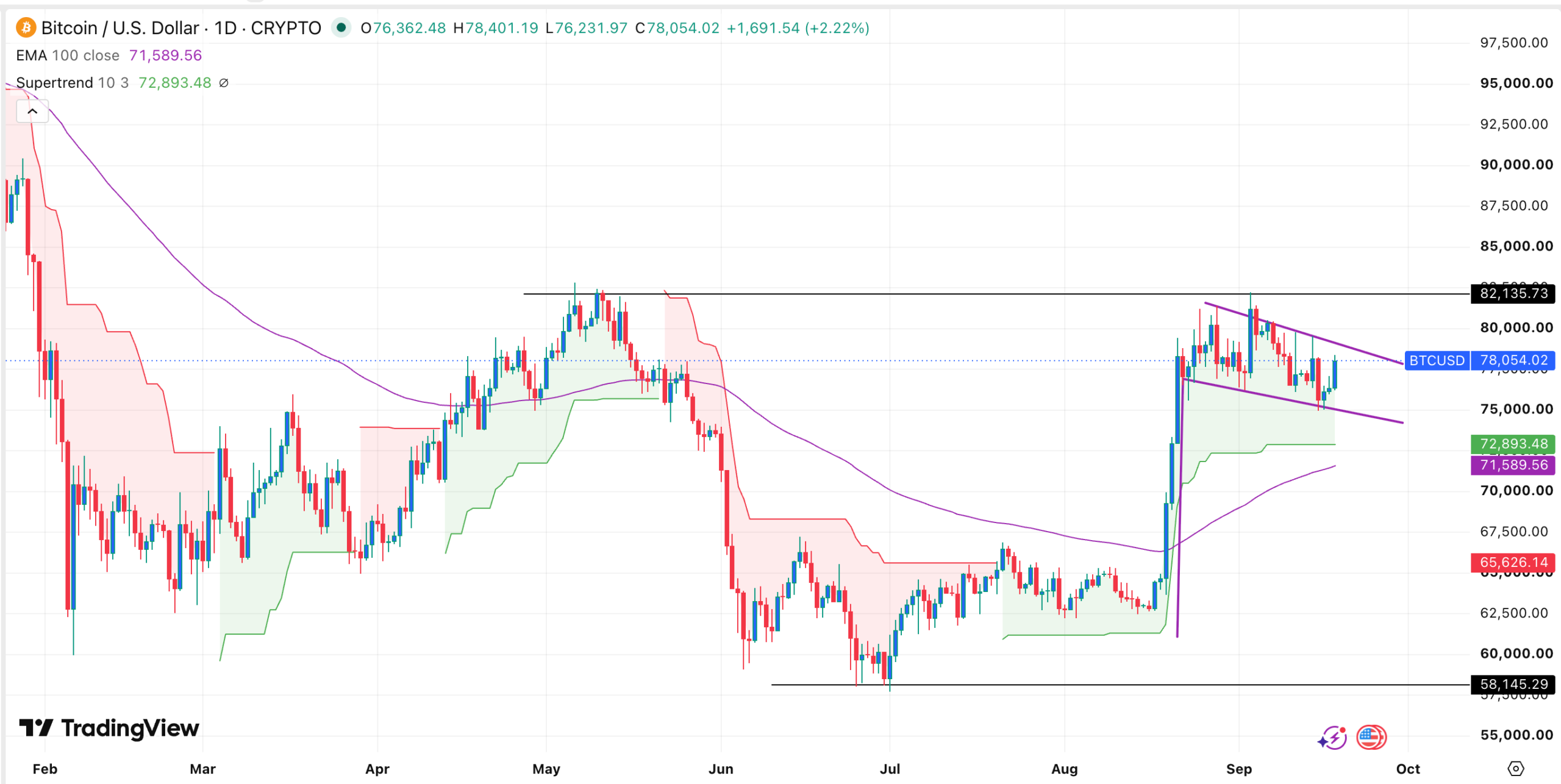
Bitcoin climbed for a third consecutive day on Friday, gaining roughly 5.9% and rebounding sharply from this month's low near $75,000 to trade around $77,960, according to a report by The Market Periodical. The advance stood out because it came despite a cluster of traditional macro risks: a 25 basis-point Federal Reserve rate hike, the Bank of Japan's move to a 31-year rate high, crude oil holding above $100 per barrel, and rising U.S. Treasury yields.
The rally matters because Bitcoin is advancing even as several macro conditions remain unfavorable for risk assets. The 10-year Treasury yield recently crossed 5%, U.S. diesel hit a record $6.4476 per gallon, and major central banks continue to signal tighter policy — yet Bitcoin has absorbed those pressures and moved back toward the $82,000 resistance area.
Interest Rates and Inflation Risks Persist
A central driver of the risk backdrop is the Middle East crisis. Iran continues to block the Strait of Hormuz, and on Friday the Islamic Revolutionary Guard Corps (IRGC) struck a tanker crossing the strait with an unknown projectile. The strait is one of the world's most critical transit routes for global oil shipments, which is why disruptions there feed quickly into energy prices worldwide. At the same time, Saudi Arabia — one of the world's largest oil exporters — continues to battle the Houthis, a conflict that has driven a major retreat in its oil shipments.
Crude prices have remained elevated as a result, with both Brent and West Texas Intermediate (WTI) jumping above $100 per barrel this week. That points to further increases at the pump: the average U.S. gasoline price has climbed to $4.46 per gallon, while diesel has reached $6.4476. These levels indicate inflation will stay above the 2% target for months to come.
The bond market added another layer of pressure as global yields continued rising. The 10-year yield is hovering around 5%, while the 30-year yield stands at 5.30%. The 10-year yield serves as a benchmark for borrowing costs across the economy, so its climb weighs on financing conditions for households and businesses. Elevated yields pose a risk to Bitcoin and other risky assets because they typically draw capital toward the bond market.
Central banks are meanwhile tightening in unison. The European Central Bank (ECB) hiked rates by 25 basis points last week, with officials suggesting more increases are likely this year if inflation remains above the 2% target. The Federal Reserve raised rates by 0.25% to a range of 3.75% to 4%, and Kevin Warsh noted that the bank may decide to hike again. On Friday, the Bank of Japan (BoJ) hiked rates to 1.25%, its highest level in decades.
Adding to the headwinds, the CLARITY Act — a bill aimed at clarifying U.S. digital asset market oversight — failed a crucial vote in the Senate, leading most traders to believe the legislation will not become law this year.
Bitcoin Holding Up Despite the Risks
Bitcoin has nonetheless performed well this week. The report attributed the resilience in part to the asset's gradual evolution into a safe haven: while Bitcoin pays no monthly return, investors increasingly view it as a hedge at a time of rising U.S. public debt, which data show has jumped to more than $40.2 trillion this year.
Institutional demand has also provided support. Spot Bitcoin ETFs, which hold the asset directly and have become a primary channel for institutional allocation, added more than $159 million in assets on Thursday. The funds have recorded net inflows of over $3.5 billion in the past three months and now hold more than $96.2 billion in assets under management, making their daily flow data a widely watched gauge of institutional demand.
Technical Picture
On the daily chart, Bitcoin has soared in recent months, jumping from a low of $57,800 to the current $77,960. The coin has formed a golden cross — a bullish crossover between the 50-day and 200-day exponential moving averages (EMAs) — as well as a bullish pattern, which consists of a vertical line followed by a falling channel. It has also remained above the Supertrend indicator. According to the analysis, these setups suggest the coin will likely continue rising, with bulls targeting the key resistance level of $82,135. Whether Bitcoin can clear that resistance — and how central bank decisions, energy prices, and ETF flows evolve in the sessions ahead — are among the key developments to watch.
This article is based on a report published by The Market Periodical on September 18, 2026.

