Bitcoin's Push Toward $90,000 Stalls as Weekly ETF Inflows Drop 90% — Is $100K Still on the Table This Year?
Key Takeaways
- •Weeklyows into U.S. spot Bitcoin ETFs fell roughly 90%, from $2.39 billion to $241.1 million, which Bitfinex analysts interpret as cooling institutional demand.
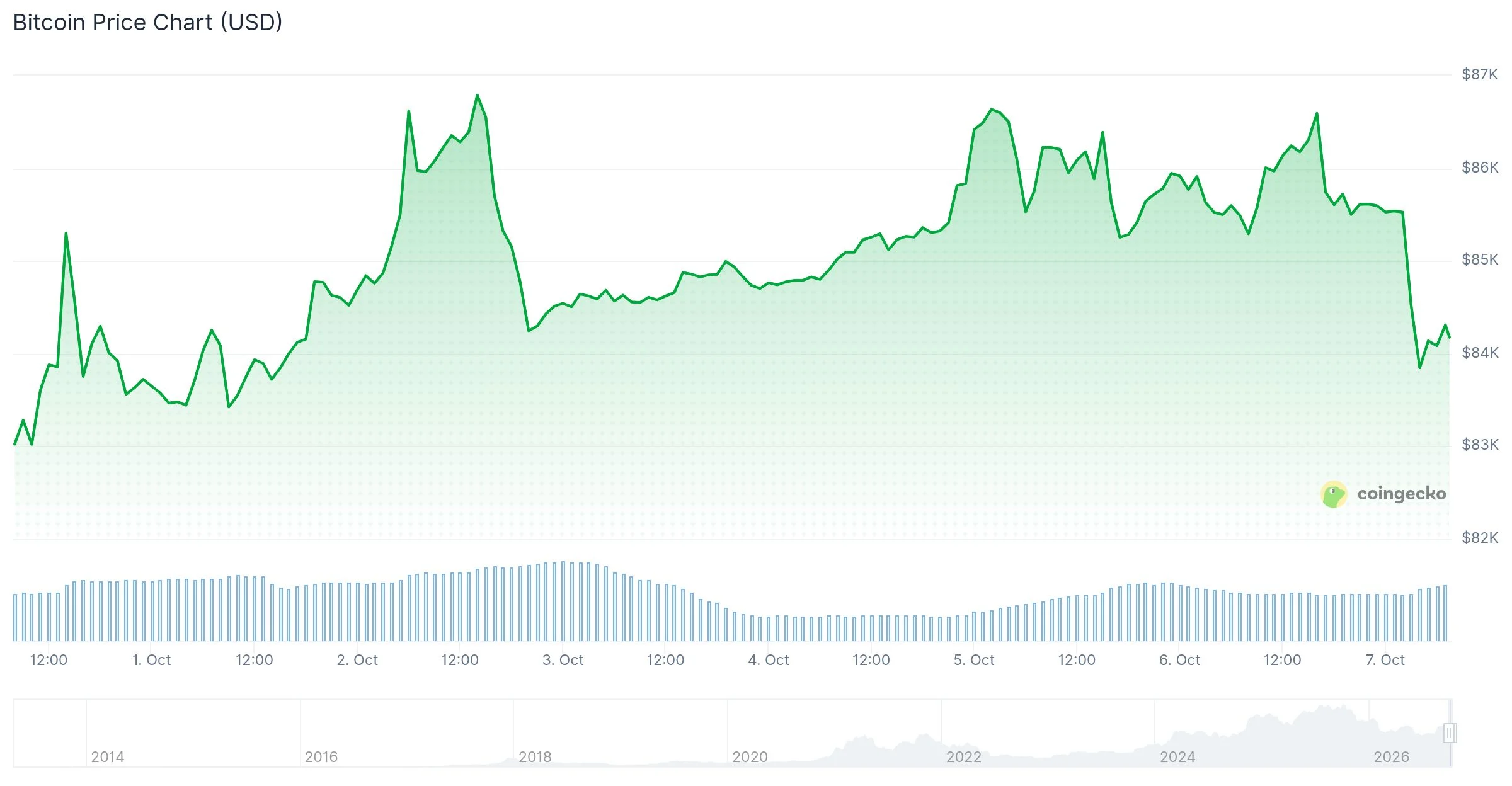
- •Bitcoin settled at $84,071, down 1.7% over 24 hours, after briefly dipping below $84,000 and trading as low as $83,800.
- •Crypto liquidations reached $555.6 million in 24 hours, with long positions accounting for $487.2 million of the total, according to CoinGlass.
- •Trader TedPillows assigned a 40% probability to Bitcoin reaching $100,000 this year but said the actual chances may be lower, with the milestone possibly arriving in early 2027.
- •Analysts identify $82,000-$82,500 and $84,000 as key support zones, and Bitget Wallet's Lacie Zhang warned that losing $82,000-$82,500 could push the price toward $80,000.
Bitcoin's Push Toward $90,000 Stalls
Bitcoin's attempt to regain $90,000 has run out of steam. The asset slipped below $87,722 after touching $87,197 on Oct. 2, then retreated toward $84,000, briefly dipping under that mark late Tuesday before settling at $84,071, down 1.7% over 24 hours.
Analysts at Bitfinex attribute the pullback largely to a sharp cooling in institutional demand: weekly inflows into United States spot Bitcoin exchange-traded funds (ETFs) fell from $2.39 billion to $241.1 million, a decline of roughly 90%. Flow data from these funds, which began trading in the U.S. in January 2024, is widely used as a proxy for institutional participation, so a drop of this size is read as a direct signal of cooling large-buyer demand. The analysts expect Bitcoin to trade between $84,000 and $87,722 this week and say the upside case remains intact, but only if new spot buying returns.
ETF Investors Reach Breakeven
Using Checkonchain, Bitfinex places the average spot ETF investor's purchase price at $84,320. Bitcoin spent 233 days below that level before reclaiming it on Sep. 21.
🚨𝗝𝗨𝗦𝗧 𝗜𝗡:🇺🇸 Bitcoin spot ETFs recorded a net inflow of $118.8M on October 6. BlackRock clients bought $122,000,000 worth of $BTC 🟢 pic.twitter.com/fOQgEdopJQ
— DustyBC Crypto (@DustyBC) October 7, 2026
The timing may help explain the slower pace of buying. Analysts note that ETF purchases often pick up only after holders build a larger profit cushion above their cost basis.
Flows have been uneven in recent sessions. On Sep. 30, a $148.7 million withdrawal ended a nine-day inflow streak worth $3.08 billion. BlackRock's IBIT led the week with $450.2 million, while Fidelity's FBTC lost $168 million.
$100,000 Odds Trimmed
Trader Ted who posts as TedPillows, put the probability of Bitcoin reaching $100,000 this year at 40%. Even though he considers the fourth quarter the most bullish period, he suggested the real odds may be lower, citing weakening spot demand and rising leverage, and said the milestone could instead arrive in early 2027.
40% chance that Bitcoin will cross $100,000 this year. I think the actual chances are lower than this despite Q4 being the most bullish quarter. The reason is weakening spot demand and rising leverage, which often results in correction and then sideways price action. IMO,… pic.twitter.com/TJuUHbFnLX
— Ted (@TedPillows) October 6, 2026
Bitfinex also flagged activity in the futures market: open interest rose $2.1 billion in the day before the September payrolls report, then fell $1.5 billion as prices dropped. Open interest — the total value of outstanding futures contracts — is typically read alongside funding rates, the periodic fees exchanged between long and short traders, to gauge how heavily leveraged the market has become.
Liquidations Hit Hundreds of Millions
The selling accelerated late Tuesday, when Bitcoin briefly fell below $84,000 and traded as low as $83,800. Crypto liquidations reached $555.6 million over 24 hours, according to CoinGlass, with long positions accounting for $487.2 million of the total. Liquidations happen when leveraged positions are forcibly closed because their margin no longer covers losses, and when many trigger at similar prices they can compound the same-direction move.
Dominick John, an analyst at Zeus Research, said the pullback was driven mainly by profit-taking and forced liquidations of long positions tied to a build-up in open interest and funding rates.
Analyst Daan Crypto Trades observed that Bitcoin's bull market support band is starting to move up quickly to follow the recent advance. He noted that Bitcoin typically retests this band at some point in a new bull cycle, though that can come later and at a different price once the band shifts higher.
$BTC 's Bull market support band is starting to move up quickly to follow this recent move. Generally BTC does end up retesting the bull market support band at some point in a new bull cycle. Of course this can be at a later date and different price. After the band itself has… pic.twitter.com/bskDGXG7MM
— Daan Crypto Trades (@DaanCrypto) October 6, 2026
Key Levels and Macro Backdrop
Analysts point to $82,000-$82,500 and $84,000 as the key support zones to watch this week. Sentiment cooled modestly: the Crypto Fear and Greed Index, a daily gauge of market mood compiled from volatility, momentum, and social signals, read 62 on Tuesday, down from 67 the day before, still pointing to greed.
ViaBTC chief analyst Jeff Ko noted that Bitcoin closed the third quarter up about 40%, with $6.5 billion in ETF inflows. He said holding the $82,000 to $83,000 range would keep the pullback looking like a normal pause after September's breakout.
Lacie Zhang, research lead at Bitget Wallet, placed the main downside liquidation zone between $82,000 and $82,500 and warned that losing that area could push the price toward $80,000. Her bullish scenario requires Bitcoin to hold $82,000 and reclaim $87,500 before a move toward $95,000. Bitfinex, for its part, identifies $84,000 as the level where 75% of supply remains in profit.
Macro conditions add further pressure points. Five-year Treasury yields are above 5% and ten-year yields above 5.2%, both at 19-year highs — levels that lift the risk-free return available on government debt and tighten the liquidity backdrop for assets like Bitcoin. September payroll growth came in at 29,000, lowering the odds of an October rate hike, though core inflation of 3% keeps a December move possible. The next major catalyst, the September CPI report, lands Oct. 14, ahead of the Federal Reserve's Oct. 27-28 meeting, giving markets a defined set of dates on which rate expectations could be reset.
Originally published on CoinCentral.

