Is Now a Good Time to Buy Bitcoin? 7 Signals Most Investors Ignore
Key Takeaways
- •Bitcoin has spent much of 2026 under pressure and is down nearly 50% from its October 2025 record near $126,000.
- •Standard Chartered, Bernstein and Fundstrat still have higher Bitcoin targets despite reducing some forecasts.
- •Traders are focused on the $64,000 area, with support around $61,500 and a potential move toward $65,000 to $67,000 if resistance is cleared.
- •Spot Bitcoin ETFs saw record outflows in the first half of 2026, but the article says those flows could reverse if macro conditions improve.
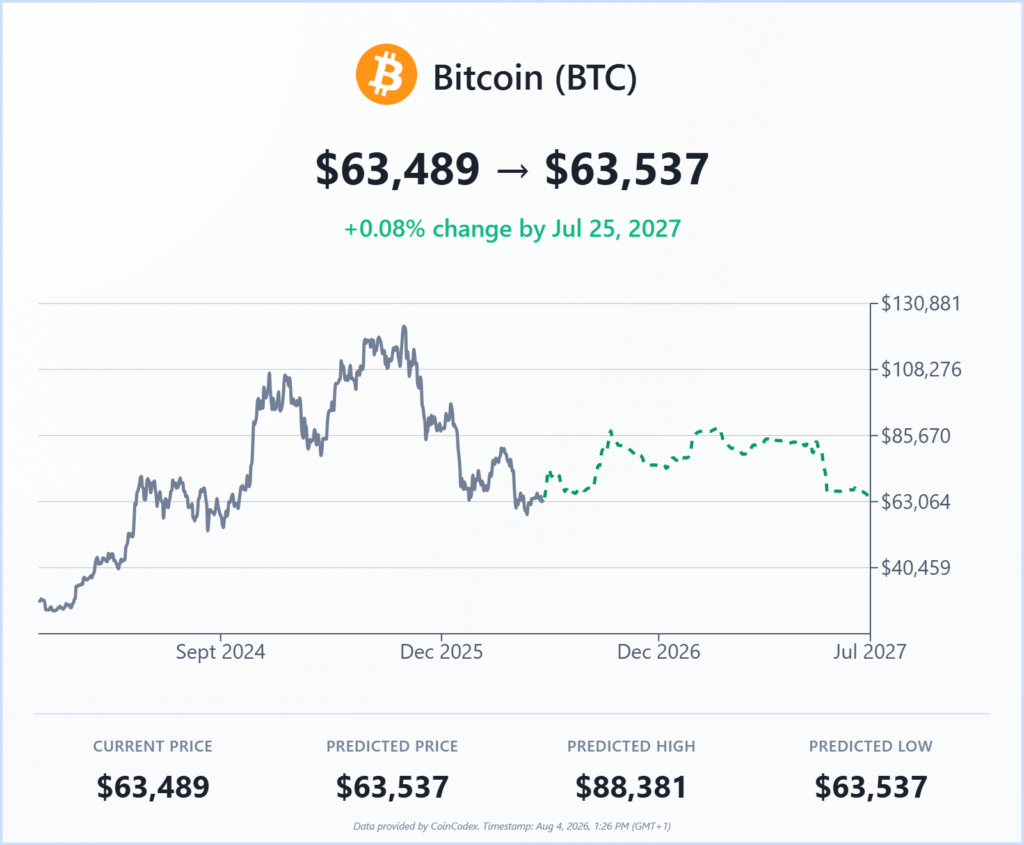
- •CoinCodex projects a gradual recovery through late 2026 and early 2027, with the strongest model month in October 2026.
Bitcoin has spent much of 2026 under pressure. It fell nearly 50% from its October 2025 peak. Persistent ETF outflows and tighter monetary policy have weighed on investor sentiment. Yet while many market participants remain focused on the recent decline, others argue the current correction may be creating one of the most attractive long-term entry points since the previous bear market.
The question is not simply whether Bitcoin can recover. It is whether today’s market conditions resemble the periods that historically preceded the next major rally. Investors looking for a broader Bitcoin price prediction can compare institutional forecasts with quantitative models. Many of them still point to higher prices over the next 12 to 18 months despite the current volatility, which is why the current debate is less about short-term timing and more about whether the market is still in a typical post-peak reset.
1. Bitcoin’s Four-Year Cycle May Be Nearing Another Turning Point
One of the strongest arguments for buying Bitcoin today comes from its historical market cycle. Previous bull markets have generally been followed by a year of deep corrections before the next expansion phase begins.
It has now been roughly ten months since Bitcoin reached its all-time high near $126,000. According to several long-term market observers, including Ark Invest CEO Cathie Wood and Coinbase CEO Brian Armstrong, the current decline may already represent the late stages of the traditional four-year cycle rather than the beginning of a prolonged bear market.
While history never guarantees future performance, Bitcoin has repeatedly recovered from similar drawdowns before reaching new record highs. That makes cyclical weakness a period many long-term investors use to gradually build positions rather than reduce exposure.
2. Institutional Forecasts Still Point Higher
Although several Wall Street firms have reduced their 2026 price targets, few have abandoned the long-term bullish case altogether.
Standard Chartered continues to target $100,000, while Bernstein still expects Bitcoin to recover toward $150,000 despite lowering its previous forecast. Even more optimistic is Fundstrat’s Tom Lee, who continues to maintain a $200,000 to $250,000 target despite this year’s correction. Those projections suggest that many institutional investors view the current weakness as a cyclical setback rather than a structural failure, and that the gap between near-term trading conditions and longer-term outlooks remains wide.
3. Technical Support Is Beginning to Strengthen
Short-term traders continue watching the $64,000 area as one of Bitcoin’s most important resistance levels. A confirmed breakout above this level could open the door toward the $65,000 to $67,000 region. Conversely, another rejection could send BTC back toward support around $61,500.
$BTC Liquidity keeps on stacking on both sides, Sooner or later we are gonna clear both of them out one by one. I expect the downside liquidity to be hunted first then a move towards upside. Just a matter of time. pic.twitter.com/6fOh3Tfy8G — Kaz (@XBTkaz) August 4, 2026
$BTC Liquidity keeps on stacking on both sides, Sooner or later we are gonna clear both of them out one by one. I expect the downside liquidity to be hunted first then a move towards upside. Just a matter of time. pic.twitter.com/6fOh3Tfy8G
Although near-term volatility remains elevated, repeated tests of major support often become important accumulation opportunities for longer-term investors. A successful reclaim of resistance would also improve sentiment after months of sustained selling pressure.
4. Liquidity Is Building on Both Sides of the Market
Current liquidation heatmaps show significant liquidity both above and below Bitcoin’s current trading range. While this setup could produce sharp short-term swings, it also reflects a market preparing for a larger directional move. It is unlikely to remain trapped in a narrow range indefinitely.
Historically, periods of compressed liquidity have often preceded major breakouts once one side of the market is forced to unwind. Therefore, these conditions are worth monitoring even if short-term volatility remains elevated, especially for traders trying to understand where forced moves may develop rather than assuming the current range will hold.
5. ETF Outflows Could Eventually Reverse
Spot Bitcoin ETFs experienced record outflows during the first half of 2026. That became one of the primary reasons institutional forecasts were revised lower.
However, ETF flows are not permanent trends. Previous cycles have shown that investor demand often returns rapidly once macroeconomic conditions stabilize. A shift in Federal Reserve policy or improving risk sentiment could quickly reverse capital flows back into digital assets. That matters because Bitcoin’s recent decline has not been driven by a single isolated factor, but by a broader mix of liquidity conditions and investor positioning that can change as quickly as they deteriorated.
6. Long-Term Adoption Continues Despite Short-Term Weakness
Price has weakened considerably throughout 2026, but the broader adoption story remains largely unchanged. Major institutions continue building Bitcoin products, governments remain engaged in digital asset regulation, and corporate ownership has not disappeared despite the correction.
Long-term investors such as Cathie Wood, Brian Armstrong, and Michael Saylor continue projecting substantially higher Bitcoin prices over the coming decade, reflecting confidence that adoption will continue growing regardless of shorter-term market cycles. For readers weighing whether the current pullback changes Bitcoin’s role in portfolios, the key point is that the asset’s institutional and product infrastructure has continued to develop even as sentiment has cooled.
7. Fear Has Historically Created the Best Buying Opportunities
Bitcoin has rarely looked attractive near market tops. Instead, the strongest long-term returns have historically come during periods when confidence was low, and headlines were overwhelmingly bearish. Today’s market environment shares many of those characteristics, with Bitcoin trading well below its previous high while many investors shift attention toward other sectors such as artificial intelligence.
Although no one can predict the exact bottom, long-term investors have often benefited from gradually accumulating during periods of maximum pessimism rather than chasing momentum after new highs.
CoinCodex Bitcoin Price Prediction
According to the latest CoinCodex Bitcoin price prediction, Bitcoin could gradually recover through late 2026 before extending gains into early 2027.
The forecast suggests modest appreciation during August and September, with average prices remaining around the upper-$60,000 range before momentum strengthens in October. That month represents the strongest period in the current model, with average prices projected near $82,700 and potential highs approaching $87,300, representing gains of roughly 37% from current levels.
The constructive outlook continues into early 2027. CoinCodex projects average prices above $83,900 in January and $85,200 in February, suggesting the recovery could continue into the new year before momentum moderates during the spring. By mid-2027, the model expects another period of consolidation, with prices gradually easing back toward the mid-$60,000 range through the summer. Overall, the forecast points to a cyclical recovery rather than a straight-line rally, with Bitcoin maintaining higher average price levels than those seen during the current correction.
Is Now a Good Time to Buy Bitcoin?
Short-term traders still face considerable uncertainty as Bitcoin navigates important technical resistance and macroeconomic headwinds. Long-term investors, however, may see the current correction as another accumulation opportunity.
Institutional forecasts continue to favor higher prices over the coming years, while historical market cycles suggest that periods of extreme pessimism have often produced attractive long-term entry points.
Keeping track of the latest Bitcoin news can help investors monitor changing macro conditions, ETF flows, and technical developments that could shape Bitcoin’s next major move. While no single indicator guarantees that Bitcoin has reached its final bottom, the combination of improving long-term fundamentals, historical cycle behavior, and constructive price forecasts suggests that patient investors may have more reasons to be optimistic than current market sentiment implies.

