Bitcoin Hovers Near $78,000 as ETF Outflows Mount: Can BTC Recover to $100,000 Before the End of 2026?
Key Takeaways
- •Bitcoin is trading near $77,930 on Nov. 1, roughly 38% below its record above $126,000 from October 2025, after finishing October below $80,000.
- •The Federal Reserve held its benchmark rate at 3.75%-4.00% on Oct. 28, and Dallas Fed President Lorie Logan said at least two more rate increases may be needed, keeping a December hike in play.
- •U.S. spot Bitcoin ETFs recorded $643.2 million in net outflows on Oct. 30, with BlackRock's IBIT losing $233.7 million and Fidelity's FBTC losing $201 million, though cumulative ETF inflows remain near $57 billion.
- •Glassnode data shows each Bitcoin decline since August has produced smaller realized losses, indicating limited panic selling, while a supply overhang from investors who bought above $85,000 could add selling pressure.
- •Standard Chartered still projects Bitcoin at $100,000 by the end of 2026, while Bernstein forecasts roughly $125,000 by year-end and $150,000 around mid-2027, requiring gains of about 28% and 60% from current levels respectively.
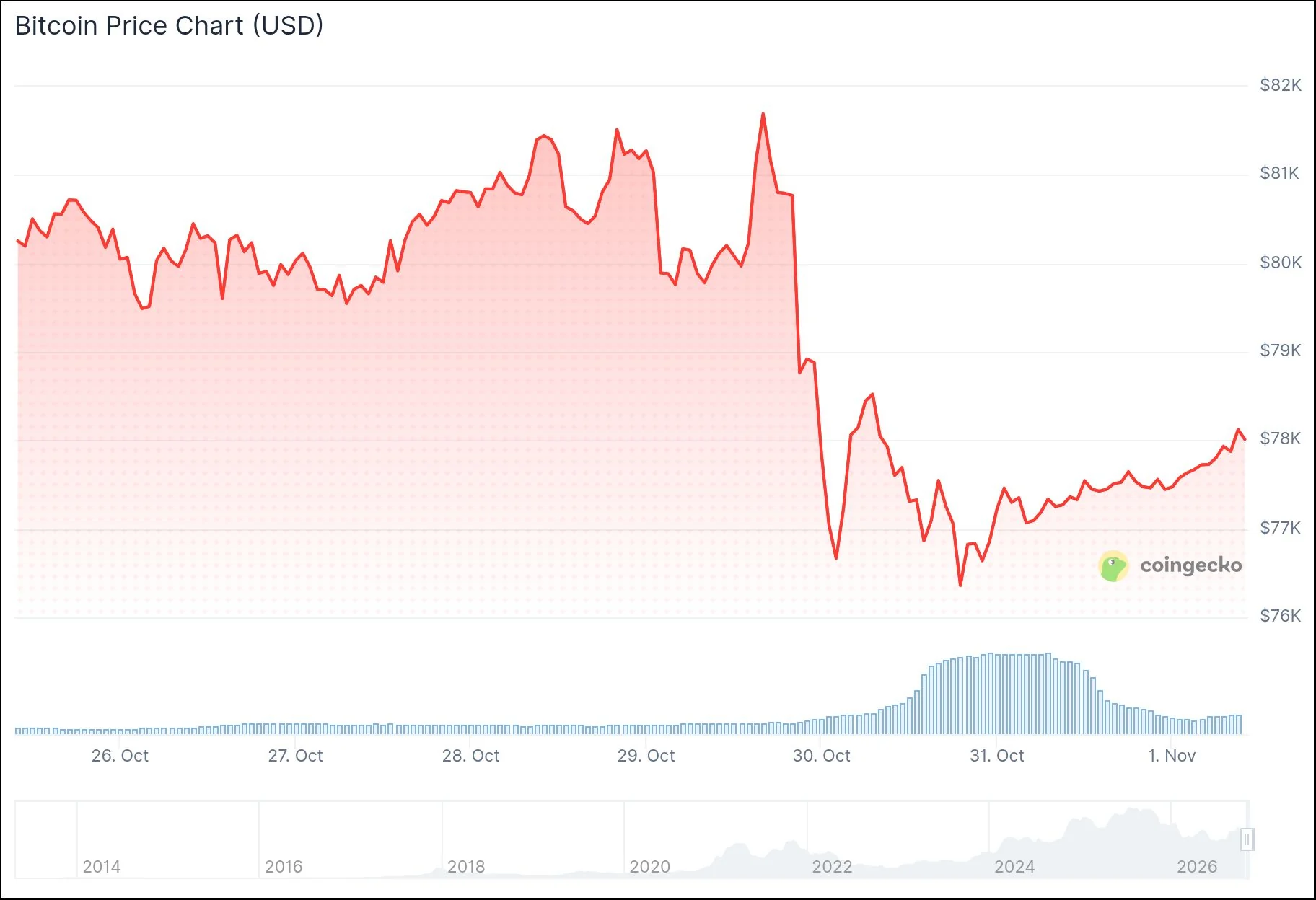
Bitcoin (BTC) is trading near $77,930 on Nov. 1 after a difficult finish to October pushed the price back below $80,000. The largest cryptocurrency now sits roughly 38% below its record above $126,000 from October 2025, leaving market participants to weigh whether a recovery toward $100,000 remains realistic before the end of 2026.
Monetary policy has added to the pressure. The Federal Reserve held its benchmark rate at 3.75%-4.00% on Oct. 28 and kept further tightening on the table as inflation remains above target. Dallas Fed President Lorie Logan said on Oct. 30 that at least two more rate increases may be needed, adding weight to expectations of a possible December hike. That path is relevant beyond banking: rate expectations are a standard input for how investors price risk assets, which makes Fed commentary ahead of the December meeting a near-term catalyst to watch.
ETF Outflows and On-Chain Data Frame the Key Levels
Flows into U.S. spot Bitcoin ETFs turned sharply negative at the end of the month. The funds saw $643.2 million in net outflows on Oct. 30, with BlackRock's IBIT losing $233.7 million and Fidelity's FBTC losing $201 million. That followed modest inflows of $17.2 million on Oct. 29 and $137.3 million on Oct. 28. Even after the latest withdrawals, cumulative ETF inflows remain near $57 billion. The Oct. 30 outflow, while sharp, is a fraction of that cumulative total, and these daily flow prints have become a widely followed barometer of institutional demand for bitcoin.
On-chain metrics point to limited panic selling. According to Glassnode, each Bitcoin decline since August has produced smaller realized losses, suggesting fewer holders are selling in panic as prices fall. Glassnode also identified a large supply overhang held by investors who bought above $85,000 — a cluster of coins sitting below their owners' purchase price that can add selling pressure as the market approaches it — while exchange order-book demand has shifted toward the $78,000-$79,000 range. The $75,000-$78,000 zone is viewed as the key support area, with resistance at $80,000-$85,000.
Analyst Crypto Patel highlighted $74,914 as the key higher-time-frame level to watch. In a post on X on Nov. 1, he argued that a higher-time-frame candle close below that level could send BTC toward $65,500-$62,500, a zone he described as the best area to accumulate for the long term.
$BTC : $74,914 is the key HTF inducement. If we get a HTF candle close below this level, I expect #BTC to move toward $65,500–$62,500. IMO, this could be the best zone to accumulate for the long term, potentially forming a major higher low before the next rally toward a new… pic.twitter.com/nenkHnVYIi
— Crypto Patel (@CryptoPatel) November 1, 2026
Source: Crypto Patel on X
Technical momentum has weakened, with the daily relative strength index (RSI) at 38.14, close to oversold, and the MACD below both its signal line and the zero line. Analyst Ted Pillows noted that BTC tapped its 100-day moving average as the RSI nears oversold levels, writing in an Oct. 31 post on X that the bottom looks close.
$BTC tapped its 100D MA level, while the RSI is approaching oversold territory. Looks like the bottom is close. pic.twitter.com/NSUWkeEjdz
— Ted (@TedPillows) October 31, 2026
Source: Ted Pillows on X
On the downside, first support sits at $75,000-$77,000, followed by a rising trendline in the low $70,000s. If those levels fail, the next demand zone lies at $64,000-$67,000. A daily close below $75,000 would expose the trendline near $72,000 and that broader support region.
On the upside, bulls would first need to reclaim the $80,000-$82,000 range, followed by resistance at $82,000-$83,000. Glassnode has identified heavier resistance at $84,000-$85,000, directly below the above-$85,000 cost-basis cluster — a stacked zone for any recovery to work through.
Year-End Forecasts Still Point Higher
Several institutional forecasts remain above current levels. Standard Chartered still projects Bitcoin at $100,000 by the end of 2026, while Bernstein sees roughly $125,000 by year-end and $150,000 around mid-2027. Measured from $77,930, BTC would need to gain about 28% to reach $100,000 and roughly 60% to reach $125,000. The data points tracked above — daily ETF flows, the $80,000-$85,000 resistance band and the Fed's December decision — are the checkpoints against which progress toward those targets is likely to be measured.
BTC opened Nov. 1 near $77,424, climbed to $78,126 and dipped to $77,370 before recovering. The technical map therefore frames the year-end debate: a sustained move back above $80,000 would reopen the path toward the bank targets cited above, while a break below $75,000 would shift attention to lower support.
This article originally appeared on CoinCentral.

