Bitcoin Tops $81,000 as Peter Brandt Flags Potential Bear Trap
Key Takeaways
- •Peter Brandt said Bitcoin's recent price structure may be forming a bear trap, a false downside break that could serve as a springboard for a powerful upward move.
- •U.S. spot Bitcoin ETFs recorded $433 million in net inflows on Sept. 18, led by Fidelity's FBTC with $310 million and BlackRock's IBIT with $108.40 million.
- •Trader Tardigrade identified a bull flag breakout on Bitcoin's daily chart and set a $104,000 target, which could be reached before October according to the analyst.
- •Raoul Pal, a former Goldman Sachs executive, expects Bitcoin to outperform the Nasdaq 100 in the coming months, citing fiscal dominance, refinancing needs, and rising liquidity demand.
- •Adam Livingston noted that Bitcoin's young-coin share of realized capitalization climbed from a July 29 low of 23.46% to 25.71%, a setup he views as conducive to renewed demand.
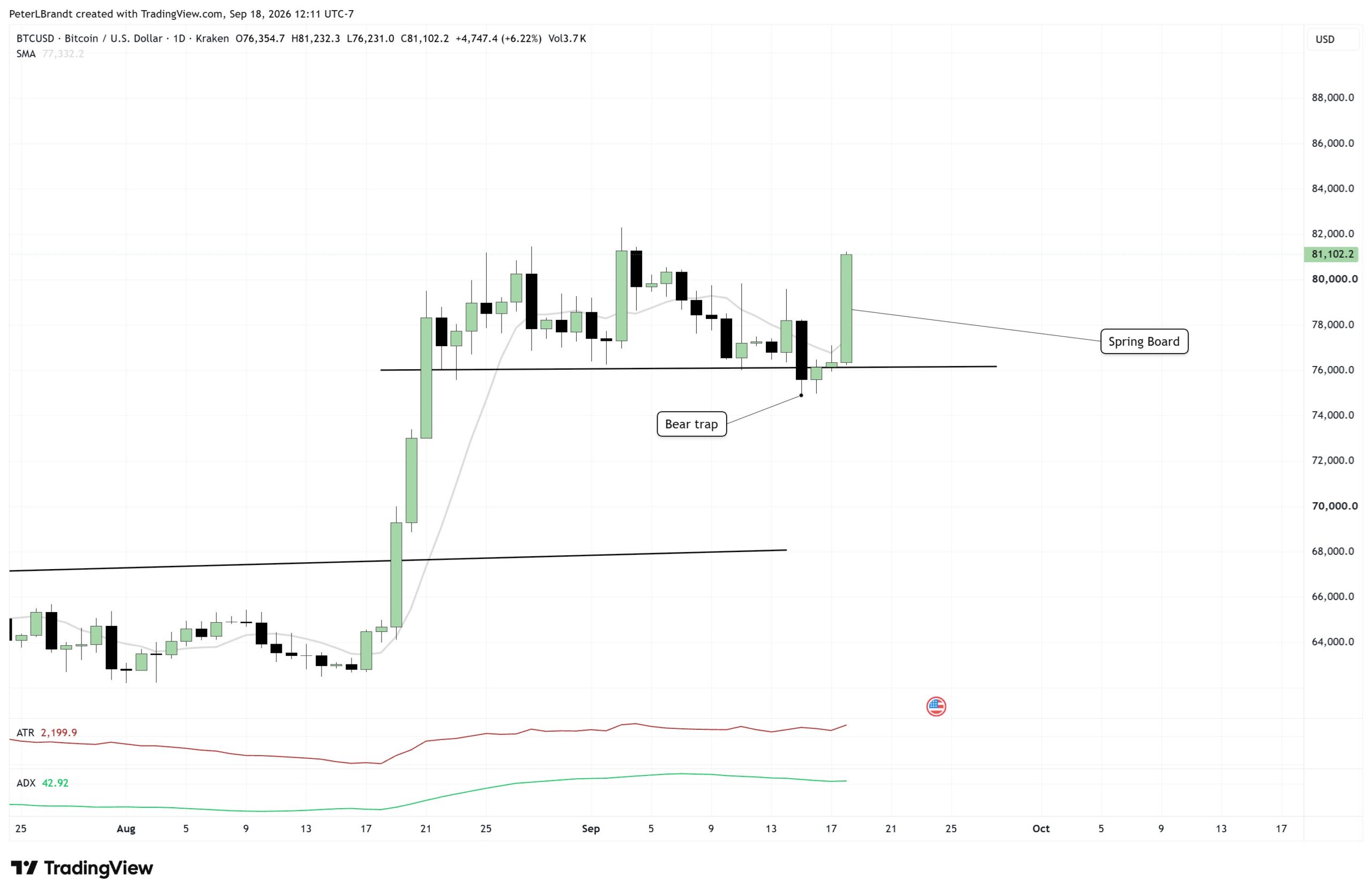
Bitcoin held near $81,000 on Sept. 19 after gaining nearly 6% on Friday, and veteran trader Peter Brandt said the latest price structure may be forming a potential “bear trap” followed by a springboard for a powerful move. The rebound coincided with $433 million in net inflows into U.S. spot Bitcoin exchange-traded funds, while technical analysts now watch the $82,000–$83,000 region as nearby resistance after the asset recovered from below $76,000 earlier in the week.
Brandt Points to a Potential “Bear Trap” Rally
Brandt, whose market calls are widely followed across the industry, said in a post on X that Bitcoin could be setting up for a “bear trap” followed by a “springboard,” with the potential for a powerful move. He advised traders not to dismiss the recent surge as just another bounce. In charting terminology, a bear trap is a false downside signal — a break that looks like the start of a deeper decline but instead reverses higher, wrong-footing traders positioned for losses.
He also pointed to historical seasonality. In previous cycles in which the first two quarters ended in negative territory, Bitcoin went on to rebound in the third quarter. In each of the prior two cycles where both Q1 and Q2 closed in the red, the asset finished Q3 with a gain. Q3 2026 is currently up roughly 30%, with less than two weeks remaining in the quarter. Seasonal comparisons describe what happened in earlier cycles; they record historical tendencies rather than guarantees for the current one.
Another analyst who publishes under the name Trader Tardigrade identified a bull flag breakout on Bitcoin’s daily chart after the price cleared a key resistance level — a pattern that follows a steep advance and typically resolves in the direction of the prior trend. The trader set a $104,000 target and noted that Bitcoin’s relative strength index (RSI), a momentum gauge that scores the pace of recent price changes on a 0-to-100 scale, is also breaking above its descending trendline. According to Trader Tardigrade, the combination of the price breakout and the RSI move confirms strengthening momentum and validates the setup, with BTC potentially reaching $104,000 before October.
Spot Bitcoin ETFs Draw $433 Million in Daily Net Inflows
U.S. spot Bitcoin ETFs recorded $433.00 million in total net inflows on Sept. 18, according to data from Farside Investors, which aggregates daily flow figures reported by the fund issuers. The figure draws attention because spot ETFs hold Bitcoin directly and trade on U.S. exchanges, letting investors gain exposure through ordinary brokerage accounts; net inflows generally reflect newly created fund shares backed by purchased coins, which is why the daily tallies are widely used as a barometer of fresh demand. Fidelity’s FBTC led all funds with $310 million in inflows, while BlackRock’s IBIT followed with $108.40 million. Bitwise’s BITB took in $9.70 million, VanEck’s HODL $2.30 million, and Ark’s ARKB $1.90 million. The remaining ETFs recorded zero inflows for the session, and follow-through in upcoming sessions will show whether the Sept. 18 total was an outlier or the start of a streak.
Pal Expects Bitcoin to Outperform the Nasdaq 100
Raoul Pal, a Wall Street veteran and former Goldman Sachs executive, said in an X post that he expects Bitcoin toperform the Nasdaq 100 (NDX), a benchmark of large-cap technology stocks, in the coming months. Pal cited fiscal dominance, refinancing needs, and increasing demand for liquidity under what he calls “The Everything Code.” Fiscal dominance describes conditions in which elevated public debt leads policymakers to prioritize keeping government borrowing costs manageable.
Pal noted that Bitcoin rose sharply even as interest rates moved higher, arguing that the current price action provides a clear signal. In the shorter term, he said Bitcoin has broken its downtrend against the NDX and formed what he described as “perfect DeMark lows.” He also pointed to DeMark 9–13 indicators on TradingView as a tool he follows; DeMark counts are timing indicators designed to flag potential exhaustion points in an established trend.
Young-Coin Supply Adds a Bullish Data Point
Analyst Adam Livingston highlighted the younger-coin portion of Bitcoin’s realized capitalization as another supportive signal in an X post. Realized capitalization values each coin at the price when it last moved on-chain rather than at the market price, so the share held in recently moved coins offers a window into how much supply has changed hands lately. The share of realized cap held in coins moved within the previous six months bottomed at 23.46% on July 29 and has since climbed to 25.71%.
Livingston noted that 50 days have passed since the indicator reached its low. During the previous cycles in 2015, 2019, and 2022–23, Bitcoin delivered returns of more than 100% over the following year.
He added that Bitcoin’s current young-coin share remains within the lowest 8% of daily readings since 2013, suggesting that a significant portion of the network’s on-chain cost basis has remained inactive long enough to age. In Livingston’s view, the setup is conducive to renewed demand.
This article is for informational purposes only and does not constitute financial or investment advice. Cryptocurrency investments involve risk, and past performance does not guarantee future results. Readers should conduct their own research before making investment decisions.
Based on a report first published by The Market Periodical.

