Bitcoin Begins Week Near $64,800 as Traders Watch $65,000 Resistance and Macro Catalysts
Key Takeaways
- •Bitcoin is trading near $64,800 and remains close to the key $64,800–$65,000 resistance area after a July recovery.
- •A decisive hourly close above $65,000 could open the way to $65,400–$65,600, with $66,000–$66,300 as the next major resistance zone.
- •Support is first seen at $64,400, while a break below $63,666 would weaken the recovery and refocus attention on $63,200–$63,000.
- •U.S. spot Bitcoin ETF flows improved in mid-July, including about $727 million in inflows over five days before a $225.2 million outflow on July 23.
- •This week’s Fed decision, PCE inflation data, consumer reports, geopolitics, and megacap technology earnings are expected to shape short-term risk sentiment.
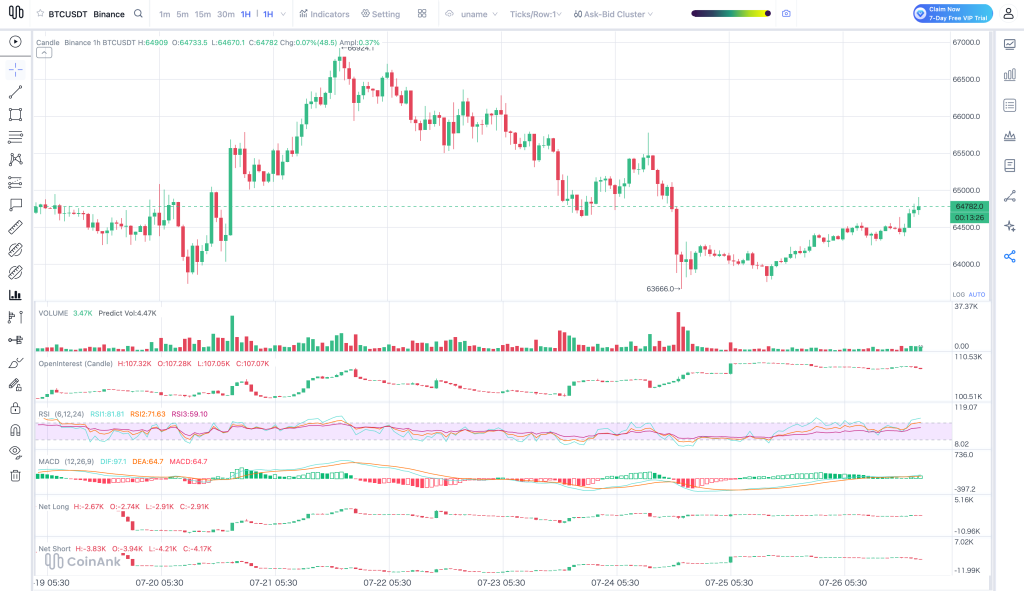
Bitcoin opened the new week trading near $64,800 after a volatile July marked by large selloffs and a subsequent steady recovery. BTC is up roughly 15% from its July low near $56,000, but momentum has moderated as the price approaches an important resistance area. Traders are watching whether the rebound can continue or whether Bitcoin faces another move lower.
The week brings a full macroeconomic and corporate calendar that could affect risk assets. The Federal Reserve’s interest rate decision, July PCE inflation data, and earnings reports from Microsoft, Meta, Apple, and Amazon are all scheduled. For Bitcoin, the near-term technical structure, ETF flow data, and broader liquidity conditions are expected to help set the tone for the next seven days.
Bitcoin Chart Analysis: Recovery Meets Resistance
Bitcoin is trying to recover from a sharp correction that pushed the price down from $66,900 to a swing low of $63,666. On the 1-hour chart, the market has formed a base near $64,000, with higher lows developing over the past 24 hours. The price is now testing the $64,800–$65,000 area, a zone that had acted as support before the breakdown.
A descending trendline drawn across recent lower highs is also being tested. A confirmed hourly close above $65,000 would break that structure and could open a move toward $65,400–$65,600, the next technical hurdle. Beyond that, the $66,000–$66,300 range remains the main resistance area, where several previous highs were formed.
On the downside, $64,400 is the first support level. Losing that area would weaken the recovery and increase the risk of another test of the $63,666 swing low. A break below that recent low would likely resume the broader downtrend toward the $63,200–$63,000 region.
Bitcoin Indicators to Watch
Short-term RSI readings are showing overbought conditions, with RSI(6) at 81.81 and RSI(12) at 71.63. Those readings indicate strong buying pressure during the bounce, but they also suggest that a pause or modest pullback could take place before any further upside. RSI(24) at 59.10 indicates that the broader recovery is not excessively extended.
The MACD histogram has moved from negative territory to nearly flat, while the MACD and signal lines are converging. That indicates bearish momentum has weakened, although stronger confirmation would require a bullish crossover and expanding green histogram bars.
Volume during the recovery has been moderate rather than expanding. That suggests buyers have been in control, but conviction has not been especially strong. Order book data shows bid liquidity building around $64,000–$64,300, while sell-side pressure is concentrated near $65,000–$65,200. A break above that sell wall would likely trigger short liquidations and accelerate upside momentum.
Bitcoin News This Week
U.S. spot Bitcoin ETF flows improved significantly in mid-July after heavy outflows in May and June. A five-day inflow streak brought in about $727 million before a $225.2 million outflow on July 23. By July 19, July net inflows had reached $200.2 million, a clear improvement from previous months. Spot ETF flows are closely watched because they provide a daily read on institutional demand through regulated investment products.
The SEC added crypto rulemaking to its 2026 regulatory agenda, including rules related to token offerings and broker-dealer custody. That indicates U.S. policy is moving toward clearer rules for digital assets. The SEC’s crypto task force remains active, reinforcing that rulemaking continues to be a live priority.
BitMart announced that it would shut down after nine years, a reminder that counterparty risk remains relevant across crypto markets despite the broader constructive tone. Exchange closures and custody issues remain important for traders because market access, liquidity, and asset security can vary widely across platforms.
Macro Events That Could Move Bitcoin
-
Markets react to US/Iran pausing strikes — Today, 6 PM ET. Geopolitical risk remains a wildcard, and any escalation or de-escalation could affect risk assets broadly.
-
July Consumer Confidence — Tuesday. A weaker-than-expected reading could reinforce recession concerns and weigh on risk-on assets.
-
July Fed Interest Rate Decision — Wednesday. Markets expect rates to remain steady. Any dovish tilt or hints about future cuts would support Bitcoin.
-
Microsoft and Meta earnings — Wednesday. Technology-sector performance often correlates with risk appetite, and strong results could lift sentiment.
-
July PCE Inflation Data — Thursday. Core PCE is the Federal Reserve’s preferred inflation gauge. A cooler reading would support expectations for rate cuts.
-
Apple and Amazon earnings — Thursday. These reports are expected to help set the tone for late-week risk appetite and liquidity flows.
-
July Michigan Consumer Sentiment and Inflation Expectations — Friday. Final readings could influence Fed expectations heading into August.
Bitcoin often trades alongside other liquidity-sensitive assets during major macro weeks, especially when investors reassess interest-rate expectations. That makes the combination of the Fed decision, inflation data, and megacap technology earnings particularly relevant for short-term risk appetite.
Key Events This Week: 1. Markets React to US/Iran Pausing Strikes – Today, 6 PM ET 2. July Consumer Confidence data – Tuesday 3. July Fed Interest Rate Decision – Wednesday 4. Microsoft, $MSFT , Meta, $META , Report Earnings – Wednesday 5. July PCE Inflation data – Thursday… — The Kobeissi Letter (@KobeissiLetter) July 26, 2026
https://x.com/KobeissiLetter/status/2081376483705069752?ref_src=twsrc%5Etfw
Key Events This Week: 1. Markets React to US/Iran Pausing Strikes – Today, 6 PM ET 2. July Consumer Confidence data – Tuesday 3. July Fed Interest Rate Decision – Wednesday 4. Microsoft, $MSFT , Meta, $META , Report Earnings – Wednesday 5. July PCE Inflation data – Thursday…
Bitcoin Price Outlook for the Next Seven Days
The short-term direction depends heavily on the $65,000 level. A decisive hourly close above $65,000 with expanding volume would likely trigger a move toward $65,400 and then $66,000–$66,300. Under that scenario, the short-term structure would shift back in favor of bullish momentum.
However, overbought RSI readings and moderate volume suggest that buyers still need confirmation. If Bitcoin fails to break $65,000 and forms a bearish rejection candle, a pullback to $64,400–$64,000 would be the most likely outcome. A break below $63,666 would invalidate the recovery and put the $63,200–$63,000 region back in focus.
The article expects consolidation between $64,000 and $65,000 through Wednesday’s Fed decision, with a breakout likely following the PCE data and technology earnings later in the week. The overall trend remains neutral until Bitcoin either reclaims $66,000 or breaks below $63,666.
Frequently Asked Questions
No one can predict what a $1 Bitcoin investment made today will be worth in 2030. Its future value will depend on Bitcoin’s price, which is influenced by adoption, regulation, institutional demand, and overall market conditions.
Bitcoin may experience periods of decline, as it has throughout its history. Short-term price movements depend on market sentiment, macroeconomic conditions, and investor demand.
A $1,000,000 Bitcoin price is possible, but it would require much wider adoption, sustained institutional demand, and favorable market conditions. There is no guarantee that Bitcoin will reach that level.

