Bitcoin Price Crash Risk Grows as $62,500 Support Comes Under Pressure
Key Takeaways
- •Bitcoin traded in a $62,525 to $63,171 range on Saturday, leaving it near the lower end after failing to hold $64,000.
- •Analysts identified $62,500 as the immediate support level, with a break below it potentially exposing $61,000 and then $60,000.
- •That Martini Guy said Bitcoin lost $64,000 after rejection near $65,000 and that bulls need to reclaim $64,000 to improve short-term momentum.
- •CryptoQuant’s Coinbase Premium Index was around negative 0.1%, suggesting weak U.S. spot demand relative to Binance.
- •KillaXBT placed Bitcoin’s 200-day moving average near $69,500 as the level that would confirm a stronger market structure.
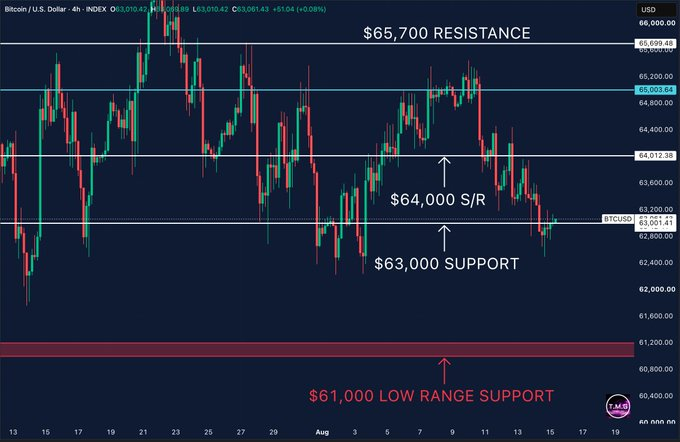
Bitcoin hovered near $63,000 on Aug. 15 after failing to hold $64,000, as traders focused on the risk of a deeper decline if the $62,500 support area gives way. Weak U.S. spot demand and price rejection near $65,000 kept short-term momentum under pressure, while market participants watched for signs that Bitcoin could stabilize above nearby support.
CoinGecko data showed Bitcoin trading in a daily range of $62,525 to $63,171 on Saturday, leaving the price close to the lower end of the range. That made the $62,500 zone the key level for technical traders tracking the possibility of a bitcoin price crash.
Ted Pillows wrote on Saturday that BTC had bounced from the $62,500 area and said a loss of that level could quickly expose $60,000. That made $62,500 the nearest downside trigger in the current setup.
Earlier on Saturday, That Martini Guy outlined a broader technical structure. He said Bitcoin lost $64,000 after rejection near $65,000 and identified $61,000 as the next major support if $63,000 failed. In his view, $64,000 was the first level bulls would need to reclaim to improve short-term momentum. Without that recovery, BTC would remain below resistance and sellers would retain control.
KillaXBT pointed to a higher confirmation level for the broader trend, placing Bitcoin’s 200-day moving average near $69,500. He said reclaiming that level would confirm a stronger market structure. That average sits well above Saturday’s spot price, showing that a short-term rebound would not by itself confirm a wider bullish reversal.
Saturday’s trading also showed how little room remained between spot and first support. CoinGecko recorded a low around $62,525, keeping downside risk active despite the rebound. The 200-day average remains important because it helps define the medium-term trend, and KillaXBT compared the current setup with 2022, when Bitcoin reclaimed that measure before a broader advance. He presented that as historical comparison rather than a guaranteed market signal.
Additional data from CryptoQuant pointed to weak demand from U.S.-based investors. The firm’s Coinbase Premium Index was around negative 0.1%, indicating a Coinbase discount versus Binance. CryptoQuant defines higher readings as stronger Coinbase spot-buying pressure. The gauge is widely followed because Coinbase is the largest U.S.-regulated spot exchange while Binance is the largest global platform, so the price spread between the two venues serves as a proxy for U.S. versus international spot demand. A CryptoQuant Quicktake said the premium had stayed mostly negative since May, suggesting limited U.S. spot demand behind any recovery.
The negative premium, however, does not determine Bitcoin’s direction on its own. Derivatives data showed that traders still held substantial exposure. Open interest measures the number of futures contracts still outstanding rather than the volume traded on a single day, so it reflects positioning that is being held rather than unwound. CME Group reported preliminary open interest of 22,196 standard Bitcoin futures contracts for Aug. 14, while Micro Bitcoin futures open interest stood at 30,420 contracts. CME is a primary regulated venue for institutional Bitcoin exposure in the United States, and its contracts are standardized at 5 BTC for the standard product and 0.1 BTC for Micro futures, which gives those figures concrete scale.
Coinbase Institutional also reported stronger derivatives positioning during July. Its Aug. 3 report said open interest increased across perpetuals, term futures, and options, while spot and perpetual trading volumes declined over the same period. That combination suggested risk was building on derivatives balance sheets even as trading activity weakened, but it did not confirm forced selling or an imminent liquidation event.
For now, the immediate bitcoin price crash trigger remains the $62,500 area highlighted by Ted Pillows. A sustained break below that zone would bring $60,000 back into focus, while Martini Guy’s framework places another support reference near $61,000. On the upside, $64,000 is the first level that bulls must recover, and the broader technical test remains near KillaXBT’s $69,500 200-day average.
CryptoQuant’s Coinbase Premium remains an additional demand check. A move back above zero would suggest stronger Coinbase buying relative to Binance. Without that shift, the BTC rebound would still lack confirmation from the U.S.-focused spot market.

