Bitcoin Holds Above Key Moving Averages Despite CLARITY Act Sell-Off
Key Takeaways
- •Bitcoin lost more than 3% to trade around $75,950 on Wednesday after the CLARITY Act failed to secure sufficient support to advance in the US Senate.
- •Altcoins experienced steeper declines in the sell-off, with Ethereum dropping over 4% and XRP sliding more than 9% over the same period.
- •The CLARITY Act is a market-structure bill intended to establish clear rules for US digital-asset regulation, and its stall leaves the timeline for a comprehensive regulatory framework uncertain.
- •Bitcoin continues to trade above its 50-day, 100-day, and 200-day EMAs, which are clustered between roughly $71,400 and $73,600, preserving its broader bullish structure.
- •Momentum indicators point to cooling conditions, with the RSI near neutral at about 49 and the MACD negative, while the Federal Reserve's rate decision and Chair Kevin Warsh's forward guidance are viewed as the next major catalysts for the market.
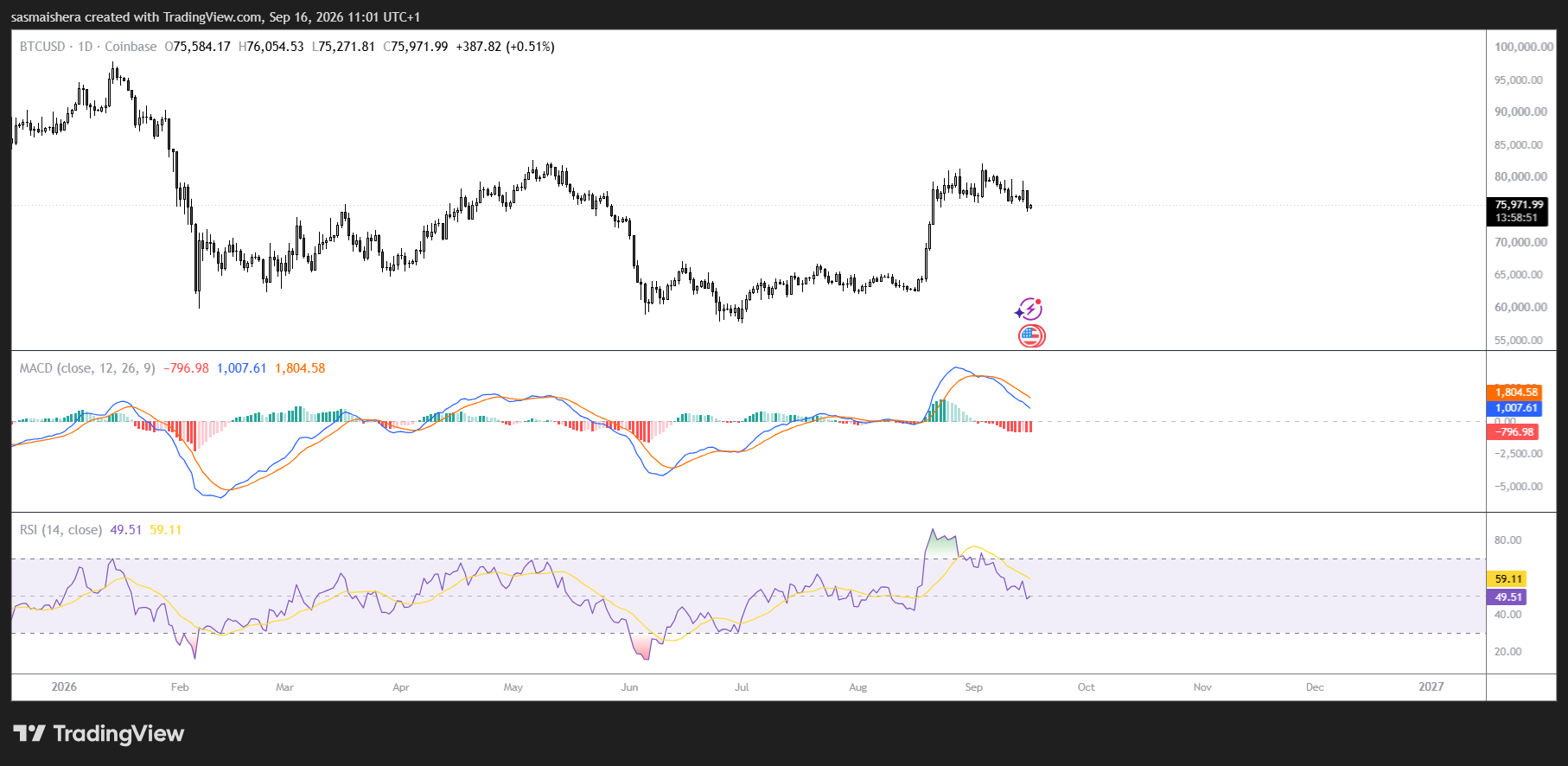
Bitcoin (BTC) traded near $75,950 on Wednesday after losing more than 3% in the previous session, when the CLARITY Act failed to secure enough support to advance in the United States Senate. The sell-off hit altcoins harder, with Ethereum (ETH) dropping more than 4% and XRP sliding more than 9% over the same period.
Despite the market-wide pullback, Bitcoin remains above its major exponential moving averages (EMAs), a position that continues to preserve its broader bullish structure. Attention now turns to the Federal Reserve's interest-rate decision and the forward guidance of Chair Kevin Warsh, which could determine the cryptocurrency market's next major move.
CLARITY Act failure pressures crypto prices
The cryptocurrency market weakened on Tuesday after the CLARITY Act failed to secure sufficient support to advance in the Senate. The setback reduced expectations that Congress would soon establish a comprehensive regulatory framework for the US digital-asset market.
The CLARITY Act is a market-structure bill intended to set clear rules for how digital assets are regulated in the United States, and its progress through Congress has been closely followed by an industry seeking regulatory certainty. With the bill stalled, the timeline for such a framework remains uncertain.
Bitcoin fell more than 3%, while heavier selling pressure across altcoins pushed Ethereum and XRP sharply lower. Prices stabilized on Wednesday, but uncertainty surrounding US monetary policy kept buyers cautious.
The Federal Reserve's rate decision and subsequent guidance could influence liquidity expectations, Treasury yields, and demand for risk assets. A more restrictive outlook could extend the crypto market's correction, while a less hawkish message may support a recovery.
Bitcoin maintains bullish EMA structure
Bitcoin continues to trade above its 50-day, 100-day, and 200-day EMAs, which are clustered between approximately $71,400 and $73,600. The 50-day EMA stands at $73,581, the 200-day EMA sits slightly lower at $73,108, and the 100-day EMA provides additional support at $71,391.
Exponential moving averages weight recent prices more heavily than older data, and long-duration averages such as the 200-day are widely used by traders as reference points for the direction of the prevailing trend.
The configuration remains constructive because BTC is trading above all three averages and the shorter-term 50-day EMA holds above the longer-term indicators. However, Bitcoin must defend this support cluster to prevent the recent pullback from developing into a deeper correction.
Momentum indicators point to cooling conditions. Bitcoin's Relative Strength Index (RSI) has slipped to approximately 49, placing it near neutral territory, which indicates that neither buyers nor sellers have established strong momentum. The decline from higher levels nonetheless shows that bullish demand weakened after Tuesday's sell-off. The Moving Average Convergence Divergence (MACD) indicator remains negative and below the zero line, suggesting that Bitcoin's broader bullish structure is still intact while short-term momentum currently favors consolidation or further downside.
The 50-day EMA at $73,581 represents Bitcoin's first important support level. If sellers push BTC below that level, the 200-day EMA at $73,108 could provide the next line of defense, with the 100-day EMA at $71,391 coming into focus in a deeper correction. Failure to hold the entire moving-average cluster could expose the lower horizontal support levels at $66,500 and $62,300.
On the upside, Bitcoin faces significant resistance near $85,000. According to the report, a sustained recovery above that barrier would signal renewed bullish strength and could restart the broader uptrend.
The full report is available at CoinJournal: Bitcoin holds above key moving averages despite CLARITY Act sell-off

