Bitcoin Price Stalls as Gold Surges: Is a Crypto Catch-Up Rally Coming?
Key Takeaways
- •Gold extended its recovery with a 1.4% gain to $4,123 per ounce, while Bitcoin dropped to $73,700, its weakest level since August.
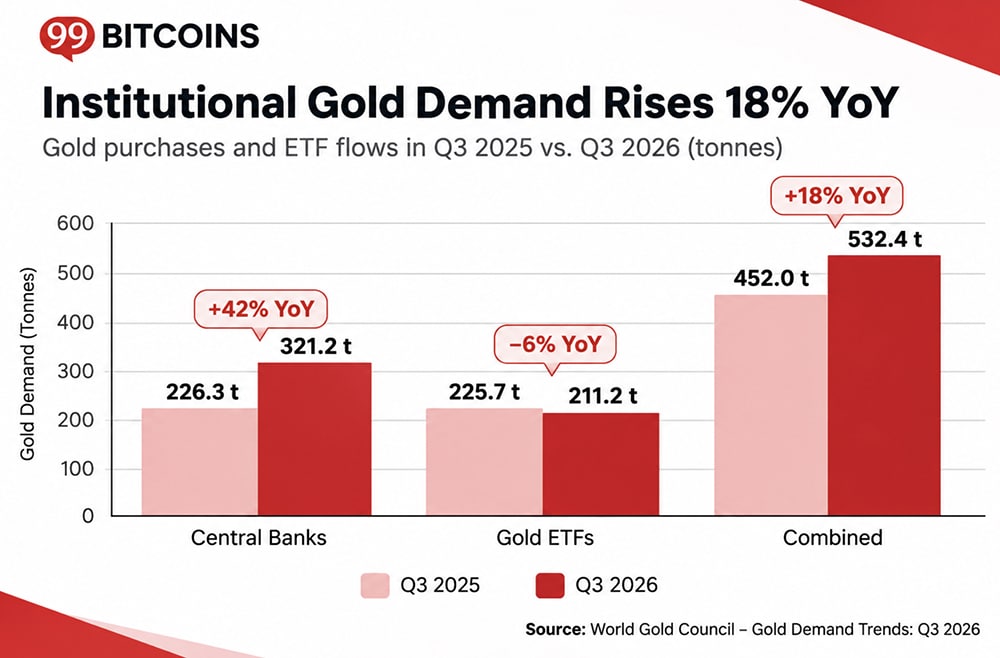
- •Central banks purchased 321 tonnes of gold in the third quarter, a 42% increase from a year earlier, and gold-backed ETFs attracted 211 tonnes over the same period.
- •Bitcoin rose 43% during the third quarter to reach $83,600 by September 30, outperforming gold and several major equity markets.
- •US spot Bitcoin ETFs accumulated 79,800 BTC worth $6.2 billion in the third quarter, exceeding the 41,300 BTC mined during that span.
- •Traders are monitoring the $75,000 region and the $81,319 30-day moving average as key levels for confirming a Bitcoin recovery.
Bitcoin price is struggling to regain momentum as gold extends its recovery above $4,100, but growing demand for scarce assets could eventually put crypto back on the radar.
Gold climbed 1.4% to $4,123 per ounce, extending gains from the previous week. Bitcoin, meanwhile, slipped to $73,700 — its lowest level since August — before attempting to stabilize.
The widening gap creates an interesting setup for crypto investors. Gold is attracting fresh attention from institutions, while Bitcoin works through another period of market consolidation. A future rotation in investment demand could emerge as an important catalyst for BTC.
BREAKING: Over $600 BILLION has been added to gold and silver in just 90 minutes. pic.twitter.com/bGOXGqDAfV
— Bull Theory (@BullTheoryio) November 9, 2026
The post from market commentator Bull Theory highlighted the scale of the move in precious metals.
Gold Rally Reflects Growing Demand for Scarce Assets
Gold's latest recovery reflects renewed interest in traditional stores of value. Investors are monitoring inflation, interest rates, geopolitical developments, and the direction of the US dollar.
Falling oil prices have supported bullion by easing inflation concerns, while a softer dollar has made gold cheaper for international buyers, adding another source of demand.
Institutional demand forms another key part of the story. The World Gold Council reported that central banks purchased 321 tonnes of gold during the third quarter, a 42% increase compared with the same period last year. Gold-backed exchange-traded funds also attracted 211 tonnes over the same quarter.
The figures indicate that institutional investors continue to value scarce assets during periods of economic uncertainty. Bitcoin shares some of those characteristics — a resemblance that has long earned it the "digital gold" label. Its fixed supply of 21 million coins offers investors an alternative to assets tied to traditional monetary systems, meaning gold's strength could reinforce the investment narrative behind Bitcoin rather than weaken it. Both assets provide different ways to gain exposure to scarcity and monetary diversification.
Bitcoin Could Be Next as Investors Reassess Crypto
Bitcoin's recent weakness has not erased its longer-term investment case. Instead, the market is approaching another important test of institutional demand.
The cryptocurrency delivered a strong third quarter, gaining 43% to reach $83,600 by September 30, and outperformed gold and several major equity markets over the same period. That performance matters because Bitcoin has already demonstrated an ability to attract capital during periods of monetary uncertainty, and its appeal extends beyond short-term speculation as institutional investment products make exposure easier.
The latest correction also follows a difficult stretch for risk assets. Technology stocks have faced renewed scrutiny over artificial intelligence spending, while uncertainty surrounding US monetary policy has influenced investor positioning. Those same macro inputs apply to both assets, keeping upcoming inflation readings and interest rate decisions on the watch list for gold and Bitcoin traders alike.
Bitcoin's market structure, however, continues to evolve. Spot ETFs have become a significant source of demand, while corporate treasury strategies have introduced another route for institutional exposure. During the third quarter, US spot Bitcoin ETFs accumulated 79,800 BTC worth $6.2 billion — exceeding the 41,300 BTC mined during the same period, a gap made possible by Bitcoin's fixed issuance schedule, which cuts the rate of new supply roughly in half every four years regardless of demand.
That institutional demand could become particularly important when market sentiment improves. Even relatively modest changes in ETF buying could influence available supply and accelerate price movements.
Bitcoin also benefits from developments across its wider ecosystem. Faster settlement networks, expanding payment infrastructure, and new applications continue creating opportunities beyond simply holding BTC.
Can Bitcoin Close the Gap With Gold?
Bitcoin now needs to establish a stronger recovery after falling below the $75,000 region, a level that remains important for those watching the market's next directional move. A sustained recovery could help restore confidence following the latest volatility.
The $81,000 area is another level worth watching. 99Bitcoins' analyst identified $81,319 as Bitcoin's 30-day moving average, and a move above that region could strengthen the recovery argument.
Gold's performance also deserves attention. Holding above $4,100 would reinforce the current strength in precious metals and keep the scarcity trade firmly in focus.
Bitcoin, however, does not necessarily need gold to weaken before making another move higher. Both assets could benefit from investors seeking alternatives to traditional financial instruments.
A more significant development would be a recovery in the Bitcoin-to-gold ratio. Such a move would indicate that Bitcoin is regaining relative strength against bullion.
Source: 99Bitcoins

