Bitcoin Falls Toward $76,000 After Senate Fails to Advance CLARITY Act
Key Takeaways
- •The Senate's 49-50 cloture vote left the CLARITY Act, legislation to establish broader rules for U.S. digital asset markets, short of the 60 votes needed to proceed.
- •Bitcoin dropped below $76,000 on Sept. 15 after failing to sustain a move above $78,000 earlier in the session.
- •Markets see roughly 90% odds of a 25-basis-point Federal Reserve rate increase at the Sept. 16 decision, creating a potential source of volatility for Bitcoin and other risk assets.
- •Polymarket now assigns the CLARITY Act a 21% probability of being signed into law during 2026.
- •Bitcoin is testing support between $76,200 and $75,780, and it must reclaim $78,000 before challenging the stronger resistance zone at $80,700-$81,300.
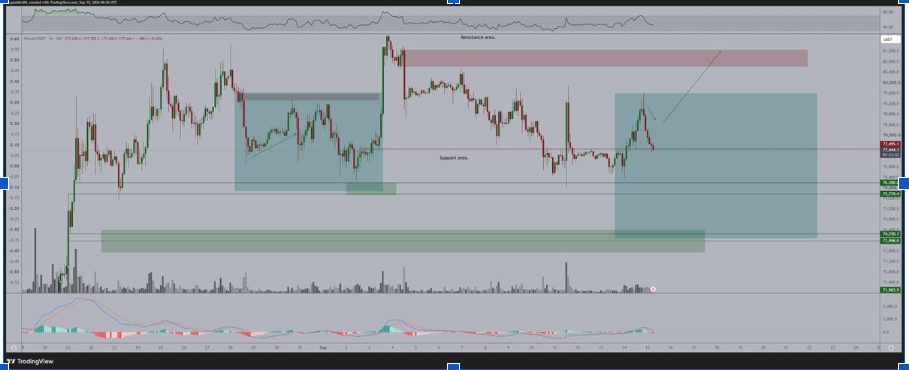
Bitcoin traded near $76,900 after failing to hold $78,000 as the U.S. Senate considered the CLARITY Act. The cryptocurrency fell below $76,000 on Sept. 15 after trading above $78,000 earlier in the session.
The decline followed a 49-50 Senate cloture vote that left the crypto market-structure bill short of the 60 votes required to proceed. Cloture is the procedure the Senate uses to end debate and move legislation toward final passage, and the 60-vote threshold means bills generally need support beyond a simple majority to advance. Market participants are now turning their attention to the Federal Reserve’s Sept. 16 interest-rate decision. Economists and futures markets broadly expect a 25-basis-point increase, creating another potential source of volatility for Bitcoin and other risk assets.
Bitcoin Trades Lower Ahead of Senate Vote
Bitcoin briefly recovered above $78,000 following fresh developments involving the US-Iran conflict, but buyers were unable to sustain the move. price subsequently returned to the $76,000-$77,000 range as traders reduced risk before the Senate vote.
Expectations for a 25-basis-point Federal Reserve rate increase have reportedly risen to around 90% following stronger core inflation data. Higher interest rates can weigh on demand for risk assets by increasing borrowing costs and making cash more attractive. That backdrop has added pressure while Bitcoin remains below short-term resistance.
Crypto analyst Michaël van de Poppe said Bitcoin’s current market structure resembles trading in late August, when the price moved sideways before sweeping lower liquidity. He identified prices below $75,700 as an area to monitor if BTC extends its decline.
Van de Poppe’s X post is available at https://x.com/CryptoMichNL/status/2099761887105659155?s=20.
CLARITY Act Passage Odds Decline
The Senate was expected to hold a cloture vote on the CLARITY Act, legislation intended to establish broader rules for U.S. digital asset markets. Rules of this kind matter to the industry because they would determine how digital assets are classified and which regulators oversee trading and exchanges. Polymarket, a prediction-market platform where users trade on event outcomes, now assigns the bill a 21% probability of becoming law during 2026. The market is available at
The lower passage probability has focused attention on Bitcoin liquidity around the vote. Trader Ted identified short-side liquidity near $79,500 and long-side liquidity around $76,000.
Recent negotiations over the legislation have also involved President Donald Trump. Draft language reportedly reflects changes Trump accepted concerning ethics and enforcement provisions. Under those revisions, state attorneys general could pursue legal action involving the Justice Department and crypto exchanges if restrictions covered by the CLARITY Act are violated. The text also includes changes affecting stablecoin yields and Treasury powers.
A favorable Senate outcome could reduce some regulatory uncertainty, while an unsuccessful vote could extend cautious positioning. Bitcoin remains close to liquidity on both sides of its current trading range.
Bitcoin Support, Resistance and On-Chain Data
Bitcoin is testing support between approximately $76,200 and $75,780. A break below that zone could expose another demand area between $74,230 and $73,800. Further selling could bring $72,000 into view, although BTC has not confirmed such a move.
On the upside, Bitcoin must first reclaim $78,000 before challenging $79,500. The stronger resistance zone is between $80,700 and $81,300, followed by a higher level near $82,842.
On-chain data presents a different signal. Bitcoin’s long-term holder spent output profit ratio has moved above 1, while long-term holder balances remain near record levels. A ratio above 1 means coins spent by long-term holders are, on average, being moved at prices above where they were acquired. The data indicates that a significant amount of BTC remains in the hands of long-term investors.
Before the current consolidation can extend higher, however, Bitcoin must confirm a technical breakout above the $80,700-$81,300 resistance zone.
The original report was published by The Market Periodical at https://themarketperiodical.com/2026/09/16/bitcoin-price-falls-toward-76k-after-clarity-act-senate-defeat/.
This article is for informational purposes only and does not constitute financial or investment advice. Cryptocurrency investments involve risk, and political or monetary-policy developments can cause sharp price volatility. Readers should conduct their own research before making investment decisions.

