Bitcoin Price Falls to $84K as CryptoQuant's Ki Young Ju Sees 3x–5x Cycle
Key Takeaways
- •Bitcoin's decline toward $84,000 on Sept. 24 came after a failed attempt to hold above $87,000, returning focus to the $82,000 support area.
- •CryptoQuant founder Ki Young Ju suggested Bitcoin's current cycle could still produce a 3x–5x advance with less extreme volatility than earlier cycles, though he did not specify a price target.
- •U.S. spot Bitcoin ETFs recorded $714.75 million in net inflows on Sept. 22, their fourth consecutive day of inflows, while spot Ethereum ETFs added $162 million.
- •Short-term holder profits have reached their highest level since the October 2025 top, which analyst Ted says raises the chance of a correction rather than signaling a 50% crash.
- •Polymarket traders currently price a 43% probability of Bitcoin hitting $100,000 by Dec. 31, 2026, rising to 69% by June 30, 2027.
Bitcoin fell toward $84,000 on Sept. 24 after failing to hold its latest move above $87,000, putting the $82,000 support area back in focus. The retreat unwound part of a recovery that had carried BTC back above its former $80,000–$82,000 range ceiling and came just as U.S. spot Bitcoin ETFs extended their inflow streak to four sessions.
The pullback followed comments from Ki Young Ju, founder of on-chain analytics firm CryptoQuant, who said on X that Bitcoin's current market cycle could still deliver a 3x–5x advance rather than another 10x-plus rally, albeit with less extreme volatility than in earlier cycles. He linked that shift to Bitcoin's larger market capitalization and growing institutional ownership.
Ju did not provide an explicit Bitcoin price target or state that the 3x–5x multiplier should be applied to the current spot price.
A Larger, More Institutional Market
Earlier Bitcoin cycles, according to Ju, developed within a smaller market that relied more heavily on retail participation. That structure allowed speculative capital to push prices sharply higher before deep bear markets followed. He now sees a different market because institutions hold more Bitcoin and overall capitalization has expanded. According to Ju, those forces can dampen extreme rallies while also limiting the severity of future drawdowns.
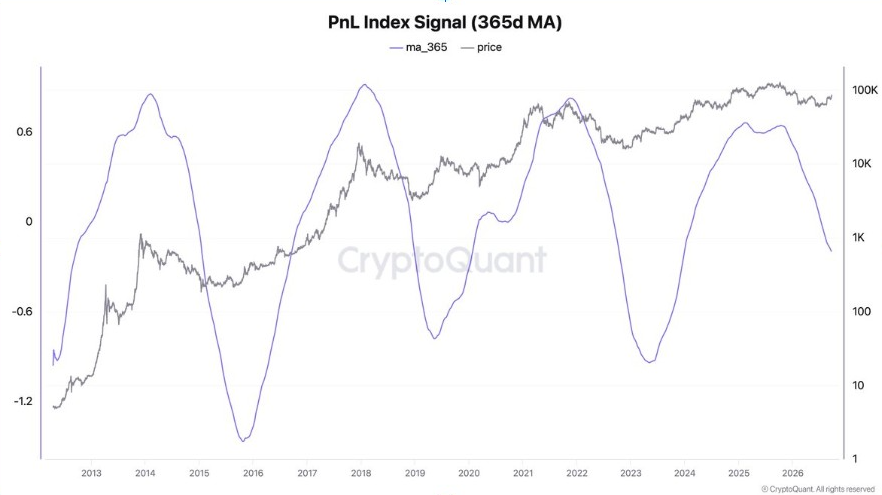
His outlook is based partly on CryptoQuant's Profit and Loss Index and its 365-day moving average. Ju said the longer-term indicator is forming an inflection that has often appeared around major cycle changes.
He also pointed to MVRV, the ratio of Bitcoin's market value to its realized value, which has remained above one throughout this cycle. That means aggregate holders have stayed above their average on-chain cost basis, even during periods of market weakness.
ETF Inflows and On-Chain Data Support Bullish Structure
Fresh capital continues to enter the market through regulated investment products. SoSoValue data showed U.S. spot Bitcoin ETFs recorded $714.75 million in net inflows on Sept. 22, a fourth consecutive day of net inflows, while spot Ethereum ETFs added $162 million. Approved by U.S. regulators in January 2024, the funds hold Bitcoin directly, making their daily flow reports a widely watched gauge of institutional demand. Rising realized capitalization, which values each coin at the price of its most recent on-chain transfer, also indicates that new capital is entering Bitcoin rather than only circulating between existing holders.
Ju said early Bitcoin whales have stopped distributing coins, while futures whales built large long positions near recent lows. He tied those trends to steadier institutional participation and less extreme market cycles.
Not every signal points higher. Short-term holder profits have reached their highest level since the October 2025 top, according to market analyst Ted, who noted on X that the reading does not signal a 50% crash but raises the chance of a correction.
Meanwhile, Polymarket traders — participants on the prediction market where users trade contracts on real-world outcomes — currently price a 43% chance of Bitcoin reaching $100,000 by Dec. 31, 2026. If that fails to happen, the implied probability rises to 59% by March 31, 2027, and 69% by June 30, 2027.
Bitcoin Price Tests $86,700 as Bulls Defend the Breakout
Bitcoin is testing the $86,700 resistance area after recovering sharply from the $60,000–$63,000 support zone. The advance pushed BTC above the former $80,000–$82,000 range ceiling, which had capped several earlier recovery attempts.
Rekt Capital said on X that the current rejection near $86,700 has not yet produced a convincing breakdown. As long as Bitcoin continues to trade above the previous breakout zone the weekly structure remains constructive while $82,000 holds as support.
A pullback toward $82,000 could therefore become the next major test for the Bitcoin price. A successful retest would confirm that former resistance has flipped into support and could prepare BTC for another move toward $86,700. If buyers secure a weekly close above that level, the breakout structure would strengthen further.
The next major resistance on the chart sits near $93,650, placing the $90,000 region within the next upside range.
The downside setup changes if BTC loses $82,000 on a sustained basis. Such a move could expose the $77,500–$80,000 zone and increase the risk of Bitcoin returning to its former trading range.
This article is for informational purposes only and does not constitute financial or investment advice. Analyst forecasts, on-chain indicators, and prediction-market probabilities do not guarantee future Bitcoin performance.
This report was originally published by The Market Periodical.

