Bitcoin Recovery Puts $65,000 in Focus After $6.8 Billion Deribit Options Expiry
Key Takeaways
- •Deribit settled $6.8 billion in Bitcoin options on Friday, representing 25.4% of total open interest, with the $65,000 strike carrying the largest contract concentration and a maximum pain level of $70,000.
- •US spot Bitcoin ETFs recorded $5.39 billion in November net outflows through Wednesday, a record month for withdrawals since the products began trading in January 2024.
- •Bitcoin liquidations totaled $189 million over 24 hours, comprising $115 million in long positions and $74 million in short positions, according to CoinGlass.
- •Stablecoin market capitalization fell approximately 12% over 30 days, and 21Shares documented a $10.7 billion supply decline over 18 days, the largest dollar-denominated contraction since Terra collapsed in 2022.
- •Analysts identified $62,500–$63,000 as immediate resistance with $65,700 beyond it, while $58,000 and $55,500 stand as near-term support levels if the recovery stalls.
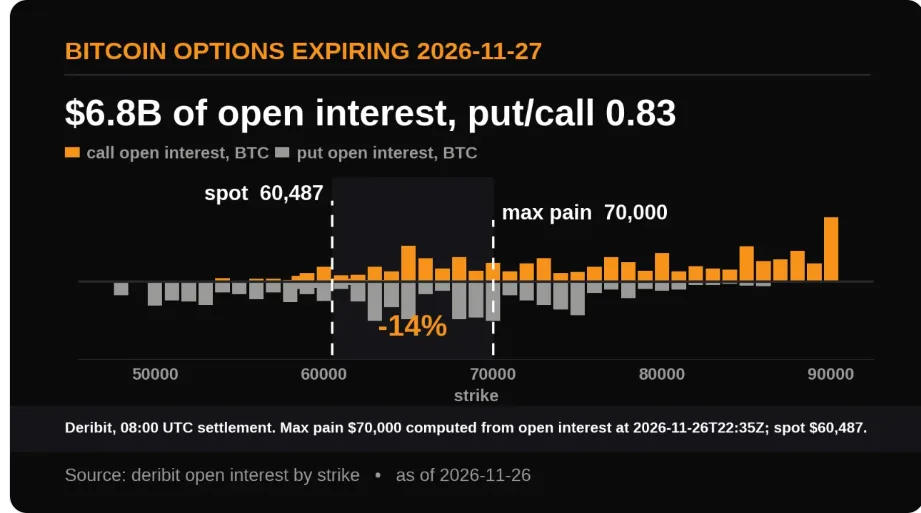
Bitcoin fell below $60,000 on Saturday, Nov. 28, following Friday's $6.8 billion options expiry on derivatives exchange Deribit, before recovering toward the $60,000 line with the $65,000 strike — home to the largest concentration of outstanding contracts — in focus. The decline coincided with rising long liquidations and record monthly withdrawals from US spot Bitcoin exchange-traded funds (ETFs).
Three figures framed the session: the $65,700 resistance level on the four-hour chart, a $6.8 billion options expiry on Deribit centered on the $65,000 strike, and $5.39 billion in November net outflows from US spot Bitcoin ETFs.
CoinGecko data showed Bitcoin (BTC) trading near $59,483 at 09:32 UTC, down 3.4% over 24 hours, after moving between $58,910 and $61,791 during the period. The asset had reached $61,700 early Friday as the broader cryptocurrency market rose 0.85% over the previous 24 hours before easing slightly. Despite the recovery, BTC remained well below its October 2025 record of $126,198 — a drawdown of roughly 53% at the quoted price.
Short Liquidations Mount as Price Recovers
According to CoinGlass, exchanges liquidated approximately $74 million in Bitcoin short positions within 24 hours. Long liquidations totaled $115 million, bringing total Bitcoin liquidations to $189 million.
Short liquidations occur when exchanges close bearish leveraged positions because holders lack sufficient margin. These closures can create buying pressure during a market recovery. Long liquidations work the same way for bullish leveraged positions, and their forced closure can add selling pressure during a pullback.
ETF Outflows Reach $5.39 Billion for November
Meanwhile, US spot Bitcoin exchange-traded funds (ETFs), which began trading in January 2024, continued to record withdrawals, a trend shared on X. SoSoValue data showed November net outflows reached $5.39 billion through Wednesday, marking a record month for withdrawals from the products. The funds posted $453.12 million in net withdrawals on Wednesday, after $231.56 million on Tuesday. Their combined net assets stood at $72.03 billion, while cumulative net inflows since launch totaled $51.59 billion. Daily flow reports will show whether the record pace of withdrawals carries into December.
$6.8 Billion Expiry Puts $65,000 Strike in Focus
CryptoQuant contributor The Daily Digits reported that Deribit, which specializes in cryptocurrency options, had scheduled $6.8 billion in Bitcoin options to expire at 08:00 UTC on Friday. The contracts represented 25.4% of total Bitcoin options open interest.
The analyst identified $65,000 as the strike with the largest concentration of outstanding contracts. Clusters of expiring contracts at a single strike tend to draw attention because options settle against the market price at expiry. Those contracts covered 5,428 BTC, worth approximately $328 million at the time, and put options accounted for most of the positions at that strike.
Put options give holders the right to sell an asset at a predetermined price. Their holders benefit from a lower settlement price, although premiums affect the outcome.
The maximum pain level was placed at $70,000. This measure identifies the settlement price that produces the lowest combined payout to options holders; the calculation does not predict where Bitcoin will settle.
December options data showed continued demand for downside protection. The monthly risk reversal stood at negative 7.22 volatility points, indicating that market participants paid higher premiums for puts than calls. With the November contracts settled, positioning across December expiries will offer the next reading on that demand.
Stablecoin Supply Contracts
CryptoQuant contributor CryptoZeno reported on X that the 30-day change in stablecoin market capitalization had fallen to approximately negative 12%.
The analyst explained that a shrinking stablecoin supply leaves less readily available capital across cryptocurrency exchanges and decentralized applications, where stablecoins serve as settlement assets and provide liquidity.
Separate research from 21Shares documented a $10.7 billion decline in stablecoin supply over 18 days. According to the firm, the contraction marked the largest dollar-denominated reduction over such a period since Terra collapsed in 2022.
Analysts Flag $62,500–$63,000 Resistance
Cryptocurrency analyst That Martini Guy identified the $62,500–$63,000 zone as the immediate resistance area on Bitcoin's four-hour chart. BTC traded near $61,405 after recovering from the $55,500 support area, according to his analysis.
He said a move above the immediate resistance zone would bring $65,700 into focus, with higher resistance levels marked at $72,000 and $76,400 — both of which BTC previously traded above.
The analyst cautioned that the Bitcoin price could form another lower high if the recovery stalls. Bitcoin's four-hour chart has recorded successive lower highs and lows since October. He identified $58,000 as a near-term support level, with a move below that price potentially sending Bitcoin back toward the $55,500 area.
This article provides market analysis for informational purposes and does not constitute financial advice. It was originally published by The Market Periodical.

