Bitcoin Slips Below $69,000 as Whales Sell and Retail Traders Buy the Dip
Key Takeaways
- •CoinGlass recorded $1.40 billion in crypto derivatives liquidations over 24 hours, with longs bearing roughly $1.24 billion of the total, including $738.78 million on Bitcoin contracts.
- •The decline accelerated on November 10 after October inflation data exceeded forecasts, pushing the probability of a December Federal Reserve rate hike to 98.8% on the CME FedWatch tool.
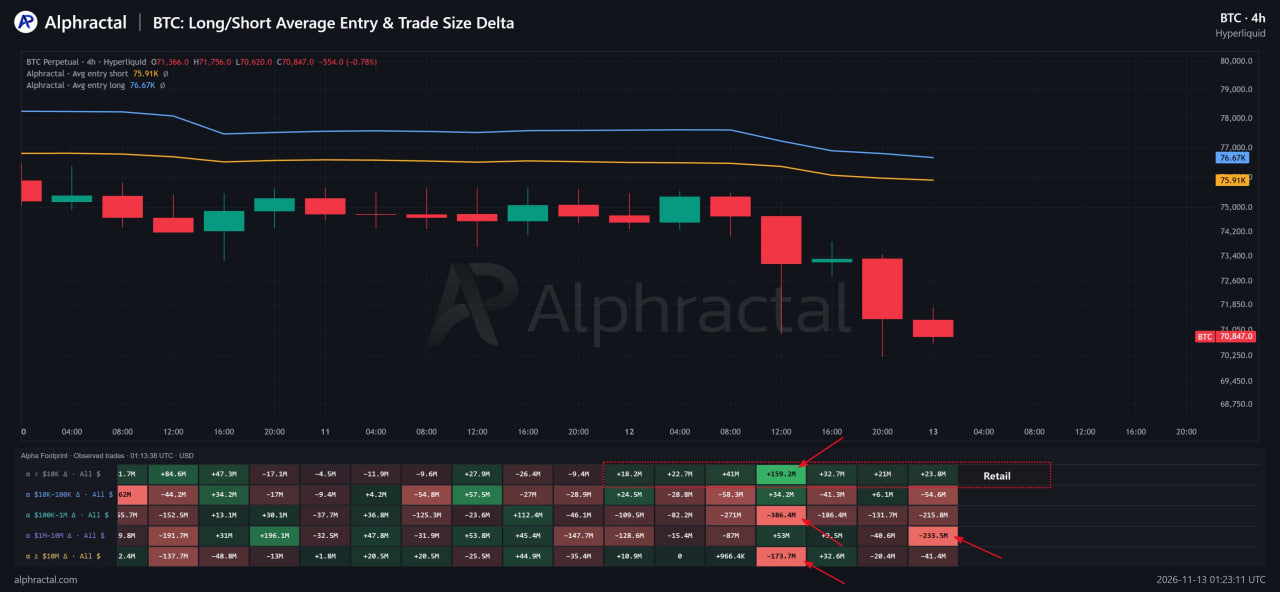
- •Alphractal order-flow data spanning 18 exchanges showed orders under $10,000 leaning long while trades of $1 million or more were mostly short, indicating larger players sold into a decline that smaller traders attempted to buy.
- •Ether fell to $1,926.94, a weekly drop of 13.5% that left it below $2,000, while Solana lost 12.38% to $78.18 and BNB declined 8.59%.
- •Bitcoin is testing the $68,500 floor, with a four-hour close below it opening the $65,550 Fibonacci extension, while the $69,000 zone near the November 2021 all-time high remains a key reference heading into Sunday's weekly close.
Bitcoin dropped below $69,000 late on Thursday and into Friday, November 13, after a fresh wave of futures-market selling drove the asset through multiple support levels within hours. The move pushed the cryptocurrency to a new November low, extended its weekly loss to nearly 9%, and forced out roughly $1.24 billion in leveraged long positions across crypto derivatives markets. Liquidation totals are a standard gauge of how much leverage a selloff strips out of the market, which is why traders track them closely during sharp drawdowns.
At the time of writing, the largest cryptocurrency traded near $68,750, down 6.7% over 24 hours, according to CoinMarketCap. Its market capitalization has shrunk to $1.38 trillion, and the decline dragged the largest altcoins lower alongside it.
The drop is the second leg of a correction that began when Bitcoin stalled near $80,500 on November 5 and accelerated on November 10. That was the day October inflation data came in above forecasts, pushing the odds of a December Federal Reserve rate hike to 98.8% on the CME FedWatch tool. Central-bank expectations are among the most closely watched inputs for leveraged markets, since higher expected policy rates raise the cost of borrowing to trade, and tools like FedWatch give derivatives traders a real-time read on that outlook. In this latest leg, futures markets drove much of the selling, and volume on the breakdown candle rose well above the levels of the preceding sessions.
Longs Took Nearly 90% of the Liquidations
CoinGlass data shows $1.40 billion in positions liquidated over 24 hours. Of that total, $1.24 billion came from traders betting on higher prices, against just $153.54 million from short sellers. Bitcoin contracts alone accounted for $738.78 million in liquidations, with longs making up 96.4% of the figure. Ether followed with $248.19 million, 90.6% of it from longs, and Solana added $52.07 million.
A liquidation occurs when a trader who borrowed to enlarge a position no longer holds enough collateral to cover losses, at which point the exchange closes the position automatically. For a long position, that means a market sell order executed at whatever price is available. When thousands of these orders trigger in the same price range, each wave of forced selling pushes Bitcoin into the next cluster of stop levels. That cascade is how the four-hour candle that broke $71,450 ran all the way down to $68,500 before buyers stepped in.
The CoinGlass heatmap also recorded liquidations on perpetual contracts tied to Nvidia shares and gold, which several crypto derivatives venues now list. Perpetuals are derivative contracts without an expiry date and account for the bulk of trading volume on crypto exchanges, so their extension to traditional assets has blurred the line between crypto venues and conventional markets. Nvidia contracts alone lost $14.33 million, suggesting the deleveraging also reached traders using crypto platforms to bet on traditional assets.
Small Wallets Bought While Large Accounts Sold
Order-flow data published by Joao Wedson, founder and CEO of analytics firm Alphractal, shows who was on the other side of those liquidated longs. Wedson broke down trades by size across 18 exchanges: orders under $10,000 leaned toward longs, while trades in the $1 million to $10 million range and above $10 million were mostly short.
In practice, larger players sold or shorted into the decline while smaller traders tried to catch the bottom, often with borrowed money. Those late longs are the positions behind the liquidation totals above. The data does not show where the low will form. It does show that the buying so far has come from the accounts least able to absorb further losses.
Ethereum and Solana Fell Harder Than Bitcoin
Altcoins followed the slump, and over seven days the two largest smart-contract platforms fell well behind Bitcoin. Ether dropped to $1,926.94, down 6.05% on the day and 13.5% on the week, leaving it below the round $2,000 mark. Solana fell to $78.18 after a 12.38% weekly decline. BNB stayed closer to Bitcoin's pace, down 8.59% over the same period.
Source: CoinMarketCap, November 13, 2026.
Altcoins usually fall further in a deleveraging because fewer buy orders sit near the current price, so the same amount of forced selling pushes their prices down further.
Bitcoin Tests the $68,500 Floor
On the four-hour chart, Bitcoin has made lower highs and lower lows since the $80,500 peak. Traders map pullbacks with Fibonacci retracement levels, measured here from that high to the most recent low. Within two days, the price broke through $73,275 and then $71,450, and both levels now sit overhead as resistance.
Bitcoin also trades well below its 50-period exponential moving average at $74,431 and its 200-period average at $78,093, and both lines point lower. The 200-period line tracks the average price over roughly the past month. The gap between it and the current price is close to $9,000, or about 13%, underscoring how fast the selloff has moved.
The Relative Strength Index (RSI) has dropped to 22.86. A reading under 30 means sellers have controlled the last 14 four-hour candles — about two and a half days of trading — to an unusually one-sided degree. Bounces often start from such conditions, but in strong downtrends the reading can stay low for days. The latest candle opened at $68,639 and has moved up to around $69,105. That small green bar sits next to a much larger red one, meaning buyers have defended $68,500 for now without turning the trend.
Whale Shorts Could Fuel a Squeeze Above $70,000
A four-hour close below $68,500 would bring the next Fibonacci extension at $65,550 into view, about 4% below that floor. On the upside, the first obstacle sits at $69,975, followed by $71,450, which held as support until Thursday. Above that, Bitcoin would need to win back $73,275 and the zone between $74,400 and $74,750 — where the 50-period average meets the 0.5 retracement — before the four-hour structure stops pointing lower.
The liquidation flush has wiped out much of the leveraged long exposure built up in the first half of November. If prices keep falling, there is now less forced selling left to accelerate the decline. The Alphractal data points the other way: if the price recovers, large accounts holding short positions may rush to close them, and that buying could add pressure to any move back above $70,000. For Ether, a return above $2,000 is the first level traders will watch to judge whether the altcoin market is stabilizing.
The $69,000 area matters beyond the four-hour chart. Bitcoin set its November 2021 all-time high near that price, and the level has been a reference point in several drawdowns since — one reason buy orders tend to gather around it. Sunday's weekly close will show whether Bitcoin can end the week above its previous cycle peak or settles below it.
Primary source: Crypto News Flash

