Bitcoin (BTC) Snaps Back 9% After $1.8 Billion Liquidation Flush
Key Takeaways
- •Friday's selloff pushed Bitcoin to $55,130, its lowest level since September 2024, before the price rebounded more than 9% to trade near $59,023 on Sunday.
- •Roughly $1.8 billion in leveraged positions were liquidated, including about $1.3 billion in long bets, fully clearing the dense $59,000-$62,000 long-liquidation cluster that Glassnode had tracked for months.
- •Bitcoin holders realized more than $11.3 billion in losses over seven days, roughly eight times the gains booked in the same period, according to CryptoQuant analyst Darkfost.
- •U.S. spot Bitcoin ETFs recorded about $1.1 billion in net withdrawals over the past week, and the Nasdaq's more than 4% Friday drop left the index near bear-market territory.
- •Mining profitability is under pressure as Hashprice fell to $26.16 per petahash per second per day with difficulty set to rise nearly 9% around November 27, while Strategy's 850,849 Bitcoin, bought at an average $75,452, sit below cost basis and its stock fell 9.67% on Friday.
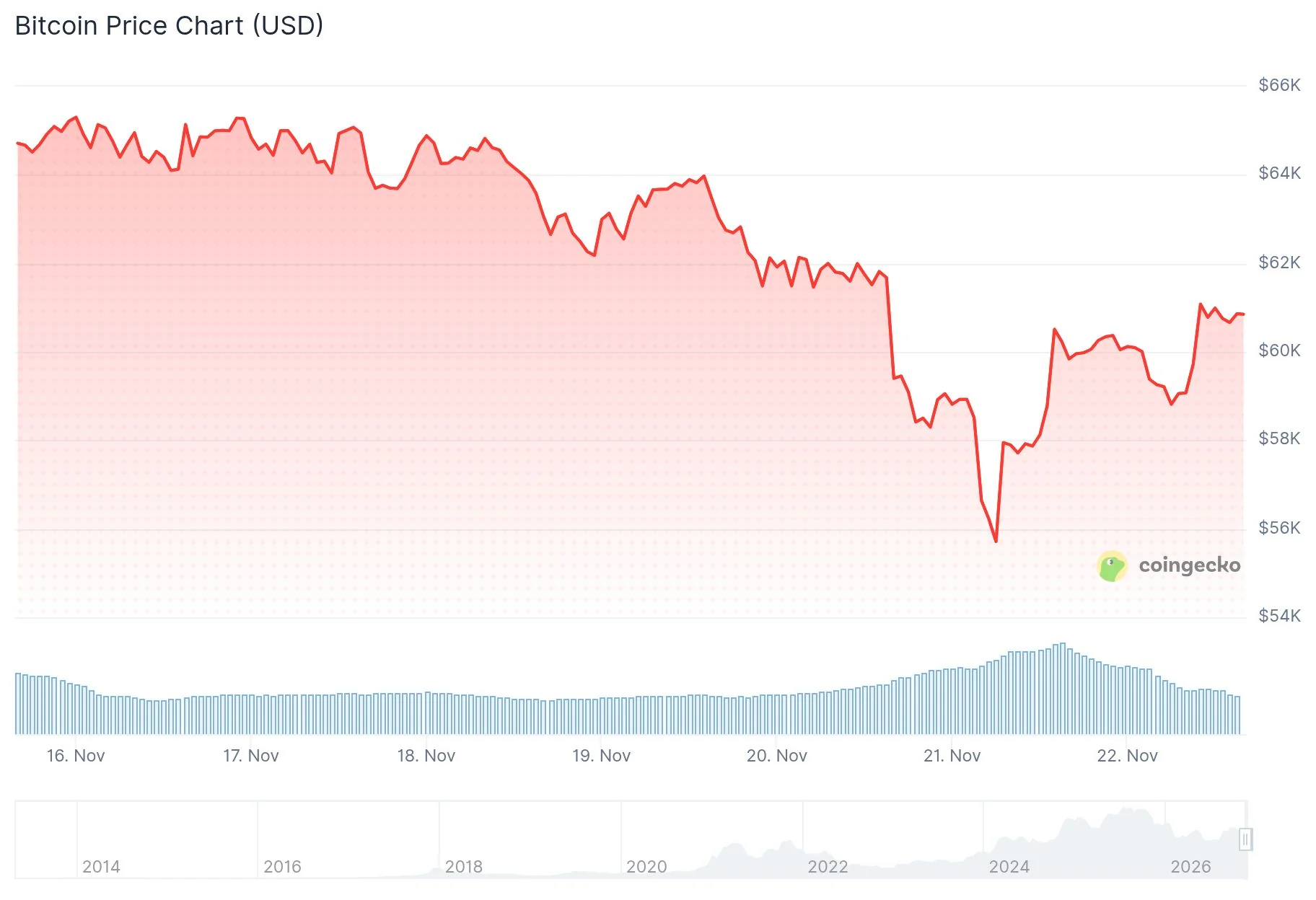
Bitcoin (BTC) traded near $59,023 on Sunday, up 1.8% on the day, after slipping back under the $60,000 level. The price touched $60,292 on Saturday but could not hold that level, and the pullback followed a sharp selloff on Friday that drove Bitcoin down to $55,130 — its lowest level since September 2024. From that low, the price bounced more than 9% before stalling. Over the past month, Bitcoin has lost more than a quarter of its value.
Ether (ETH) traded near $1,680, up about 3%, while Solana (SOL) rose 2.3% to around $71.
The Friday drop wiped out roughly $1.8 billion in leveraged positions, according to CoinGlass data, which tracks forced closures across crypto exchanges. About $1.3 billion of that total came from traders betting on higher prices. Liquidations occur when exchanges automatically close leveraged trades as losses approach a trader's posted collateral, and long-side closures matter for the broader market because each one feeds a forced sell order into a falling market.
Liquidations Clear a Key Cluster
Glassnode had tracked a dense cluster of leveraged long positions between $59,000 and $62,000 for months. Friday's move closed out that cluster, which the on-chain analytics firm said removes a large source of forced selling below the market. Bitcoin's bounce has since carried the price back to the lower edge of that cleared band.
"The largest bitcoin:native liquidation cluster has been cleared. We have been tracking a dense cluster of long liquidations between $59K and $62K for months. Yesterday, they were fully cleared out, removing a large source of forced selling under price." — glassnode (@glassnode), November 21, 2026
CryptoQuant analyst Darkfost described the move as extreme capitulation, noting that holders realized more than $11.3 billion in losses over seven days — about eight times the gains booked over the same period. Realized losses are recorded when coins move on-chain at prices below their prior cost basis, making the figure a direct measure of selling at a loss.
Analyst Lao-Qi (@laoqi_hl) said on X that he was among the first to warn followers to sell Bitcoin near $120,000, and argued the market has not found a bottom at $55,000. He expects a real low in the $50,000 to $40,000 range.
"I was one of the first to warn you to sell all your $BTC around the $120K zone. Now people think we've found a bottom for $BTC at $55K. Sorry to be the bearer of bad news, but I believe we're still heading lower. I don't think we'll find a real bottom until we reach the…" — Lao-Qi 劳奇 🈲 (@laoqi_hl), November 21, 2026
He added that he plans to buy Bitcoin and several altcoins at those levels, and said the Federal Reserve could raise interest rates again — a move he argued would give the market more reasons to fall than rise.
Traditional markets added to the pressure. The Nasdaq fell more than 4% on Friday, putting the index close to bear-market territory — conventionally defined as a decline of 20% or more from recent highs — and U.S. markets reopen on Monday.
U.S. spot Bitcoin ETFs, which began trading in January 2024, recorded about $1.1 billion in net withdrawals over the past week — meaning outflows exceeded inflows across the funds — according to Farside Investors data. Updated Friday figures for BlackRock's IBIT, the largest fund by net assets, are still pending.
QCP Capital, a Singapore-based trading firm, said the next real recovery will likely require steadier technology stocks, calmer rate volatility and signs that institutional flows are returning. Until then, the firm said, short-covering rallies may struggle to turn into lasting gains. Those conditions give market watchers concrete markers to track: Monday's U.S. equity open, the pending IBIT figure, and the direction of ETF flows in coming sessions.
Miners and Strategy Feel the Pressure
Mining revenue has dropped even as computing power recovers. Hashprice — a benchmark measuring daily mining revenue per unit of computing power — fell to $26.16 per petahash per second per day on Saturday. Transaction fees made up just 0.64% of block rewards over the prior 24 hours, leaving miners heavily dependent on Bitcoin's price, since fee income sits on top of the fixed block subsidy. The network hashrate rebounded above one zettahash per second after falling to about 912 exahashes on November 14, meaning more computing power is competing for thinner rewards.
Mining difficulty is projected to rise nearly 9% around November 27. Difficulty recalibrates roughly every two weeks to keep block production steady, so when total hashrate grows, each miner's share of rewards shrinks — a change that could add further pressure on operators already facing weak profitability.
Strategy, the largest corporate holder of Bitcoin, holds 850,849 Bitcoin purchased at an average price of $75,452 — well above current market prices, leaving the treasury below its cost basis at current levels. Its stock closed down 9.67% at $77.80 on Friday, and Executive Chairman Michael Saylor urged investors to keep their conviction.
Separately, Bitcoin Core disclosed a medium-severity vulnerability on Friday that could briefly stall network nodes. The flaw was identified through AI-assisted research, has been fixed in updated releases, and could not be used to steal Bitcoin. Because the flaw was patched and posed no theft risk, the disclosure reflects ongoing security work on the network's open-source software rather than a loss of user funds.
In another development, former U.S. Space Force technology official Jason Lowery proposed using proof-of-work — the computational mechanism Bitcoin uses to secure its ledger — to defend digital infrastructure against AI attacks. The idea remains conceptual, with no implementation announced.
Source: CoinCentral

