Bitcoin Falls to August Lows Near $68,700 as Inflation Data Lifts December Hike Odds
Key Takeaways
- •Bitcoin slid about 4% to near $68,700 on Saturday after briefly hitting a roughly 12-week low around $67,500, leaving it down 11.2% in November and 17.7% for the fourth quarter.
- •October's Producer Price Index rose 6.5% year over year, the largest annual gain since November 2022, lifting CME FedWatch odds of a 25-basis-point December rate hike to 89.7%.
- •Economist Robin Brooks described a quarter-point hike as all but inevitable, arguing a larger move would not resolve the oil-price spike tied to the US-Iran war and the Strait of Hormuz.
- •Analyst Rekt Capital warned that a weekly close below $73,000 on Sunday would be Bitcoin's third break of that level in 2026, with each prior breakdown followed by a decline to roughly $60,000.
- •US equities opened lower alongside crypto, with the S&P 500 down 1.2% and the Nasdaq Composite down 1.5%, as traders also absorbed news of Nvidia CEO Jensen Huang's resignation.
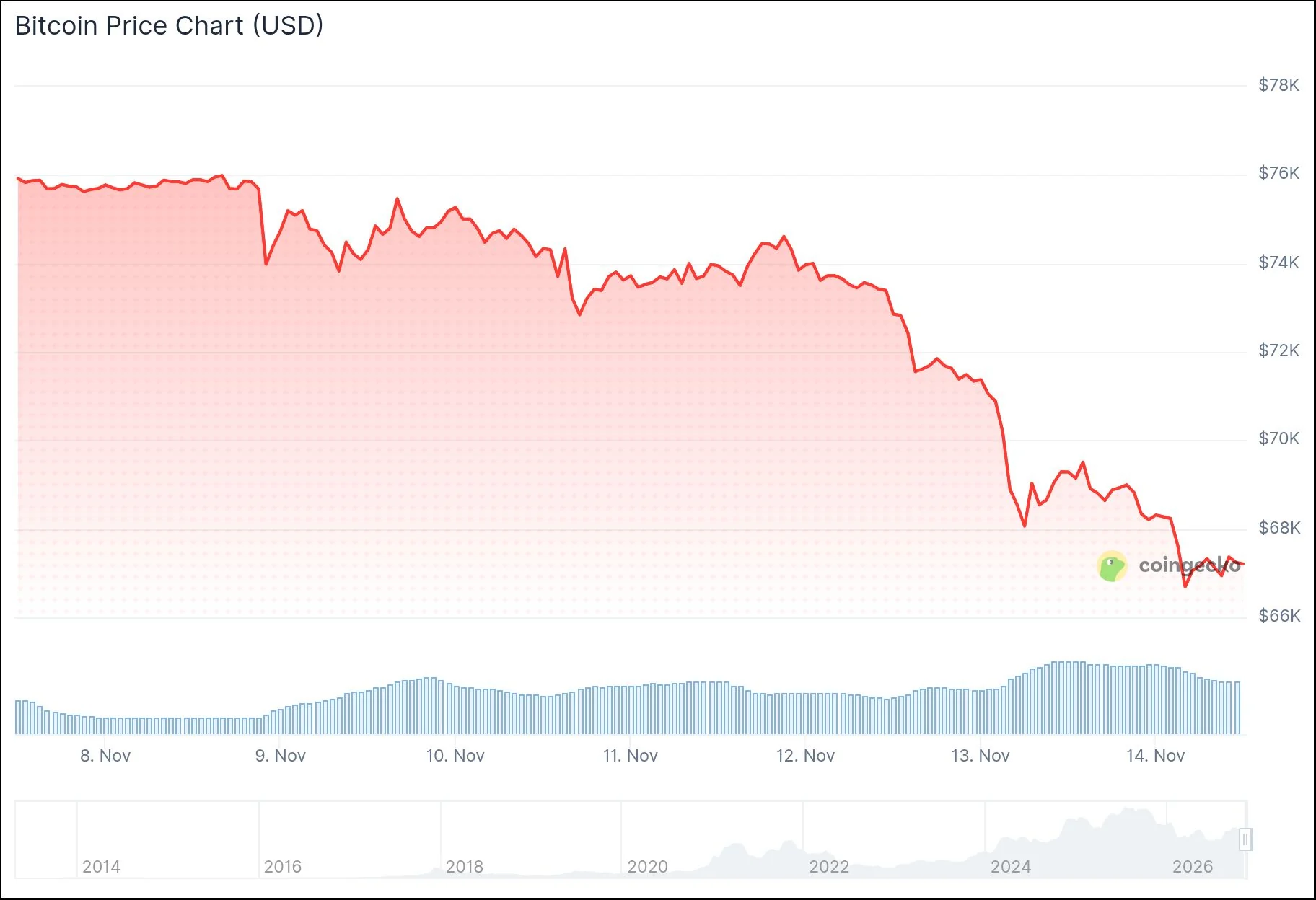
Bitcoin fell to approximately $68,700 on Saturday after dropping 4% and briefly reaching a roughly 12-week low near $67,500. The rebound from that level left traders watching whether it can hold into next week.
BTC is down 11.2% so far in November and 17.7% in the fourth quarter. According to CoinGlass, the quarter is Bitcoin’s second-worst on record, with only one earlier quarter posting a larger decline. Several weeks remain before the quarter ends.
Producer Prices Rise 6.5% Year Over Year
Fresh US inflation data added to the market’s focus on Federal Reserve policy. The Producer Price Index rose 0.3% in October from the previous month and increased 6.5% from a year earlier, its largest annual gain since November 2022. Both readings were 0.1 percentage point below forecasts.
The index measures the prices domestic producers receive for goods and services, and because those costs sit upstream of consumer prices, the report is treated as an early read on the inflation trend that shapes Fed policy. It is one of three readings traders track alongside the consumer-focused CPI and PCE indexes, with the latter serving as the Fed’s preferred inflation gauge. The Bureau of Labor Statistics said prices for final-demand goods rose 0.5% in October, while final-demand services prices increased 0.2%.
The Kobeissi Letter wrote on X:
BREAKING: October PPI Inflation rises to 6.5%, its highest level since November 2022. Core PPI Inflation was 5.0%, in-line with expectations of 5.0%. CPI, PPI, and PCE inflation continue to push higher in the US. All signs point toward a December rate hike.
— The Kobeissi Letter (@KobeissiLetter) November 13, 2026
https://x.com/KobeissiLetter/status/2121234688391942348?ref_src=twsrc%5Etfw
Following the report, traders increased their expectations for a Federal Reserve rate increase in December. CME Group’s FedWatch Tool showed an 89.7% probability of a 25-basis-point hike, up from 85.4% on Thursday. The probability of a larger 50-basis-point increase fell from 14.5% to 10.3%, making a quarter-point move the clear base case. The Fed is scheduled to meet in December. Rate odds matter for Bitcoin because the asset is widely traded as a liquidity-sensitive market whose conditions tighten or ease with Fed policy.
Economist Robin Brooks described a 25-basis-point increase as “all but inevitable” and argued against a larger move. He said a 75-basis-point hike would not resolve an oil-price spike connected to the US-Iran war and the Strait of Hormuz. Brooks added that if underlying inflation has accelerated, 75 basis points would be too small. He said the appropriate response depends on the cause of the price increase, without stating which cause he considered more likely.
US stocks also opened lower. The S&P 500 was down 1.2%, while the Nasdaq Composite fell 1.5%. Traders were also responding to news that Nvidia CEO Jensen Huang resigned on Thursday.
Analysts Watch Moving Averages and Weekly Support
Analyst CryptoBullet said on X that he had identified $68,000 as the bottom of Bitcoin’s two-month correction. He added that Bitcoin’s loss of its 200-day moving average—a long-term trend indicator watched closely in crypto technical analysis—was concerning and described the 200-week moving average as the “last hope.”
I had $68k as the bottom for this 2-month correction (that I perfectly called a month before it even started) But I don't like that $BTC lost the 200-Day MA 😕 The 200-Week MA is our last hope 🤞 pic.twitter.com/K6Ps1wqrKZ — CryptoBullet (@CryptoBullet1) November 13, 2026
https://x.com/CryptoBullet1/status/2121323795239886905?ref_src=twsrc%5Etfw
Benjamin Cowen referred to historical cycle timing in a separate X post, writing that Bitcoin has historically capitulated into its cycle low sometime after the US midterms.
Bitcoin has historically capitulated into its cycle low sometime after the US midterms pic.twitter.com/dkeR1wo40T — Benjamin Cowen (@benjamincowen) November 14, 2026
https://x.com/benjamincowen/status/2121463045360881676?ref_src=twsrc%5Etfw
Rekt Capital focused on Bitcoin’s weekly chart, a timeframe technical analysts use to filter out intraday noise and confirm trend shifts. The analyst said the previous weekly candle closed below three levels—$75,000, $76,800 and $78,300—which he described as evidence that sell-side momentum was growing and that bears were in control. He said the current week’s candle appeared likely to produce a similar result.
A weekly close below $73,000 on Sunday would represent Bitcoin’s third break of that support level in 2026. Each of the two previous breakdowns was followed by a decline to approximately $60,000. BTC was trading about $4,300 below the $73,000 level at the time of writing.
The weekly candle closes on Sunday, which will determine whether Bitcoin ends the week above or below the level identified by Rekt Capital, while the Fed’s December meeting stands as the next scheduled macro event on traders’ calendars. The original report was published by CoinCentral.

