Bitcoin Price Prediction: Crash Stalls as Spot ETFs Head for Worst Month Ever
Key Takeaways
- •Spot Bitcoin ETFs have recorded outflows in five consecutive weeks, losing $1.25 billion this week and more than $5.39 billion for the month, their worst since launching in 2024.
- •The sustained redemptions have pushed the funds into a net outflow for the year, returning underlying coins to the market and signaling weakening institutional demand.
- •Risk-off sentiment has lifted the US Dollar Index to 104, its highest level since early last year, while the Nasdaq 100 fell into a bear market and rate-hike odds exceeded 90% on Polymarket and Kalshi.
- •Bitcoin faces additional pressure from the US midterm election results, which could lead Democrats to unwind some deregulation, and from a Binance hack in which North Korean hackers stole about $6.3 billion.
- •Technically, Bitcoin trades below its 50-day moving average within a bearish pennant pattern, making a bearish breakout toward the monthly low of $55,173 the most likely scenario.
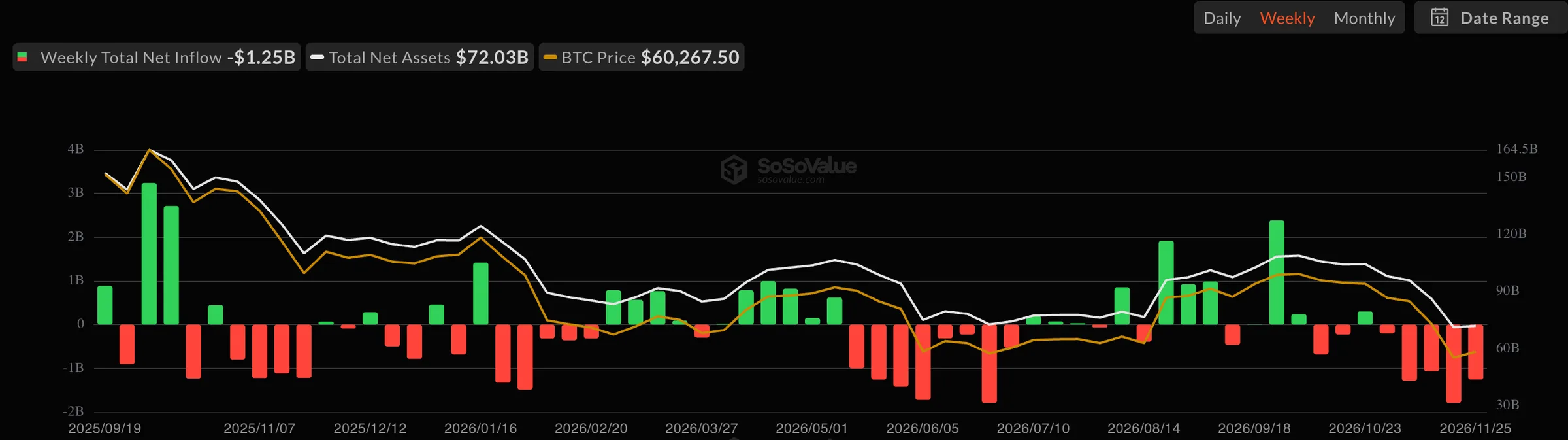
Bitcoin price has performed well over the past two days as the recent crash faded, holding above the $60,000 level and trading at $60,400 — a modest gain from its lowest level of the month. The stabilization has raised the possibility of a rebound in the near term, even as spot Bitcoin exchange-traded funds (ETFs) head toward their worst month on record, with outflows already exceeding $5.39 billion, according to SoSoValue data. The question now is whether the stabilization can hold while fund outflows continue.
Spot Bitcoin ETFs Head for Their Worst Month Ever
American investors have been actively redeeming their ETF holdings, a sign that many expect prices to continue falling in the near term. SoSoValue data shows that spot Bitcoin ETFs have shed substantial assets over the past several weeks, recording outflows in five consecutive weeks. Because these funds report their flows daily, the redemption streak has become one of the most closely watched barometers of institutional appetite for Bitcoin.
The funds lost $1.25 billion this week alone, bringing the monthly total to more than $5.39 billion. That is far higher than the $515 million in outflows recorded last month.
A closer look at the monthly figures confirms this is the worst month for these products since they were launched in 2024. The previous record was set in June, when the funds lost more than $4.6 billion in assets.
The sustained redemptions mean the funds have slipped into a net outflow for the year as a whole — a development that is not favorable for the market. That flip implies the same products attracted enough inflows earlier in the year to absorb the current wave of redemptions, a sharp reversal in institutional behavior. When investors redeem their Bitcoin ETF shares, the underlying coins are returned to the market, increasing total supply. The trend also signals that demand among institutional investors is weakening.
Risk-Off Sentiment Grips Broader Markets
The ongoing ETF outflows have coincided with a period in which investors have embraced risk-off sentiment, an environment in which capital rushes toward safe-haven assets. The US Dollar Index (DXY) has jumped to 104, its highest level since early last year, offering a clear example of the shift.
US stocks, by contrast, have continued their freefall. The Nasdaq 100 Index has fallen into bear market territory, while the Dow Jones and the S&P 500 have entered a correction — a period in which an asset drops by at least 10% from its recent peak.
One reason for the pressure is the rising expectation that the Federal Reserve will raise interest rates at its next meeting. Odds of a hike have jumped to over 90% on Polymarket and Kalshi, a surge that came as investors reacted to the latest inflation data released the previous day. The upcoming decision is now among the most closely watched macro events on the calendar for equity and crypto traders alike.
Bitcoin has also come under pressure from the US midterm elections, in which Democrats and Republicans won by large margins. They will control the Senate with 56 seats and the House of Representatives by more than 50 seats. As a result, Democrats will seek to undo some of the deregulation implemented under the Trump administration.
The cryptocurrency was additionally pressured by the recent Binance hack, in which North Korean hackers stole about $6.3 billion from the exchange. The breach sent shockwaves through the industry and underscored that no crypto exchange is safe from such attacks.
Bitcoin Price Technical Analysis
The daily chart shows that BTC price has been in a strong sell-off this month. Most recently, it has formed a symmetrical triangle pattern, with its two trendlines nearing confluence — a formation that typically reflects a pause as price compresses before a directional move. The triangle is part of a bearish pennant pattern, which normally leads to a bearish continuation.
Bitcoin has consistently remained below its 50-day moving average, a condition that usually indicates bears are in control. As long as price stays below that moving average, the bearish setup remains intact, while a sustained move back above it would be the first sign that sellers are losing control. Accordingly, the most likely scenario is a bearish breakout. If that occurs, the next level to watch is this month's low of $55,173, and a move below that level would lead to further continuation.

