Bitcoin Hyper Raises $33 Million Layer 2 Presale as Amboss Expands BTC Merchant Payments
Key Takeaways
- •Amboss is paying affiliates 15% to 20% of platform fees from referred merchants for 12 months.
- •The company says merchants can accept Bitcoin payments and settle in either BTC or stablecoins.
- •Bitcoin Hyper is building a high-speed Layer 2 for Bitcoin that uses the Solana Virtual Machine and aims to process thousands of transactions per second.
- •Bitcoin Hyper says its presale has raised $33 million at a token price of $0.01368.
- •The project says staking currently offers 35% APY and its contracts have been audited by Coinsult and SpyWolf.
Bitcoin's payment story is getting more practical. This week, Lightning infrastructure company Amboss launched an affiliate program that pays people recurring Bitcoin commissions for referring merchants to its payments API. The idea is straightforward: participants can help more businesses accept BTC and earn a share of the fees those businesses generate. Amboss says referred merchants can receive Bitcoin payments while settling into either BTC or stablecoins — an arrangement that reduces one of the obvious problems for businesses that do not want to hold a volatile asset.
Companies across the world are still putting money and effort into making Bitcoin easier to transact with — from Lightning payment channels to sidechains and newer rollup-style networks — and that continued buildout makes the Bitcoin Hyper Layer 2 presale especially timely. The project is built both for fast BTC payments and for trading and other financial activity around Bitcoin, and its presale has raised $33 million at a token price of $0.01368 — one of the biggest presales of the year.
Bitcoin Payments Are Becoming More Practical
Bitcoin was introduced as peer-to-peer electronic cash, but much of its success since then has come from people choosing to hold rather than spend it. The base layer also imposes hard limits on everyday spending: blocks arrive roughly every ten minutes, and the network can process only a handful of transactions per second, far below what retail payments require. Those constraints are why overlays like the Lightning Network — the layer where Amboss builds its infrastructure — exist at all, and why infrastructure providers keep working on the other side of the equation, with much of that work aimed squarely at the spending side.
Amboss' new program pays affiliates 15% to 20% of platform fees from the merchants they refer, for 12 months. It is a small development in the context of Bitcoin as a whole, but it illustrates something important: people do not necessarily need convincing that Bitcoin has value. Making BTC useful for routine transactions is increasingly a question of removing as much friction as possible.
Bitcoin Hyper is designed for exactly that job, using a rather novel idea.
Bitcoin Hyper Gives BTC Somewhere Faster to Work
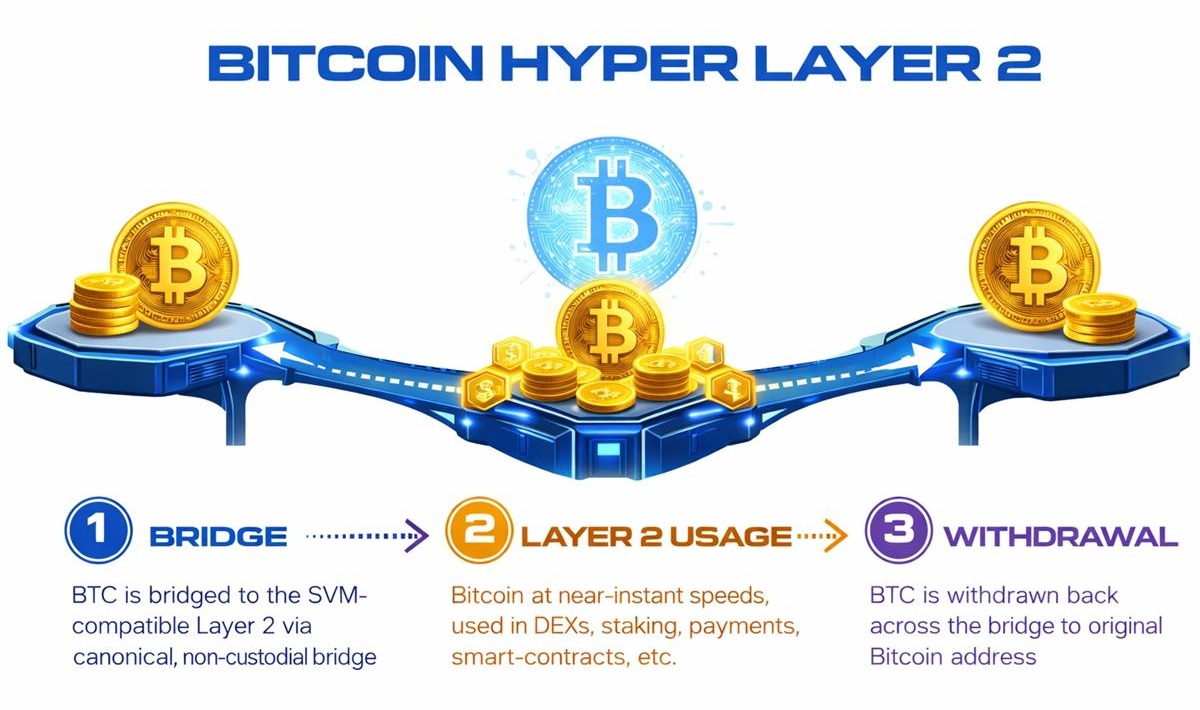
Bitcoin Hyper is developing a high-speed Layer 2 above Bitcoin that is based on the Solana Virtual Machine — the execution environment that runs Solana, a chain known for high throughput — handling transactions much faster than Bitcoin Layer 1: thousands of transactions per second rather than just a handful.
HYPER, as a token, is used to pay gas fees, while batches of payments processed on the Layer 2 are later anchored back to Bitcoin for settlement. The result, by design, is near-instant finality, with the Bitcoin base layer recording transactions for immutability — a division of labor familiar from rollup designs in other ecosystems, where fast execution happens off the base layer and settles back to it.
The practical outcome is more important than the architecture. A user can pay for a coffee instantly, or move BTC quickly enough to use in DeFi and other applications normally reserved for Ethereum or Solana chains. The project's documentation specifically describes support for decentralized trading and staking, as well as faster BTC transfers — a broader target than improving a single type of payment, even as it serves the long-held ambition of using BTC as currency.
Bitcoin Hyper aims to make all of those activities possible without requiring Bitcoin itself to become a different kind of blockchain. A merchant can receive BTC quickly, a trader can put Bitcoin capital to work without waiting on the base chain for every interaction, and a developer can build a financial product around BTC using familiar Solana tools.
$33M Presale Bets Bitcoin Holders Will Become Users
HYPER has now raised $33 million during its presale, with tokens priced at $0.01368, according to the project. That amount suggests buyers see room for another layer of Bitcoin infrastructure. While the project moves toward launch, staking currently offers 35% APY, and the project's contracts have been audited by Coinsult and SpyWolf — a standard baseline check for presale-stage contracts, though not a guarantee of how a network will perform once it is live.
Bitcoin Hyper has also publicly emphasized its work on cross-network transfers:
Cross-network transfers should feel simple from start to finish. Bitcoin Hyper is refining transaction handling, state tracking, and ecosystem integration to make moving assets between supported networks more predictable and reliable. Read the full article: … pic.twitter.com/MWSjnwh758
— Bitcoin Hyper (@BTC_Hyper2) August 21, 2026
HYPER still has plenty to prove. Presale demand is not the same as network usage, and the real test begins when people can judge the Layer 2 on transaction activity, applications, and users. But the opportunity it is targeting already exists, and the total addressable market it is aiming at is large: Bitcoin remains the largest cryptocurrency by market value, and much of it has historically sat in wallets rather than moving through payment or trading applications.
Bitcoin's history has largely been about proving that digital money can be valuable. The next phase of infrastructure development is increasingly concerned with making that value easier to use. Amboss pushing Bitcoin payments toward more merchants is one example of the shift. Bitcoin Hyper's Layer 2 is a different type, built around faster execution and a wider range of activity than simply transferring BTC between wallets. And if Bitcoin holders decide their BTC needs to do more than sit in a wallet, Bitcoin Hyper says it is building for them.
Source: ICO Bench

