Fed's Daly Maps Longer Inflation Path, Leaving Bitcoin's Rate Tailwind Conditional
Key Takeaways
- •Mary Daly said on April 10, 2026 that an oil shock tied to the Iran conflict had extended the timeline for returning inflation to the Fed's 2% target, making patience on rate cuts appropriate.
- •Daly stated that a rate cut would be possible only if the ceasefire held, oil prices retreated, and inflation resumed falling, and that holding rates steady would otherwise be the appropriate move.
- •The July 29, 2026 FOMC statement kept the federal funds target range at 3.5 to 3.75 percent, and minutes released on August 19, 2026 showed many participants saw upside inflation risks, with three dissents favoring a hike.
- •Bitfinex analysts said a hawkish Fed tone and hot inflation would be negative for equities and crypto, while treating oil-driven inflation as temporary could extend the crypto rally.
- •Bitcoin traded near $74,443 with a 7.37% 24-hour gain, while the Fear and Greed Index read 72, indicating 'Greed' sentiment despite a still-restrictive policy rate.
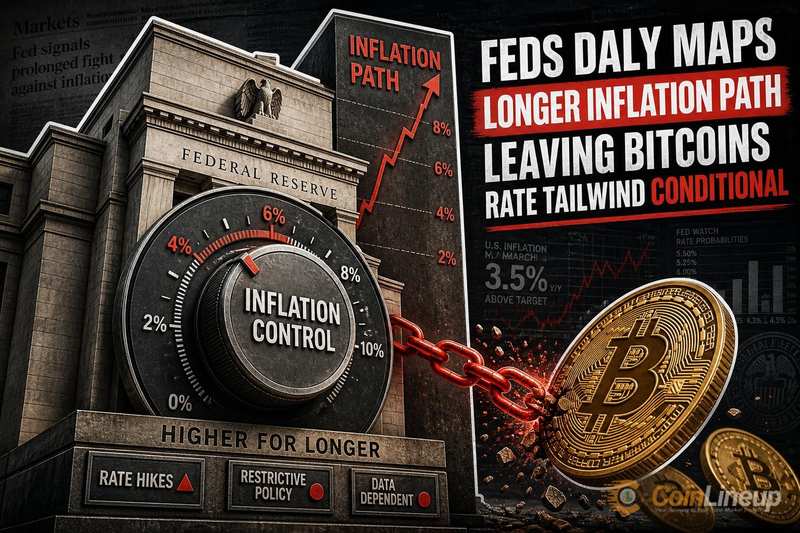
San Francisco Fed President Mary Daly has outlined a longer path back to 2% inflation, leaving Bitcoin’s potential rate-related tailwind conditional rather than assured. Any macro boost for BTC still depends on whether disinflation actually resumes.
What Daly’s Longer Inflation Path Signals for Fed Policy
A “longer inflation path” means the Federal Reserve expects prices to take more time to return to its 2% target, which points to patience on rate cuts rather than urgency. On April 10, 2026, Daly said an oil shock tied to the Iran conflict had extended that timeline and made patience appropriate, Reuters reported. For related coverage, see Hashdex Liquidates $14.7M Bitcoin ETF as BlackRock IBIT Adds $143.6M.
Delayed disinflation pushes back rate-cut expectations because the Fed is reluctant to ease while prices remain elevated. Daly said a cut would be possible only if the ceasefire held, oil prices retreated, and inflation resumed falling; otherwise, holding rates steady would be the appropriate move. For related coverage, see Coldcard Releases Firmware 5.6.1, Urges Affected Users to Move Bitcoin.
That caution is already reflected in the policy stance. The July 29, 2026 FOMC statement kept the federal funds target range at 3-1/2 to 3-3/4 percent, noting that inflation remained elevated and that recent supply shocks, including energy, had pushed up prices for consumers and businesses.
This article interprets the policy implications of that stance rather than describing a new Fed decision. The minutes released on August 19, 2026 sharpened the message: many participants saw upside inflation risks, and many judged that policy tightening would likely be necessary if inflation did not decline, with three dissents favoring a hike. That hawkish split has also been visible in prior Fed minutes showing a widening divide among officials.
Why Bitcoin’s Rate Tailwind Remains Conditional
A “rate tailwind” for Bitcoin refers to the boost the asset often receives when investors expect looser financial conditions, which can push capital toward risk-on holdings such as BTC. That framing is a market interpretation, and the idea that Daly’s outlook creates such a tailwind for Bitcoin comes from unconfirmed reports, not a direct Federal Reserve statement.
The tailwind is conditional, not automatic, because the easing it depends on is not guaranteed. If inflation remains sticky, the policy pivot that could support risk assets may be delayed, which is exactly the scenario Daly’s longer path describes. The relationship between Fed policy, liquidity, and BTC is a familiar channel, as covered in how DXY, liquidity and Fed policy affect Bitcoin.
Bitfinex analysts framed the two-sided risk, saying a hawkish Fed tone and hot inflation would be negative for equities and crypto, while treating oil-driven inflation as temporary could extend the crypto rally, CoinDesk reported. That distinction matters because the same macro backdrop can either delay easing or preserve the conditions for it, depending on how quickly inflation data cools. Bitcoin traded near $74,443 with a 7.37% 24-hour gain in the research snapshot, a constructive backdrop that reflects risk appetite rather than confirmed Fed easing.
What Traders Should Watch Next in the Bitcoin-Macro Setup
The uncertainty in this setup makes forward-looking indicators the main focus. The variables Daly identified form the checklist: the inflation trend, whether oil prices retreat, the Fed’s tone in coming statements, and market-implied rate-cut expectations.
The bullish scenario is straightforward: if the ceasefire holds and inflation resumes falling, officials could treat the oil shock as temporary, and the delayed rate cut becomes a live catalyst for BTC. The bearish scenario is the mirror image, with sticky inflation triggering the tightening contingency that many participants flagged in the July minutes.
Sentiment currently leans risk-on, with the Fear and Greed Index reading 72, or “Greed.” That optimism sits against a policy rate still in restrictive territory and ETF flows that have moved both ways, including a quarter when Bitcoin ETFs bled 77,000 BTC as retail investors exited.
The signals to monitor tie directly back to the conditional thesis: each one either confirms that disinflation is resuming, strengthening the case for easing, or shows inflation holding firm, keeping the macro tailwind on hold and the higher-for-longer stance intact.
Disclaimer: This article is for informational purposes only and does not constitute financial or investment advice. Cryptocurrency and digital asset markets carry significant risk. Always do your own research before making decisions.

