CoinShares: Bitcoin Unlikely to Break $80K Without Inflation or Fed Shift
Key Takeaways
- •Bitcoin was quoted at $80,715, leaving the market just above the $80,000 level reportedly tied to an unverified CoinShares condition for a move higher.
- •The Federal Open Market Committee raised the federal-funds target range by 25 basis points to 3.75%-4.00% on September 16, 2026, and restated its 2% inflation objective.
- •July figures from the Bureau of Economic Analysis showed headline PCE inflation at 3.7% year over year and core PCE at 3.3%, consistent with the Fed's characterization of elevated inflation.
- •Spot Bitcoin ETFs recorded $1 billion in weekly outflows, while XRP spot ETFs attracted inflows on June 26 even as Bitcoin and Ether ETFs saw outflows that day.
- •If inflation stays near current readings, the 3.75%-4.00% policy range is likely to remain the dominant macro reference point, with future data, Fed communication, and ETF demand shaping market direction.
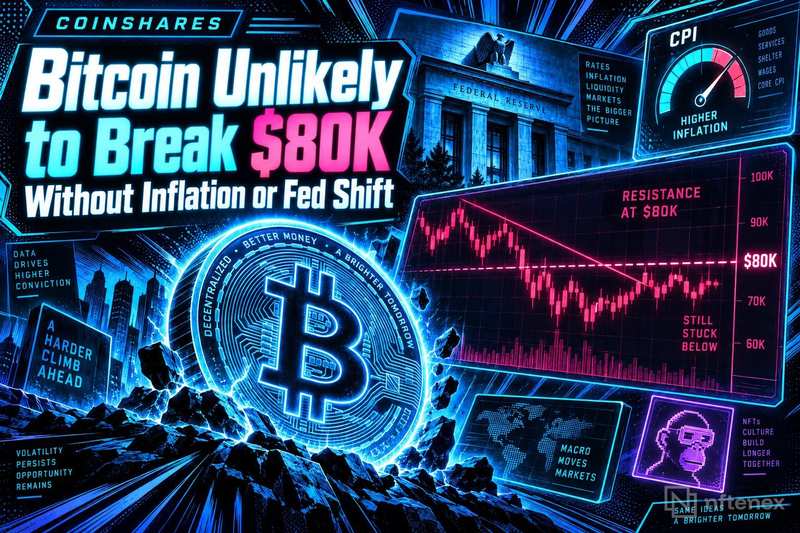
Bitcoin traded at $80,715 in the market snapshot accompanying the report, placing it just above the $80,000 threshold at the center of a reported CoinShares view. That proximity makes the story less about a distant price target and more about whether macroeconomic conditions — above all inflation and Federal Reserve policy — can sustain a breakout above the level.
CoinShares Sets Conditions for a Bitcoin Move Above the Threshold
A conditional view, not a guaranteed prediction
No directly readable research note or statement from CoinShares, a digital asset investment and research firm, was supplied to independently establish the reported condition, so the attribution should be treated as unconfirmed rather than as a firm forecast. The surrounding evidence does, however, point to a restrictive macro backdrop: the Federal Reserve said inflation remains elevated in its latest policy statement.
With Bitcoin quoted at $80,715, that distinction matters for NFT markets as well as for crypto trading. Collectors may read Bitcoin strength as a liquidity signal, while creators build more durable revenue rails through token-gated releases, memberships and royalties. A price snapshot can shape trading mood, but it does not by itself establish demand for any particular artist, collection or marketplace.
Why Inflation and the Federal Reserve Matter for Bitcoin
The policy setting is still restrictive
On September 16, 2026, the Federal Open Market Committee — the Fed's rate-setting body — raised its federal-funds target range by 25 basis points (0.25 percentage points) to 3.75% to 4.00% and reiterated its 2% inflation objective. Higher policy rates can raise the hurdle for risk-sensitive allocations, including Bitcoin and the more speculative end of digital collectibles.
Inflation data shapes expectations
The Bureau of Economic Analysis reported that the PCE price index — the Fed's preferred inflation gauge — rose 0.2% month over month and 3.7% year over year in July, while core PCE increased 0.2% month over month and 3.3% year over year. Those readings are the concrete data points behind the Fed's description of elevated inflation.
With headline PCE at 3.7% and core PCE at 3.3%, traders have reason to focus on whether upcoming data changes the expected path of financial conditions. That macro sensitivity is separate from fund-flow narratives such as recent Bitcoin ETF outflows, but both can influence the capital available for crypto-native markets.
What Could Keep Bitcoin Below the Discussed Level
A near-term watchlist for collectors and traders
If inflation fails to cool from the 3.7% headline PCE reading, the FOMC's 3.75% to 4.00% target range could remain the dominant macro reference point. That would support the cautious interpretation of the unconfirmed CoinShares view without turning it into a verdict on Bitcoin's long-term role or on the value of individual NFT collections.
Readers should watch the next inflation release, subsequent FOMC language and shifts in ETF demand rather than assuming any single indicator settles the market. Recent flows — a frequently watched gauge of institutional demand — have been mixed: spot Bitcoin ETFs posted $1 billion in weekly outflows, while XRP spot ETFs drew inflows on June 26 even as Bitcoin and Ether ETFs posted outflows that day. The contrast shows why liquidity can fragment across Bitcoin, Ether and XRP even when the broader crypto narrative looks constructive.
For the creator economy, the practical signal from the July PCE reading is to separate market beta from ownership infrastructure: royalty enforcement, chain migration and collector utility remain product decisions even when Bitcoin becomes the day's headline. Marketplace teams and artists preparing new drops will be watching whether the next round of macro data improves conditions for discretionary collecting, alongside the institutional demand reflected in Bitcoin and Ether ETF performance.
: This article is for informational purposes only and does not constitute financial or investment advice. Cryptocurrency and digital asset markets carry significant risk. Always do your own research before making decisions.

