Bitcoin Miners Have Sold Nearly Half Their BTC Reserves as Data Center Spending Reshapes Treasury Strategies
Key Takeaways
- •Glassnode reported on November 18 that publicly listed Bitcoin miners have divested close to half of their holdings since January 2026, reversing years of retention.
- •Ten major listed miners sold 49,000 BTC during the first half of 2026, cutting combined reserves to roughly 82,000 BTC from about 109,000 BTC at the end of 2025, according to Block Scholes.
- •MARA sold 26,984 BTC for approximately $1.9 billion in the nine months ended September and a further 13,597 BTC for about $1.1 billion afterward, directing $750 million toward repaying Bitcoin-backed loans and releasing pledged collateral.
- •Riot Platforms sold 20,264 BTC through September to raise roughly $1.5 billion, primarily funding data-center development, and announced a 15-year Corsicana lease covering 910 megawatts of computing capacity in November.
- •CoinShares estimated average production cash costs of $75,500 per Bitcoin in the second quarter, pressuring miners to draw on previously accumulated holdings to fund operations and infrastructure.
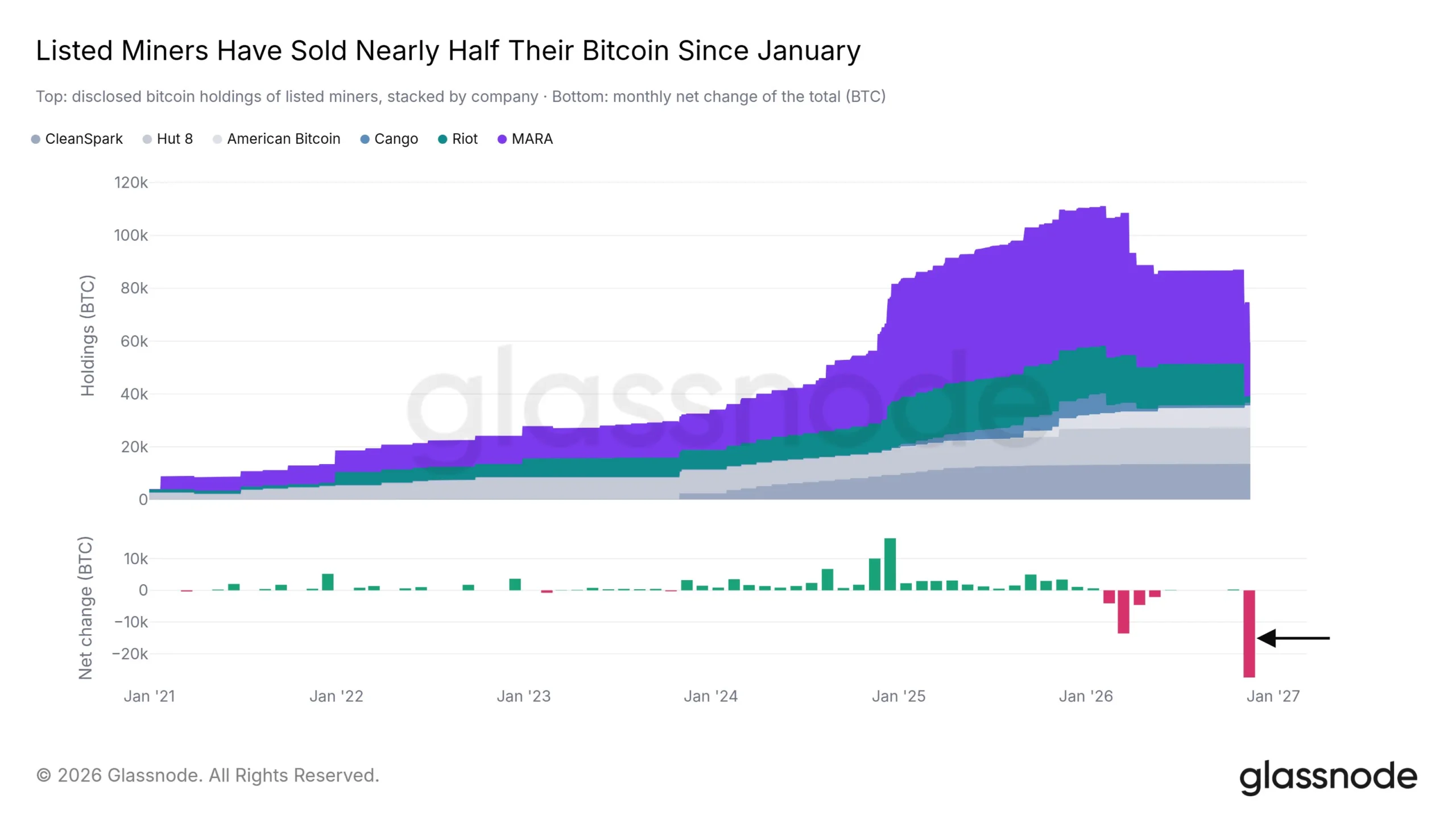
Publicly listed Bitcoin miners have sold nearly half of their Bitcoin reserves since January 2026, according to on-chain analytics firm Glassnode, as publicly traded operators redirect proceeds toward artificial intelligence data centers. Glassnode reported on X on November 18 that the tracked companies had divested close to half of their Bitcoin holdings since January. The move reverses years of retaining mined BTC and, in some periods, purchasing additional coins — putting years of accumulated corporate holdings directly behind the sector's pivot toward AI computing.
Reserve Decline Marks Shift in Treasury Strategy
The drawdown marks a change in how listed mining companies manage their finances. Several operators previously treated Bitcoin as a long-term asset rather than regularly converting holdings into cash, but infrastructure spending now competes with that accumulation strategy.
Research firm Block Scholes found that ten major listed miners sold 49,000 BTC during the first half of 2026, according to its analysis. Those sales exceeded the group's combined production and reduced holdings to roughly 82,000 BTC, from approximately 109,000 BTC at the end of 2025.
Lower mining revenue is also pressuring companies that carry substantial electricity and equipment costs. CoinShares estimated average production cash costs of $75,500 per Bitcoin during the second quarter, and its mining report identified data-center development as a growing spending priority. At cost levels like those, drawing on coins accumulated in earlier years gives operators funding capacity that current production does not provide on its own.
MARA Sales Support Debt Repayment
MARA sold 26,984 BTC for approximately $1.9 billion during the nine months ended September. The company said those transactions supported operations, expansion and liquidity management. Its September balance sheet still included approximately 34,012 BTC, including coins held under asset management arrangements.
After September, MARA sold a further 13,597 BTC and collected approximately $1.1 billion, directing $750 million toward repaying Bitcoin-backed loans and releasing previously pledged collateral. The miner disclosed those transactions in its November 9 quarterly filing.
MARA also plans to use Bitcoin proceeds for data-center opportunities and other obligations. Its broader computing strategy now runs alongside mining, with power infrastructure emerging as another business priority. The company has reduced debt while keeping Bitcoin available for future funding needs.
Riot Platforms Channels Sales Into Data Center Expansion
Riot Platforms sold 20,264 BTC through September, raising approximately $1.5 billion, with those proceeds primarily directed toward data-center development, according to its November 4 earnings release. Riot held 2,418 BTC in September, compared with 18,005 BTC at the close of 2025.
The miner has also expanded its infrastructure commitments through long-term leases at its Texas campuses. In November, Riot announced a 15-year Corsicana lease covering 910 megawatts of computing capacity, an agreement that supports revenue from power and land beyond Bitcoin mining. Riot's earlier Bitcoin sales marked its departure from a previously accumulation-focused strategy, though the broader shift does not mean every mining company has stopped retaining coins. Block Scholes' tally of roughly 82,000 BTC is a mid-year figure, so the later sales disclosed by MARA and Riot are not fully reflected in it, and upcoming quarterly filings and updated reserve estimates will show how much treasury stock remains to fund the industry's computing transition.

