Bitcoin Millionaire Statistics 2026: Who Owns the Most BTC and How Wealth Is Distributed
Key Takeaways
- •Henley & Partners' Crypto Wealth Report 2026 estimates that 92,272 people worldwide hold at least $1 million worth of Bitcoin, accounting for 68% of all cryptocurrency millionaires.
- •An estimated 371 million people now own Bitcoin globally, reflecting a 4.9% increase in funded addresses during the year ended August 31, 2026.
- •Satoshi Nakamoto is estimated to hold 1.096 million BTC, roughly 5.5% of the maximum possible supply, and the coins have not moved since 2010.
- •U.S. spot Bitcoin ETFs collectively hold 1.26 million BTC, with 79% of those assets outside institutional 13F filings, indicating most ETF exposure belongs to retail investors and private clients.
- •The six largest entities—Satoshi Nakamoto, Coinbase, Strategy, BlackRock, Binance, and the U.S. government—together control more than 20% of Bitcoin's total supply.
Bitcoin’s price has fallen roughly 38% from its October 2025 high near $126,000, but the number of people holding Bitcoin has continued to rise. Henley & Partners’ Crypto Wealth Report 2026 estimates that 92,272 people worldwide are Bitcoin millionaires, meaning their BTC holdings are worth at least $1 million.
As of August 31, 2026, the global cryptocurrency market was valued at $2.6 trillion. Bitcoin accounted for $1.6 trillion, or about 60% of the total market.
The figures in this article combine on-chain data from Arkham, address statistics from BitInfoCharts, and wealth estimates from Henley & Partners.
The crypto wealth pyramid
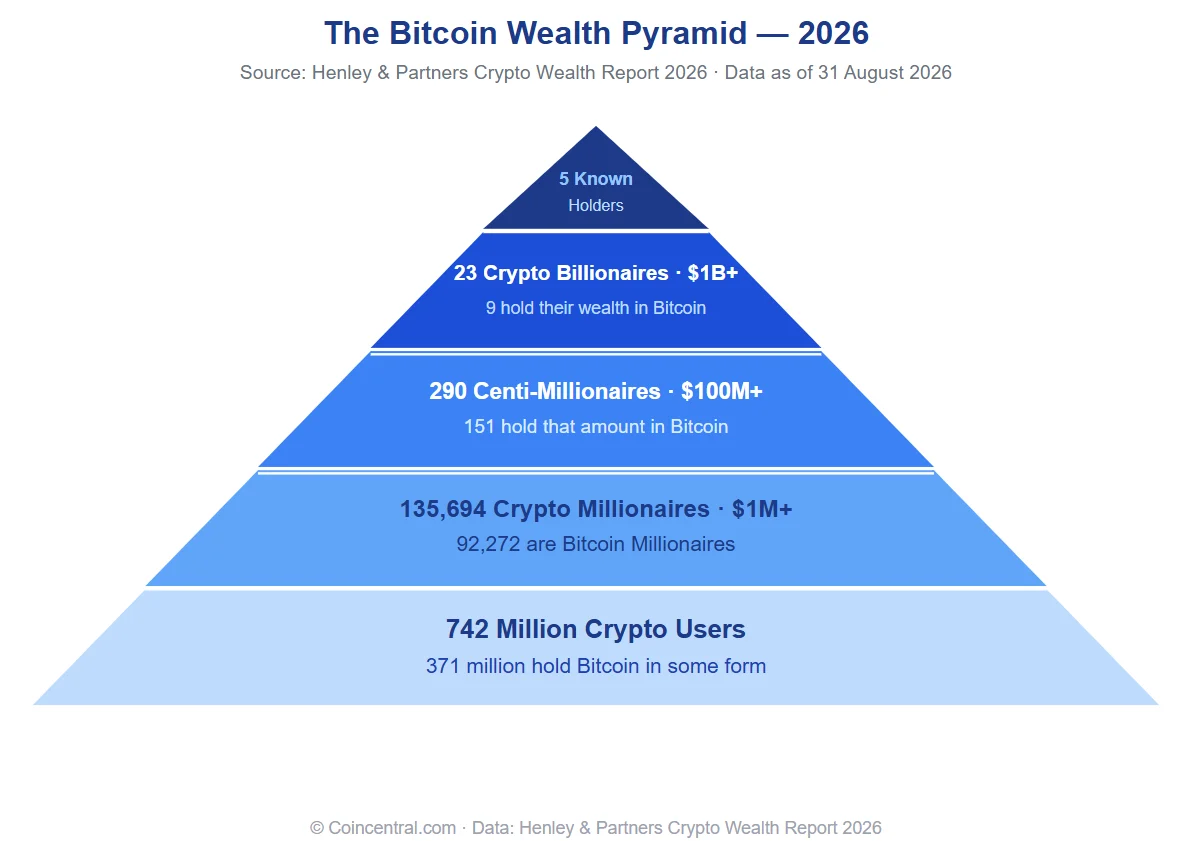
An estimated 742 million people worldwide hold some form of digital asset. Of that group, approximately 371 million hold Bitcoin. About half of the world’s digital-asset holders therefore own Bitcoin, based on these estimates.
Bitcoin ownership increased during the year ending August 31, 2026. Funded Bitcoin addresses rose by 4.9% over that period. Crypto.com’s mid2025 estimate put the number of Bitcoin owners at 354 million. Applying the reported growth rate produces the 2026 estimate of 371 million owners.
Wealth is considerably more concentrated at higher levels. There are 135,694 crypto millionaires, defined as people with at least $1 million in digital assets. Of those, 92,272 hold their million-dollar wealth in Bitcoin alone. Bitcoin millionaires therefore represent 68% of all crypto millionaires.
The next tier includes 290 centi-millionaires, or people holding at least $100 million in cryptocurrency. Bitcoin accounts for the wealth of 151 people in that group. At the top are 23 crypto billionaires, nine of whom hold their wealth in BTC.
Bitcoin’s share of wealth declines at the highest levels. Among crypto millionaires, Bitcoin represents about 68% of the cryptocurrency market excluding stablecoins. Among billionaires, that share falls to approximately 40%. Many of the largest fortunes are connected to founders’ holdings in their own blockchain networks rather than to Bitcoin.
The 2026 wealth figures use market prices from August 31, 2026, when Bitcoin traded at $78,008. Henley & Partners said the figures are not directly comparable with earlier reports because the methodology changed.
Source: Henley & Partners, Crypto Wealth Report 2026, data as of August 31, 2026.
Who holds the most Bitcoin?
When addresses are grouped by entity—a cluster of wallets believed to be controlled by one person or organization—Satoshi Nakamoto ranks first. The anonymous creator of Bitcoin is estimated to hold 1.096 million BTC, worth roughly $92 billion at current prices. The coins were mined from about 22,000 blocks during Bitcoin’s earliest years and have not moved since 2010.
Institutions occupy the next positions. Coinbase, the U.S.-based cryptocurrency exchange, holds 969,000 BTC for itself and its customers. Strategy, formerly known as MicroStrategy, holds 848,000 BTC after converting its corporate treasury to Bitcoin beginning in 2020. BlackRock, the world’s largest asset manager, holds 799,000 BTC through its Bitcoin ETF.
Binance, the world’s largest crypto exchange by trading volume, holds 714,000 BTC. Fidelity Custody, which provides custody services for many major Bitcoin holders, holds 436,000 BTC.
Exchange balances require careful interpretation. Most of the 969,000 BTC held by Coinbase belongs to customers rather than to Coinbase itself. Exchange cold wallets store customer deposits and operational reserves and do not represent only the exchange’s proprietary wealth.
The U.S. government holds 325,000 BTC, making it the fifth-largest entity holder. The government’s Bitcoin came from criminal seizures rather than purchases. Tether, the stablecoin issuer, is another major private-sector holder, with 97,000 BTC in its reserves.
Source: Arkham Intel Platform, September 2026.
The largest individual Bitcoin wallets
Address-level data, rather than grouped entity data, shows which individual wallets contain the most BTC. The four largest individual wallets are exchange cold wallets used to store customers’ Bitcoin offline.
Binance controls two of the four largest wallets. Its largest cold wallet contains 249,000 BTC, while a second Binance cold wallet holds 210,000 BTC. Robinhood’s cold wallet contains 141,000 BTC, and Bitfinex’s cold wallet contains 130,000 BTC.
Several other large wallets have no publicly identified owner. The largest unattributed wallet contains 92,000 BTC, worth approximately $8 billion, and has remained inactive since receiving its initial deposit. Unattributed wallets are a normal feature of on-chain data, because blockchain records show balances without always identifying the owner.
Source: Arkham Intel Platform, September 2026.
Exchange and ETF holdings
Exchanges hold substantial Bitcoin balances to serve customers. Cold wallets, which are offline storage addresses, protect those deposits from internet-connected systems. Coinbase controls 4.8% of the total Bitcoin supply, while Binance controls 3.6%. Together, the two exchanges account for more than 8% of all existing Bitcoin.
U.S. spot Bitcoin exchange-traded funds launched in January 2024. Arkham was the first blockchain analytics firm to identify the on-chain locations of the ETF holdings. U.S. spot Bitcoin ETFs now hold a combined 1.26 million BTC.
Of that amount, 79% is outside institutional 13F filings, the quarterly disclosures required from large U.S. investment managers. The figure indicates that most ETF Bitcoin is held by retail investors and private clients rather than by large institutions whose holdings appear in public filings.
BlackRock leads ETF issuers with 799,000 BTC. Fidelity holds 433,000 BTC in custody for its ETF and for Strategy’s corporate holdings. Grayscale reports its BTC balance publicly but has not disclosed its on-chain addresses. Its holdings are distributed across more than 1,750 wallets, each containing no more than 1,000 BTC. Arkham identified those wallets independently. Other major ETF issuers include Bitwise, ARK Invest, and Morgan Stanley.
The introduction of Bitcoin ETFs created a class of holders who do not appear directly on the blockchain. Their exposure exists through ETF shares held in brokerage accounts. The structure mirrors conventional stock ownership, in which the investor holds shares and the fund holds the underlying asset. Consequently, the actual number of Bitcoin millionaires is higher than raw on-chain data indicates.
Government Bitcoin holdings
Governments generally hold Bitcoin because law-enforcement agencies seized it from criminal investigations. The United States is by far the largest government holder, with 325,000 BTC valued at approximately $27 billion.
U.S. holdings come from multiple cases. The FBI recovered Bitcoin connected to the 2016 Bitfinex hack. Authorities also seized Bitcoin from the Silk Road darknet marketplace and from hacker James Zhong. More recently, the U.S. government acquired 127,000 BTC from an address linked to the LuBian hacker. In July 2026, the government transferred $280 million worth of Bitcoin and Ether to Coinbase Prime.
The United Kingdom is the second-largest government holder, with 61,245 BTC. The coins were seized from Jian Wen and Zhimin Qian in 2018 during a money-laundering investigation. UK police obtained access to the wallets in July 2021.
El Salvador represents a different model. The country made Bitcoin legal tender in 2021 and has purchased BTC. It now holds 7,200 BTC. President Nayib Bukele announced in 2022 that the country would purchase one Bitcoin per day going forward.
Bhutan has mined Bitcoin since 2019 using hydroelectric power from its glacial rivers. Druk and Investments, the country’s sovereign wealth fund, once held approximately 6,000 BTC. That balance had fallen to about 500 BTC in 2026 as Bhutan sold portions of its holdings.
The UAE’s government-linked Bitcoin comes from mining operations. The UAE Royal Group holds a majority stake in Citadel, a publicly listed mining company that controls approximately 7,100 BTC.
Source: Arkham Intel Platform, September 2026. The related chart uses a logarithmic scale because of the large difference between the U.S. holdings and those of other governments.
Public-company holdings
Public companies have been adding Bitcoin to their corporate treasuries. Strategy leads the group with 848,000 BTC, accumulated through regular purchases since August 2020.
Strategy’s on-chain wallets contain slightly less than the company’s confirmed total. Arkham has verified approximately 83% of Strategy’s on-chain Bitcoin. Fidelity Custody holds the remaining portion, roughly 184,000 BTC, on Strategy’s behalf. Combined, the holdings are worth approximately $77 billion.
Metaplanet, which is listed on the Tokyo Stock Exchange, has adopted a similar strategy. It holds 43,000 BTC and describes the position as a hedge against long-term weakness in the Japanese yen. Metaplanet has acquired the informal label “Japan’s MicroStrategy.”
MARA Holdings, formerly Marathon Digital, is a publicly traded Bitcoin mining company. A recent SEC filing reported that MARA held 35,500 BTC. The company mines an average of 22.7 BTC per day at nine facilities in North America. Its filings are available through the SEC.
SpaceX, which recently became a publicly traded company, holds 19,000 BTC in its corporate treasury. With a market capitalization of approximately $2 trillion, SpaceX is the largest Bitcoin treasury company when measured by the size of its parent company.
Source: Arkham Intel Platform and SEC filings, 2026.
Bitcoin addresses holding more than $1 million
As of August 6, 2026, 111,801 Bitcoin addresses held balances worth more than $1 million. Another 14,025 addresses held more than $10 million each. BitInfoCharts provides the figures, which change continuously as Bitcoin’s price moves.
These address counts do not correspond directly to the number of individual millionaires. The largest addresses belong to exchanges, custodians, and funds holding Bitcoin for thousands of clients. A Binance cold wallet containing $21 billion does not represent the wealth of one person.
Conversely, an individual Bitcoin millionaire may distribute holdings across several wallets, with none of those addresses individually exceeding $1 million. The result is a double-counting problem that causes address totals to diverge from the number of individuals in both directions.
Henley & Partners’ estimate of 92,272 Bitcoin millionaires attempts to adjust for these distortions. The methodology removes exchange and fund addresses, which account for roughly 22% of addresses in this range; estimates and removes lost coins, representing about 15% of the remaining group; consolidates multiple addresses belonging to the same owner; and adds approximately 31,000 people who hold Bitcoin only through ETFs and therefore never appear on-chain.
The address count also changes whenever Bitcoin’s price moves. A price change of only a few percent can move thousands of addresses near the $1 million threshold above or below it without any transaction occurring. Address-based figures are therefore approximations rather than precise counts of millionaires.
How much Bitcoin makes someone a millionaire?
The answer depends on Bitcoin’s price. At $78,008 per BTC on August 31, 2026, a holder needed approximately 12.82 BTC to own $1 million worth of Bitcoin. At Bitcoin’s October 2025 peak near $126,000, roughly 8 BTC would have been enough.
The threshold is determined solely by price. A person holding exactly 12.82 BTC can move above or below millionaire status without buying or selling any Bitcoin. A change in the market price is sufficient.
For that reason, Bitcoin millionaire counts are snapshots linked to a specific date and price. The 2026 Henley estimate used a price of $78,008, while the 2025 report used June 2025 prices near $105,869. The figures are not directly comparable because both the price and the methodology changed.
Calculation: $1,000,000 ÷ BTC price. Reference price: BitInfoCharts, August 6, 2026.
The most crypto-friendly countries
The Henley Crypto Adoption Index 2026 ranks 36 countries according to how well they support digital-asset investors. It uses more than 900 data points covering regulatory frameworks, tax policy, infrastructure, innovation, and public adoption.
Singapore ranks first for the fourth consecutive year. The city-state receives its highest score for innovation and technology and does not impose capital-gains tax on individual crypto investors.
The UAE moved from fifth to second place, receiving a perfect 10 out of 10 for tax-friendliness. It taxes neither crypto trading, staking, nor mining. Dubai established the world’s first dedicated virtual-asset regulator in 2022.
Hong Kong ranks third, with the highest scores for infrastructure adoption and economic factors. The United States ranks fourth and is the only country in the index to receive a perfect 10 for public adoption. Switzerland completes the top five, with strong scores for innovation and economic factors.
Malta has the highest regulatory-environment score in the index and ranks sixth overall. Thailand, the United Kingdom, Cyprus, and The Bahamas complete the top 10.
The European Union’s Markets in Crypto-Assets Regulation, or MiCAR, took full effect in December 2024 and established a common digital-asset rulebook across 30 countries. This reduced the ability of individual EU member states to compete solely through regulation. Tax policy and residency options have become more important factors in attracting crypto wealth within the EU.
Source: Henley Crypto Adoption Index 2026.
New reporting rules
Seventy-six countries have signed onto the OECD’s Crypto-Asset Reporting Framework, known as CARF. The first automatic data exchanges between 46 of those countries are scheduled for September 2027. Once implemented, crypto holdings will be subject to cross-border tax reporting similar to that used for traditional bank accounts.
The framework changes the practical significance of where a Bitcoin holder resides. Tax authorities previously found it difficult to track Bitcoin wealth across borders. Information-sharing agreements are expected to make that more difficult for holders seeking to keep assets outside reporting systems.
Henley & Partners reports growing demand from clients seeking professional advice about residency and citizenship options in jurisdictions with clear and favorable digital-asset rules.
Stablecoins are also changing how digital wealth moves between financial centers. Stablecoin payment rails can transfer dollar-denominated value between custodians in Dubai, Singapore, and Europe within minutes rather than days, without using the traditional correspondent-banking system. Bahrain and Hong Kong are among the jurisdictions that have introduced dedicated stablecoin regulations.
Conclusion
Bitcoin ownership in 2026 spans an anonymous creator who mined coins in 2009, governments that seized BTC from criminal investigations, companies that purchased Bitcoin for corporate treasuries, and retail investors who hold exposure through ETF shares.
Ownership remains highly concentrated at the top. Satoshi Nakamoto is estimated to hold 5.5% of all Bitcoin that can ever exist. The six largest entities—Satoshi, Coinbase, Strategy, BlackRock, Binance, and the U.S. government—together control more than 20% of the total supply.
At the same time, ownership is more widespread than in earlier years. Approximately 371 million people now hold Bitcoin in some form, more than at any previous point in the asset’s history.
Of the 21 million Bitcoin that can ultimately be created, an estimated 3.7 million are permanently lost in inaccessible wallets. That leaves an effective circulating supply of roughly 17.3 million coins.
The 92,272 Bitcoin millionaires counted in 2026 represent a snapshot based on one price and one date. The figure changes as Bitcoin’s price changes, even when no coins change hands.
Sources
Henley & Partners, Crypto Wealth Report 2026, published September 8, 2026, London.
Arkham Intel Platform, Bitcoin Token Page and Entity Holdings, accessed September 2026.
BitInfoCharts, Bitcoin Rich List and Address Distribution, data as of August 6, 2026.
Glassnode, Clustering-Based Address-to-Owner Ratio, with a network average of 0.81 owners per address.
Crypto.com, Global Crypto Ownership Report, mid-2025 edition.
MARA Holdings, SEC 10-Q filing, 2026.
Strategy, formerly MicroStrategy, Bitcoin Tracker and Treasury Reports, 2026.
Henley & Partners, Crypto Adoption Index 2026, benchmarking 36 countries across more than 900 data points.
OECD, Crypto-Asset Reporting Framework, with first data exchanges scheduled for September 2027.
New World Wealth, Crypto Wealth Estimates, 2025 edition, used as a methodology cross-check for the 2026 report.

