Could U.S. Midterms Trigger Another Bitcoin (BTC) Price Selloff?
Key Takeaways
- •Bitcoin fell to $57,850 on July 1, roughly 125 days before the November 3 midterms, unlike past cycles when major lows arrived about 13 to 71 days after the vote.
- •Historical midterm evidence is mixed, with cited post-election declines of 72%, 65%, 52%, and 27% following 2010, 2014, 2018, and 2022, yet monthly returns showed gains after the first two of those elections.
- •A whale transferred 4,000 BTC, worth about $327 million, to Binance and Deribit within five hours, though the deposits alone do not establish that the coins were sold.
- •Traders are monitoring the $80,000 level, where short-side liquidity clusters between $79,500 and $80,600, while $73,000 has been identified as the average purchase price of recent buyers.
- •U.S. spot Bitcoin funds recorded $526.6 million in net inflows on October 19, but the purchases did not produce a sustained price rally.
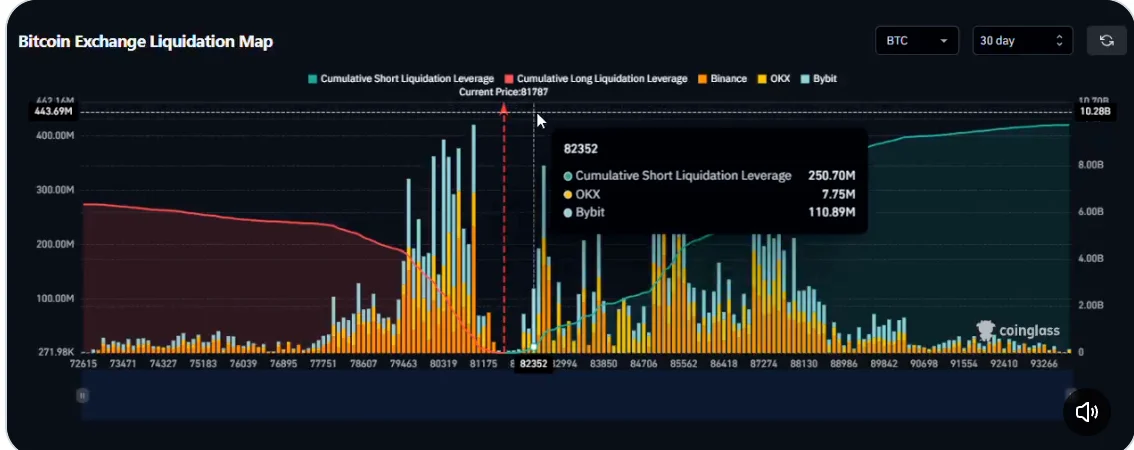
Bitcoin (BTC) is facing renewed downside warnings ahead of the November 3 U.S midterm elections, as analysts compare the cryptocurrency's strong recovery from this summer's low with a historical pattern in which its deepest bear-market lows formed only after voters went to the polls. A large whale transfer to two major trading venues and a cluster of nearby liquidity levels have sharpened attention on the $80,000 mark heading into the vote.
Bitcoin Enters the Midterms After an Early Recovery
Bitcoin fell to $57,850 on July 1, roughly 125 days before election day. By October 22, it traded near $81,455, approximately 41% above that low. Previous midterm years followed a different timeline, with the cycle's major lows arriving only after ballots were cast. Bitcoin reached those lows in January 2015, December 2018, and November 2022, dates that came approximately 71, 38, and 13 days after their respective elections. Because this year's low arrived well before election day, the historical pattern leaves open whether a comparable post-election bottom will form in 2026. The timing difference has become a focal point for traders weighing seasonal patterns around this year's vote. The midterms, held halfway through a presidential term, will fill all 435 U.S. House seats and about one-third of the Senate, anchoring the seasonal debate to a fixed date on the calendar.
Past Election Cycles Offer Mixed Evidence
Analyst Ali Martinez cited Bitcoin declines of 72%, 65%, 52%, and 27% following the 2010, 2014, 2018, and 2022 midterms. A review of monthly post-election returns, however, found gains after the first two of those elections — a discrepancy that shows how sharply results can differ depending on the measurement period. With only four midterm cycles in Bitcoin's trading history, the sample offers limited statistical weight in either direction.
Martinez also reported fourth-quarter losses of 16.7% in 2014, 42.16% in 2018, and 14.75% in 2022. Bitcoin gained 391% during the final quarter of 2010. Taken together, the figures show no consistent quarterly outcome across midterm years, and broader market conditions in each cycle further complicate direct comparisons.
Whale Transfer and Liquidity Levels Draw Attention
Blockchain tracker Lookonchain reported on X that a whale sent 4,000 BTC, worth about $327 million, to Binance and Deribit within five hours. Binance ranks among the world's largest cryptocurrency exchanges, while Deribit is known primarily for crypto derivatives. Deposits to exchanges can precede trading activity, but the transfers alone do not establish that the holder sold the coins.
A whale deposited 4,000 $BTC ($327M) into #Binance and #Deribit over the past 5 hours. pic.twitter.com/v43rwx2T3T
— Lookonchain (@lookonchain) October 23, 2026
Separately, trader Ted Pillows identified a cluster of short-side liquidity between $79,500 and $80,600. Short-side liquidity refers to buy-side orders — such as stop-losses and potential short liquidations — clustered above the prevailing price. He raised the possibility of a dip below $80,000 followed by a reversal. A recent Bitcoin price report likewise identified $80,000 as a closely watched support level.
Traders Weigh $73,000 Against Equity Weakness
Martinez identified $73,000 as the average purchase price of recently acquired Bitcoin, according to his on-chain estimate. He said a decline toward that level could test demand from those buyers. His forecast remains conditional, and nothing guarantees that past midterm moves will repeat in November.
Meanwhile, U.S. spot Bitcoin funds recorded $526.6 million in net inflows on October 19, according to recent Bitcoin ETF data. Those purchases followed an earlier stretch of withdrawals and did not produce a sustained price rally.
Equities add a further variable. QQQ fell 23% between September and December 2018 and dropped 17% before the 2022 election, while it gained 17% ahead of the 2014 vote. More recently, Bitcoin and QQQ each lost about 6% over the past 30 days, with 90-day returns of 26% and 3%, respectively. The figures place Bitcoin's recent 30-day drawdown alongside a weaker stretch for the Nasdaq-100 benchmark, while their longer-term returns have diverged. With the vote set for November 3, daily ETF flow figures and the price levels identified above give traders specific markers to track through election day.

