Bitcoin Bear-Cycle Return Looks Increasingly Unlikely, CryptoQuant Analysts Say
Key Takeaways
- •The percentage of Bitcoin UTXOs held at a loss dropped from roughly 60% to approximately 27%, a shift CryptoQuant's Crypto Dan says has historically coincided with transitions out of bearish market conditions.
- •Bitcoin is positioned between an active-supply support level near $71,300 and an invested-capital resistance level near $79,800, having traded around $76,400 on September 17.
- •U.S. spot Bitcoin ETFs experienced about $450 million in net withdrawals on September 15, their largest single-day outflow since June, according to SoSoValue data.
- •The ETF outflows occurred on the day the CLARITY Act failed to advance in the Senate and were followed by a 25-basis-point Federal Reserve interest rate increase the next day.
- •A durable recovery would require Bitcoin to keep the $71,300 support intact, absorb potential selling near the $79,800 break-even zone, and see ETF fund flows stabilize.
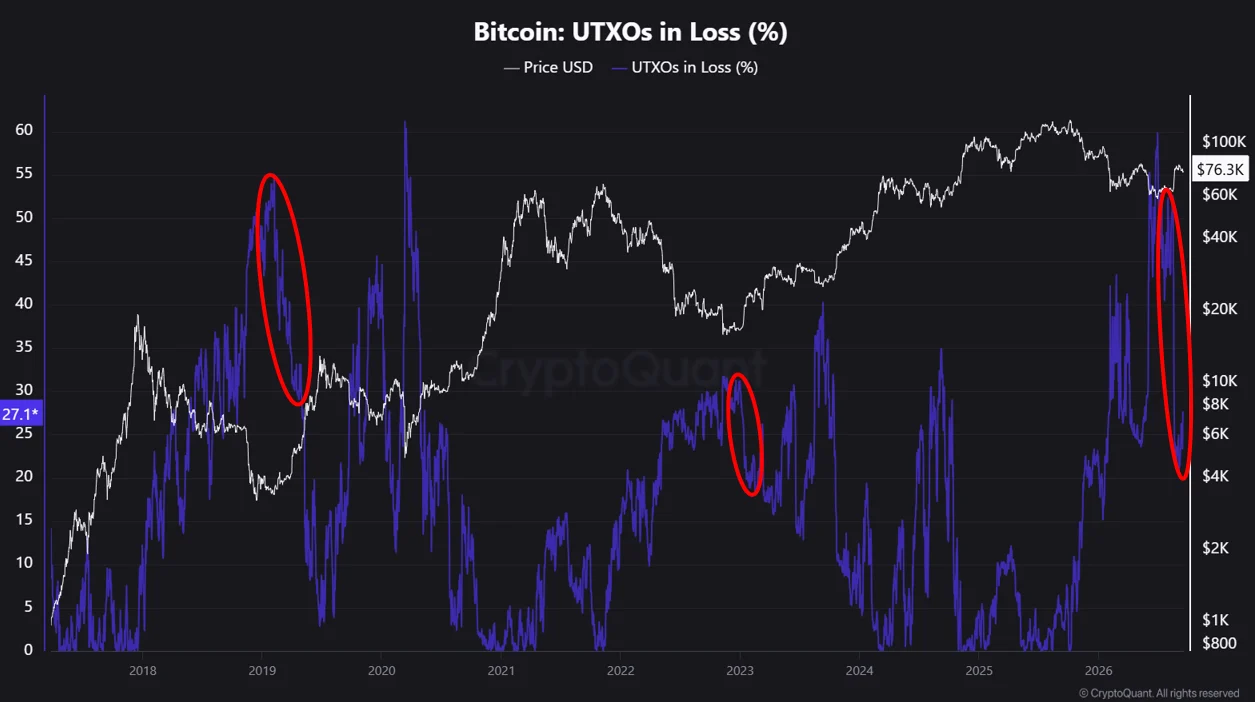
The share of Bitcoin transaction outputs sitting at a loss has dropped from nearly 60% to approximately 27%, and two CryptoQuant analysts argue that a decline of this scale has historically accompanied moves out of bearish market conditions. A parallel cost-basis analysis, however, shows the recovery still faces a critical test near $79,800, while recent exchange-traded fund outflows complicate the improving onchain picture.
Fewer Losing Outputs Reshape the Cycle Picture
The percentage of Bitcoin transaction outputs held at a loss has fallen from close to 60% to approximately 27%, according to CryptoQuant contributor Crypto Dan. He argues that declines of similar magnitude accompanied earlier transitions away from bearish conditions.
A Bitcoin transaction output, known as a UO, is an individual piece of spendable BTC recorded on the blockchain. It is classified as being at a loss when Bitcoin's current price is below its implied cost basis, calculated from the market price when the output was created. That figure does not necessarily identify what the current owner paid: a transaction can represent a purchase, but it can also be a transfer between wallets controlled by the same person or company.
Even so, the decline shows that financial pressure has eased across a far larger number of outputs. Fewer of them now sit below their implied cost basis than at the height of the downturn.
The metric counts blockchain outputs rather than people or an equal-weighted share of Bitcoin's supply, so it does not mean that 27% of Bitcoin investors are losing money. One person can control many UTXOs, and individual outputs can contain very different amounts of BTC. The historical comparison is also suggestive rather than conclusive, because Bitcoin has completed only a small number of major market cycles — swings that many analysts frame against the network's roughly four-year halving schedule, which periodically halves the reward for producing new blocks. No single onchain metric officially determines when a bear cycle has ended, and a less likely return to a bear cycle does not rule out another correction. The analysis concerns Bitcoin's broader multi-month structure, not its next daily move.
Bitcoin Remains Between Two Groups of Holders
The loss metric describes an improving market, but it does not show where buyers and sellers may react next. A separate analysis by CryptoQuant contributor Darkfost places Bitcoin between two cost-basis levels: potential active-supply support near $71,300 and invested-capital resistance around $79,800.
Bitcoin traded near $76,400 at 08:53 UTC on September 17, according to CoinMarketCap market data checked at the time of writing. That put the price approximately 7% above the lower boundary and 4% below the upper one. The range turns Crypto Dan's wider cycle argument into a testable price structure: Bitcoin has recovered enough to keep active holders broadly profitable, but not enough to absorb all the supply waiting near break-even.
$71,300 Reflects the Cost Basis of Active Supply
The active-supply cost basis estimates the average price of coins that remain economically relevant to the current market. Bitcoin that has not moved for more than seven years is excluded, reducing the influence of holdings that may be lost, inaccessible, or unlikely to participate.
Bitcoin trading above approximately $71,300 means the average coin in this group remains in profit. Investors whose cost basis is nearby may resist selling below it, helping the area behave as support when price returns. That behavior is not guaranteed. A sustained move below $71,300 would place more active supply underwater, and if buyers failed to reclaim the level, investors trying to avoid deeper losses could turn the former support into a source of selling.
$79,800 Is Where the Recovery Meets Sellers
The invested-capital cost near $79,800 represents a different group. At that level, some capital currently held at a loss returns to break-even. Investors who bought at higher prices may use the recovery to exit without realizing a loss, while more recent buyers may also take profits in the same area. Those decisions can add supply near $79,800 and help explain why Bitcoin has struggled to advance through it.
This does not contradict the falling percentage of losing outputs. The same recovery that brings more UTXOs back into profit also moves previously underwater holders closer to an exit. Bitcoin must absorb their potential selling before the improving onchain structure can translate into a sustained move higher.
The Loss Percentage Can Reverse With Price
The main counterargument is built into the UTXO indicator itself. Its improvement is partly a consequence of Bitcoin's recovery: when the price rises, outputs automatically move from loss into profit, and when it falls, that process reverses. The metric therefore confirms that conditions have improved, but it cannot independently show whether demand is strong enough to maintain that improvement. The cost-basis range and capital entering or leaving the market provide the necessary second test.
Recent fund flows are less supportive. U.S. spot Bitcoin ETFs — investment funds that hold Bitcoin directly and trade on U.S. exchanges — recorded approximately $450 million in net withdrawals on September 15, according to SoSoValue data, their largest daily outflow since June. The withdrawals occurred on the day the CLARITY Act, a crypto market-structure bill that would clarify which U.S. regulators oversee digital-asset trading, failed to advance in the Senate, and one day later the Federal Reserve raised interest rates by 25 basis points. The timing does not prove that either event caused the redemptions, but both developments created a more difficult backdrop for risk-sensitive demand.
Higher rates can make speculative assets less attractive, although Bitcoin has not responded identically to every tightening decision. Its past reactions to Federal Reserve rate increases depended on whether the policy change had already been priced in and what officials signaled next.
The Next Pull Will Test the Cycle Argument
The bullish case does not require Bitcoin to rise without interruption. It requires future declines to leave the percentage of losing outputs relatively contained while the active-supply cost basis continues to hold. Stabilizing ETF demand would provide additional evidence that the improvement is supported by new capital rather than price recovery alone.
The opposing case would strengthen if Bitcoin remained below its active-supply cost basis, the share of losing outputs began rising sharply, and fund withdrawals continued. That combination would show that the recovery had failed to protect holders once demand weakened.
Crypto Dan's metric suggests that Bitcoin no longer carries the same level of widespread unrealized stress seen earlier in the downturn. Darkfost's range identifies what remains unresolved: the market has recovered enough to create potential support, but not yet enough to absorb all the capital waiting to exit near break-even.
This article is provided for informational purposes only and does not constitute financial or investment advice. Onchain indicators and historical market patterns do not guarantee future price performance.

