Bitcoin Hyper Pushes SVM-Based Bitcoin Layer 2 as BTC Scaling Gains Attention
Key Takeaways
- •Stacks, Bitlayer, Citrea, and Rootstock are each pursuing different Bitcoin scaling models to support more on-chain financial activity around BTC.
- •Stacks said its earlier Dual Stacking pilot distributed 22.4 BTC to 1,044 participants, and sBTC deployment peaked at more than 5,000 BTC.
- •Stacks plans to launch a new 90-day DeFi incentive program beginning around September 10 to reward borrowing and liquidity markets.
- •Bitcoin Hyper is building a Bitcoin Layer 2 that uses the Solana Virtual Machine and plans to commit Layer 2 state back to Bitcoin while using zero-knowledge proofs.
- •Bitcoin Hyper’s presale has raised more than $33 million, with HYPER priced at $0.0136852, a fixed supply of 21 billion tokens, and staking advertised at 35% APY.
Bitcoin’s next major crypto opportunity may come not from a move in the BTC price, but from renewed work on a long-standing challenge: making the world’s largest cryptocurrency useful for more than holding and transferring value.
In August, Bitcoin Layer 2 projects have returned to the spotlight. Networks including Stacks, Bitlayer, Citrea, and Rootstock are pursuing different approaches to support payments, lending, trading, and decentralized finance around BTC. Stacks is also preparing a new 90-day DeFi incentive program designed to reward borrowing and liquidity activity involving its Bitcoin-linked sBTC asset.
Among these projects, Bitcoin Hyper (HYPER) is drawing attention with a presale that has raised more than $33 million. The project’s central proposal is a Bitcoin Layer 2 compatible with the Solana Virtual Machine (SVM).
Solana-like speed combined with Bitcoin’s security and safety is an idea that is attracting interest.
Bitcoin Layer 2s Aim to Unlock More BTC Utility
Bitcoin’s limitations are well known. The base network prioritizes security and decentralization over raw transaction speed, and its scripting system is much more restrictive than the smart contract environments available on networks such as Ethereum and Solana.
That is usually not a problem for users who simply buy BTC and hold it in a wallet. It becomes more important when developers try to build real-world payments, decentralized exchanges, lending markets, or other applications that require frequent transactions.
Bitcoin Layer 2 projects aim to move that activity away from the base layer while maintaining a connection to BTC and the Bitcoin network.
There is no single model. Stacks has built its own smart contract environment and sBTC asset. Bitlayer is working with BitVM technology and zero-knowledge proofs. Citrea is taking a rollup-based approach, and Rootstock has long provided an EVM-compatible smart contract network connected to Bitcoin.
What connects these projects is the amount of capital they want to put to work. BTC remains by far the largest cryptocurrency, with more than $1.5 trillion in TVL, but compared with other major blockchain ecosystems, relatively little of that value is active in on-chain financial applications.
For that reason, the current wave of Bitcoin scaling projects is being watched not just for technical design, but for whether they can attract actual usage. Even established Bitcoin scaling projects are still testing demand. This month, Stacks said its earlier Dual Stacking pilot distributed 22.4 BTC to 1,044 participants, while sBTC deployment peaked at more than 5,000 BTC. Its next incentive program will direct Bitcoin rewards toward borrowing and liquidity markets beginning around September 10.
Bitcoin Hyper Adds SVM Execution
Rather than trying to make Bitcoin itself process more transactions, Bitcoin Hyper is building a separate high-performance environment using the Solana Virtual Machine.
The SVM is already associated with fast blockchain applications and high transaction throughput, and Bitcoin Hyper plans to use it for activities that would be difficult or expensive to carry out directly on Bitcoin, including real-world payments, trading, lending, staking, and decentralized applications.
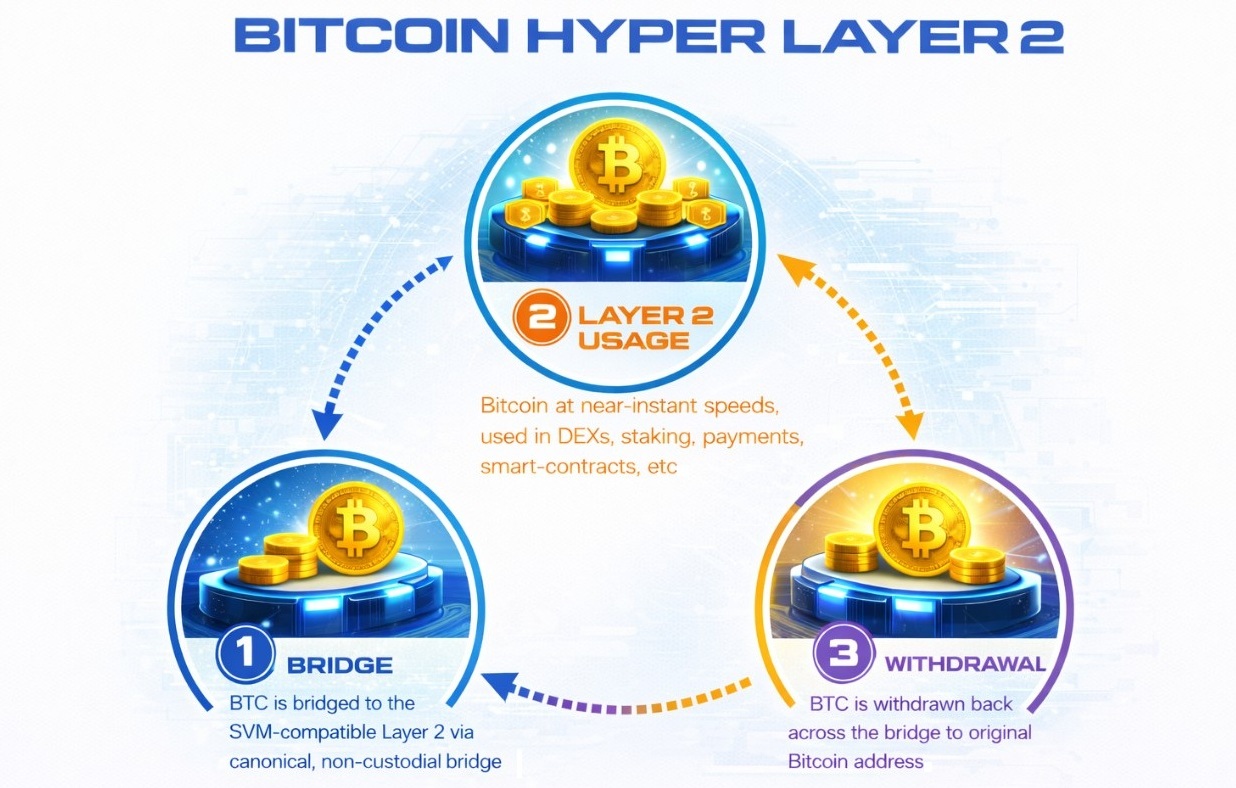
BTC is moved into the Layer 2 environment, where it can be used within those applications, while Bitcoin Hyper periodically commits Layer 2 state back to Bitcoin. The project also plans to use zero-knowledge proofs to verify transaction validity.
In effect, the BTC main chain remains the ultimate ledger, while transactions can happen quickly enough to be used at a supermarket register.
HYPER Token Structure
HYPER is the network’s native token. It is used for transaction fees and smart contract execution, and holders can also stake it to participate in governance.
The project’s whitepaper lists additional possible uses, including access to ecosystem features and incentives for developers building applications on the network.
Hyper speed. Maximum blast. pic.twitter.com/R7BUhvLCZW — Bitcoin Hyper (@BTC_Hyper2) August 24, 2026
Hyper speed. Maximum blast. pic.twitter.com/R7BUhvLCZW — Bitcoin Hyper (@BTC_Hyper2) August 24, 2026
The token has a fixed supply of 21 billion HYPER, and its Ethereum contract has been reviewed by SpyWolf, whose audit covers common vulnerabilities and logic flaws.
Presale demand has already given Bitcoin Hyper one clear advantage over many early-stage Layer 2 projects: visibility. HYPER has raised more than $33 million, with tokens priced at $0.0136852 and staking offering 35% APY.
Whether that makes HYPER the next crypto to explode will depend on execution after the presale, since a Bitcoin Layer 2 needs more than fast transactions on paper. Still, the broader market appears to recognize the protocol’s value.
Stacks, Bitlayer, Citrea, and others are approaching Bitcoin scaling with increasingly different technical designs, while Bitcoin Hyper says that combining Bitcoin with an SVM execution layer offers a faster route and brings Bitcoin back to Satoshi’s original currency goals without sacrificing security.

