What Happens to Bitcoin During a Recession? History Shows a Two-Phase Pattern
Key Takeaways
- •Bitcoin has historically declined alongside risk assets at the onset of a downturn, then rebounded after central bank stimulus expanded the money supply.
- •During the March 2020 pandemic shock, Bitcoin fell more than 50% within 48 hours before later setting a new all-time high once central banks injected cash into markets.
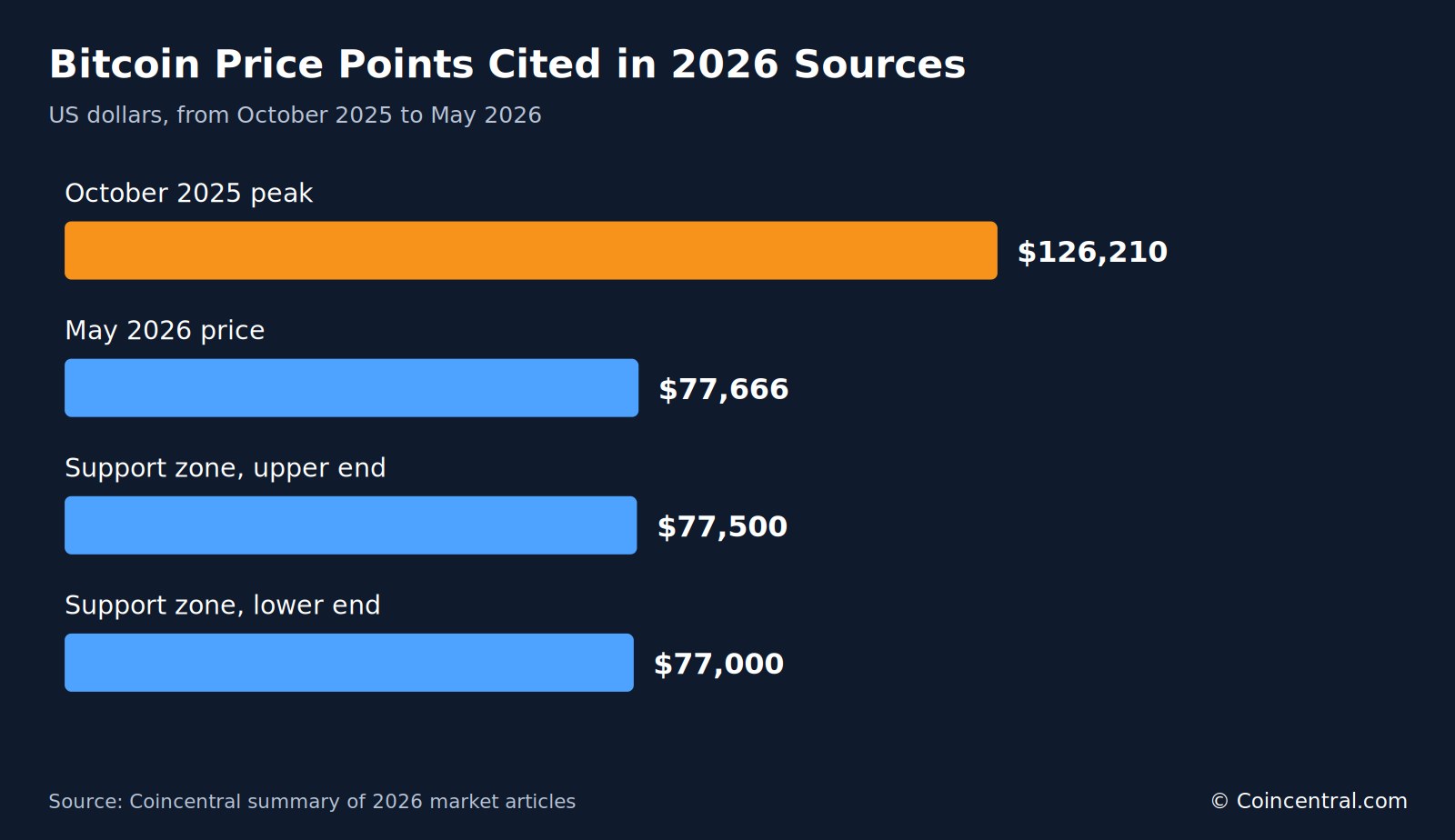
- •By May 2026, Bitcoin traded near $77,666, approximately 38.5% below its October 2025 peak of $126,210, and no recession had been officially declared at that time.
- •Spot Bitcoin ETFs and corporate treasuries led by MicroStrategy have shifted ownership toward long-term holders, and one analyst estimates downturn drawdowns near 25% compared with 80% in early retail-dominated cycles.
- •Bitcoin's 21 million coin supply cap and code-driven issuance appeal to investors as an inflation hedge, though its record has been mixed when central banks raise rates to fight rising prices.
Bitcoin emerged from the wreckage of the 2008 financial crisis as a monetary system designed to operate without banks or central banks. That origin story fuels a common expectation: that the asset should shield savings when the broader economy weakens. The record from previous downturns, however, tells a more complicated story.
As a general pattern, Bitcoin has fallen alongside stocks when a shock first lands, then often rebounded quickly once central banks moved in with support. This article examines the figures, the history and the principal risks. The underlying figures come from articles published between March 2025 and June 2026. Prices move quickly, so readers should consult live data before acting on any of it. Nothing here constitutes financial advice.
Key Bitcoin Recession Statistics at a Glance
A handful of numbers frame the debate. They are drawn from the sources listed at the end of this article.
Bitcoin peaked at $126,210 in October 2025. By May 2026 it traded near $77,666, a decline of roughly 38.5% from the high.
Supply, meanwhile, is fixed by design. Only 21 million bitcoin will ever exist, and the cap is projected to be reached in 2140. The rate of new coin issuance is cut in half roughly every four years.
Bitcoin remains technically inflationary today. Total supply expands as coins are mined, but the pace is dictated by code rather than by any central bank. Supporters view this as a defining contrast with fiat money.
Why do these figures matter in a recession? The size of past drops shows how much risk an investor takes on when markets turn, while the supply rules explain why some investors treat Bitcoin as a long-term store of value.
Price data cited in this article was captured in May 2026. Because Bitcoin trades around the clock, current prices may differ.
How Bitcoin Behaved in Past Downturns
Bitcoin is young, so researchers have few recessions to study. The two episodes cited most often are the 2018 risk-off period and the 2020 pandemic crash. Each illustrates a different facet of the asset.
2018: A Sharp Drop Across Crypto
In 2018, tightening conditions triggered a broad crypto selloff. Bitcoin fell sharply, and altcoins fell further still. The network, however, kept operating: price losses did not interrupt transactions or block production.
March 2020: A Fast Fall
The pandemic shock struck all markets simultaneously. Bitcoin fell alongside stocks and bonds as investors dumped assets to raise cash. One source says Bitcoin dropped more than 50% within a 48-hour window in March 2020.
Another source characterizes the decline as moderate over the stock market downturn that ran from February to April 2020. The two accounts diverge, underscoring how much the outcome depends on the window measured. A two-day low looks very different from a three-month view.
The Recovery
According to one source, prices began climbing in October 2020. Bitcoin later set a new all-time high, by which point central banks had injected large volumes of cash into markets.
On one point the sources agree: Bitcoin fell with other risk assets first, then recovered after support arrived.
Two cases form a small sample. They do not prove how Bitcoin will behave in the next recession, since each downturn carried its own cause and its own policy response.
The Two-Phase Recession Pattern
One analysis describes a two-phase pattern: Bitcoin behaves like a risk asset in the first phase, then shifts toward inflation-hedge behavior in the second.
Phase One: The Dash for Cash
When a recession begins, corporate revenue declines and unemployment climbs. Investors facing margin calls on other holdings sell whatever can be liquidated quickly, and Bitcoin is easy to sell, so it is often among the first assets sold.
Bitcoin trades 24 hours a day, every day. Stock and bond markets close on nights and weekends, so sudden shocks can land on crypto first. Some analysts therefore treat it as an early warning signal for markets.
In this phase, Bitcoin has tracked tech-heavy benchmarks such as the Nasdaq Composite. It has not functioned as an instant safe haven.
Phase Two: Stimulus and Rebound
The second phase follows policy intervention. Central banks cut rates toward zero and restart quantitative easing, while governments expand deficit spending.
Those measures enlarge the money supply and stoke concerns about the purchasing power of fiat currency. The analysis argues that capital then migrates toward assets with fixed issuance rules, Bitcoin among them.
The source says this stage has historically produced sharp, V-shaped rallies. That claim rests on earlier cycles, and past results do not guarantee future ones.
The Stagflation Exception
Stagflation, meaning weak growth combined with rising prices, presents a different scenario. Financial models cited in one article suggest stocks could face weak long-term returns under those conditions, in which case capital might rotate toward gold and Bitcoin.
That is a forecast from models, not a record of past results.
Why Altcoins Often Fall Harder
In downturns, investors cut risk rapidly. Smaller tokens carry more project-specific risk and thinner trading volume, so investors tend to exit them first.
One source notes that Bitcoin's share of the crypto market tends to rise during a recession, as capital concentrates in the largest and most established network.
Inflation, Interest Rates and Liquidity
Bitcoin is frequently described as an inflation hedge, but the track record is mixed. In recent years it has moved with stocks whenever central banks fought rising prices.
When inflation accelerates, the US Federal Reserve and other central banks may raise rates or tighten policy, and many asset classes, crypto included, can decline in response.
Higher yields also hand investors an alternative. Government bonds pay interest, and Bitcoin does not. When yields hold firm, safer assets siphon attention away from digital coins.
Dollar Strength and M2
A strong US dollar adds pressure. Cash becomes more attractive, and dollar-denominated debts grow harder to service around the world, a dynamic that has often coincided with dips in Bitcoin.
M2, a measure of the money supply, matters as well. When money flows more freely, risk assets tend to gain; when monetary growth slows, those bets can unwind just as fast.
Credit and Liquidity
Tighter credit strikes speculative assets first. Borrowing costs rise, lending standards tighten and investors pare risky positions. One article says Bitcoin can begin falling before official reports confirm a recession.
The same article notes that a recession is not required for a decline. If money exits the market faster than buyers arrive, prices can fall on that alone.
Not All Crypto Is the Same
Different cryptocurrencies carry different monetary policies and therefore face different inflation rates. A coin is inflationary when its supply grows over time through mining or staking rewards.
Stablecoins attempt to hold a fixed value against fiat money, so their worth is directly affected by inflation in the currency they track.
Bitcoin's issuance is set by code. Once all 21 million coins are mined, miners can still earn income from transaction fees.
The Long-Term View
Over longer horizons, the sources point to features that may help Bitcoin resist inflation: scarcity, ease of transfer and the absence of direct government control.
The same article cautions against over-concentration in any single asset class. Crypto can add diversification, it argues, but only in limited amounts.
ETFs, Big Investors and Smaller Drawdowns
Spot Bitcoin ETFs and corporate treasuries have reshaped who holds Bitcoin, moving the asset from niche markets into standard investment portfolios.
One article says corporate buyers, led by MicroStrategy, have absorbed thousands of coins and outpaced annual mining supply, creating what it describes as a deficit on spot exchanges.
Smaller Drawdowns
That analysis adds that macro downturns still produce localized drops of around 25%, a fraction of the 80% wipeouts seen in early cycles dominated by retail buyers. It is one analyst's view, and a fresh shock could test it.
How ETF Flows Work
ETF inflows can pull trading from crypto-only platforms into regulated markets. Many ETF investors intend to hold for years, which can support steadier buying.
When money leaves ETFs, it can deepen a fall, as investors trim holdings across every market at once.
The Trade-Off
Wider access forges tighter links to traditional finance. Bitcoin may gain security, easier funding and simpler entry, and it may also react more sharply to rate moves, investment caps and swings in other markets.
On-Chain Signals
Blockchain data adds context to price action. Coins moving onto exchanges can signal selling, while coins moving into cold storage can signal long-term conviction.
Long-term holders who stand pat tend to calm fear; heavy selling by them can prolong a slump.
Miners feel pressure too. When revenue falls, some sell coins or switch off machines. A high hashrate protects the network but does not halt price declines.
Bitcoin vs Gold in a Recession
Gold is the standard comparison. An article from March 2025 noted that gold had reached an all-time high in US dollars, while Bitcoin stood near its own highs despite recent falls.
Both are frequently called hard money because their supply is limited or difficult to expand. Gold backed currencies until the United States left the gold standard in 1971.
The Short-Term View
The author expects Bitcoin to face downward price pressure in a recession, viewing it as a risk asset traded in a market open around the clock.
Gold may gain value as governments use it to hedge against US dollar dominance, the article adds. It also cites tariffs and says China's central bank has shifted toward buying gold.
The Long-Term View
The author argues that Bitcoin has delivered the best risk-adjusted return of any financial asset over the long term. That is one writer's opinion, and the same article concedes that Bitcoin lacks gold's centuries-long track record.
Bitcoin dominance has been climbing. It passed 60% in early 2025, a level unseen since 2021, meaning Bitcoin holds a larger share of total crypto value.
Paper Gold and Paper Bitcoin
Most gold exposure runs through paper products such as ETFs. Some observers speculate that paper gold represents about 20 times the amount of physical gold. The comparable ratio for Bitcoin is less certain.
The article reports growing demand for Bitcoin self-custody and notes that Bitcoin ETFs arrived as long-term ownership was rising relative to coins held on exchanges.
Risks on Both Sides
Gold is difficult to move, which limits its usefulness as a medium of exchange. Bitcoin depends on the internet, which can be shut down within a region. Both would falter if people lost the ability to govern, trade and communicate.
Bitcoin also carries exchange risk. The Bybit hack, which cost roughly $1.5 billion in Ethereum at the time, is cited as the kind of event that could hit prices. Nation-state holdings of Bitcoin also remain far smaller than those of gold.
Bull and Bear Views, and What to Watch
Analysts remain split on Bitcoin and recessions. Bulls cite scarcity and institutional demand; bears point to Bitcoin's linkage with global liquidity.
The Bull Case
Supporters argue that fixed supply means no authority can create more coins to cover shortfalls or fund bailouts. If confidence in fiat money erodes, demand for Bitcoin may rise.
One article adds that a recession could help Bitcoin stand apart from other cryptocurrencies, positioning it alone as digital hard money.
The Bear Case
Skeptics counter that Bitcoin often sells off first in a crisis, because paper money remains the default asset for many. Fixed supply, they say, protects the rules of the system, not its trading price.
One 2026 article says the system's survival looks nearly guaranteed. The harder question, it argues, is how large the swings will get before cash flows rise again.
Governments and Bitcoin
Government interest adds another layer. Some countries have embraced holding Bitcoin as a strategic reserve, while others mine it.
In the United States, several reserve bills have appeared at the state level, alongside a bill to buy one million Bitcoin. El Salvador, an early adopter, signed a deal with the IMF, which wants an end to voluntary public-sector buying of Bitcoin.
The author of the March 2025 article says state holdings of Bitcoin sit far below gold levels, which sets a lower floor but may leave a higher ceiling.
What 2026 Shows
The drop from the $126,210 peak to $77,666 comes to about 38.5%, larger than the 25% localized drops one analyst cites but smaller than the 80% falls of early cycles.
As of May 2026, one article reports that no recession had been officially declared. It describes slow growth, sticky inflation and cautious spending, along with a market pause marked by slow trading and slightly less cash available.
Signals to Watch
The articles point to several data points that tend to move before official recession calls:
- PMI readings, which track business activity
- Job postings and layoff filings
- Bond yields and the US dollar index
- M2 money supply trends
- ETF inflows and outflows
- Bitcoin flows onto and off exchanges
What happens to Bitcoin in a recession ultimately depends on the cause of the downturn and the policy response. The record so far shows a fast fall alongside other risk assets, followed by a recovery once support arrives. With so few historical cases, any forecast carries real uncertainty.
Sources
- Gold Vs. Bitcoin In An Age Of Recession And Inflation
- Bitcoin and Recession Signals in 2026: Is BTC Entering a Macro Slowdown Phase?
- What rising inflation means for bitcoin
- What Happens to the Price of Bitcoin During a Global Recession?

