Bitcoin Hyper (HYPER) Targets Bitcoin's 7 TPS Bottleneck as Presale Tops $33 Million
Key Takeaways
- •Bitcoin Hyper's Layer 2 presale has raised over $33 million, with the HYPER token priced at $0.01368 ahead of planned exchange listings.
- •Bitcoin's main chain processes only about seven transactions per second, a deliberate trade-off that prioritizes decentralization and security but limits everyday payment use.
- •Bitcoin Hyper separates execution from settlement by using a Solana Virtual Machine-compatible Layer 2 that commits batched activity back to Bitcoin.
- •The HYPER token functions as the network's gas token and supports staking and governance, with presale staking currently offering 35% APY.
- •Key milestones ahead include the Layer 2 mainnet rollout, real-world throughput and fee performance, and planned exchange listings.
Bitcoin has become the most valuable cryptocurrency in the world, yet it still struggles with something far simpler: moving quickly.
The Bitcoin main chain processes only around seven transactions per second (TPS). That deliberate limitation has helped preserve a secure, decentralized network, but it also makes BTC extremely awkward for the kinds of activity modern crypto users increasingly expect – instant payments, decentralized trading, lending, and applications that can respond in real time.
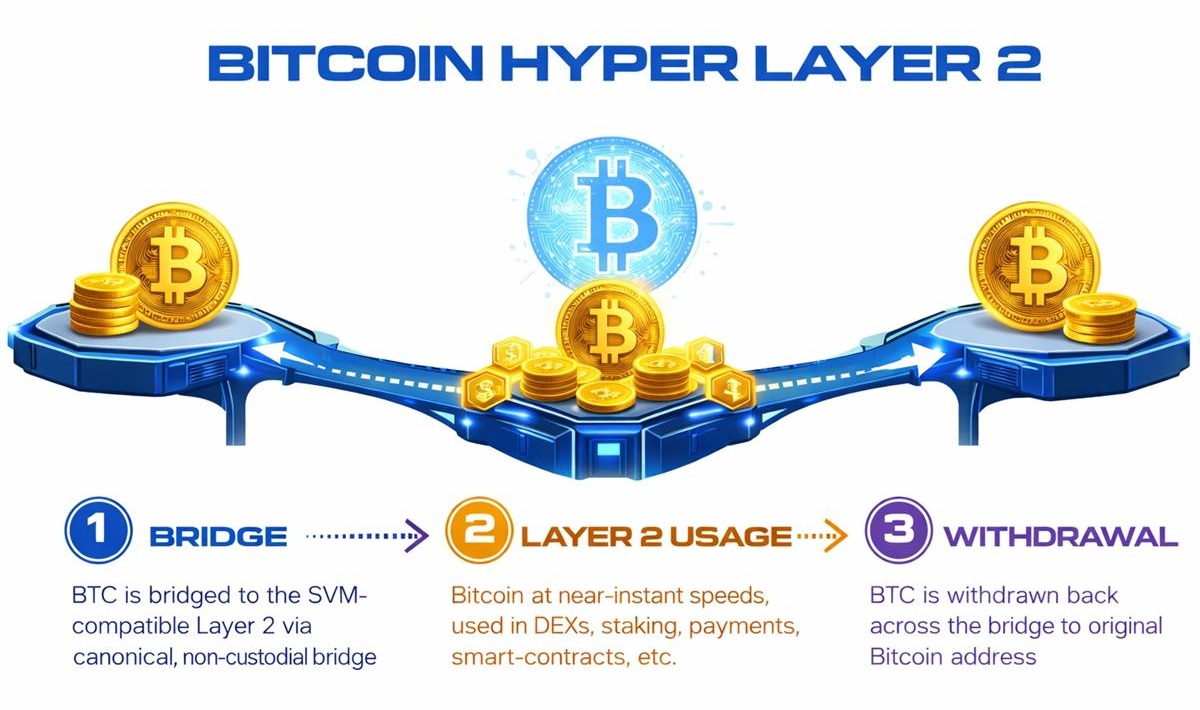
Can Bitcoin gain modern features without losing what makes BTC fundamentally different from everything else? That is the question being tackled by Bitcoin Hyper (HYPER), which has taken one of the more ambitious approaches. HYPER's Layer 2 combines Bitcoin settlement with a Solana Virtual Machine-compatible environment, making BTC usable at speeds much closer to those of modern blockchain networks without affecting the core chain.
The idea is gaining traction: the presale has already raised more than $33 million, with HYPER currently priced at $0.01368.
Bitcoin Solved Scarcity Before It Solved Speed
Bitcoin's limited throughput is not a design failure. The network was built to prioritize decentralization, security, and the ability to independently verify its ledger. Increasing raw transaction capacity on the main chain comes with trade-offs, which is one reason Bitcoin has resisted changing its base to compete with faster blockchains.
That approach worked extraordinarily well for creating digital scarcity, and it means Bitcoin can move billions of dollars in value without relying on a bank, government, or payment company. Its fixed supply has also helped turn BTC into an asset increasingly treated as digital gold.
Everyday payments, however, are a different challenge. Someone buying groceries does not want to stand at the checkout waiting ten minutes for a Bitcoin block to be processed. A trader using an on-chain exchange expects orders to settle quickly, while lending markets and decentralized applications require transactions to occur near-instantly, free of network congestion.
Bitcoin's roughly seven transactions per second were never designed for that kind of experience – but Layer 2 networks offer another route: leave Bitcoin's base layer alone and move activity somewhere built specifically for speed. It is a route Bitcoin has walked before: the Lightning Network has focused on fast, low-cost BTC payments, while projects like Stacks and the Liquid sidechain have explored extending Bitcoin with additional functionality. Bitcoin Hyper enters a growing field of efforts to make the world's largest cryptocurrency more usable without altering its base layer.
Bitcoin Hyper Uses SVM Execution to Get Around the Bottleneck
Bitcoin Hyper's core concept – already drawing market attention with a massive raise – separates execution from settlement. Rather than trying to make the Bitcoin main chain process thousands of transactions every second, the project's Layer 2 is an environment compatible with the Solana Virtual Machine (SVM).
Bitcoin can therefore continue doing what it does best – providing a highly secure underlying ledger – while the Layer 2 enables thousands of transactions per second, bringing speed and sub-cent fees to Bitcoin.
BTC brought into the Bitcoin Hyper environment can then be used for real-world payments, trading, lending, and decentralized applications, without waiting for every interaction to complete on the Bitcoin main chain. In practical terms, the goal is to make Bitcoin usable somewhere as ordinary as a supermarket or coffee shop.
Activity on the Layer 2 is ultimately batched and committed back to Bitcoin, and developers gain access to an SVM-compatible environment far better suited to programmable applications than Bitcoin's deliberately slow base chain. The choice of the SVM also taps into an existing developer ecosystem: smart contract tooling built for Solana can, in principle, be adapted for the Layer 2, which may lower the barrier for teams already familiar with that environment.
Enormous value already sits in Bitcoin across wallets, institutions, funds, and corporate balance sheets, and Bitcoin Hyper asks what happens if more of that BTC can become useful. Bitcoin solved scarcity – HYPER wants to create convenience.
Bitcoin's 7 TPS Limit Could Make HYPER One of the Best Cryptos to Buy
The HYPER token powers the Layer 2 itself, serving as the network's gas token for transactions and smart contract execution, while holders can also stake HYPER and participate in governance. Presale staking currently offers 35% APY.
The token is priced at $0.01368, and more than $33 million has been raised ahead of public listings on exchanges.
Hyper is the future. 33M Raised! pic.twitter.com/lOKtlYvAlq
— Bitcoin Hyper (@BTC_Hyper2) August 6, 2026
That is a sizeable result for a project focused entirely on a problem Bitcoin has carried since its earliest days – and if the project succeeds, it could force a rethink of Bitcoin as a whole. Right now, Ethereum, Solana, and other chains are winning the payment narratives. HYPER wants to give the king back its crown.
As with any presale-stage project, key milestones ahead include the Layer 2 mainnet rollout, delivery on the promised transaction throughput and fees in live conditions, and the planned exchange listings – all of which will show whether the technology performs as described.
Source: ICO Bench
