Bitcoin Consolidates Below $66,000 After 13% July Rebound Stalls
Key Takeaways
- •Bitcoin remained range-bound between $64,000 and $66,800 for a third straight session after recovering over 13% from its July 1 trough of $57,750.
- •Bitcoin futures open interest fell to 743,000 BTC from earlier weekly highs above 760,000 BTC, suggesting recent price weakness stems from long liquidations rather than aggressive new short positioning.
- •Ethereum derivatives diverged from Bitcoin, with ETH open interest increasing during the overnight decline and its cumulative volume delta remaining positive, indicating continued buyer engagement.
- •Bitcoin's 30-day implied volatility index climbed for a fifth consecutive day, a pattern that has historically correlated with potential price pullbacks since the launch of spot ETFs.
- •WLFI, a token linked to the Trump family, was the top performer with a 12.18% gain, pushing its market capitalization back to $2 billion.
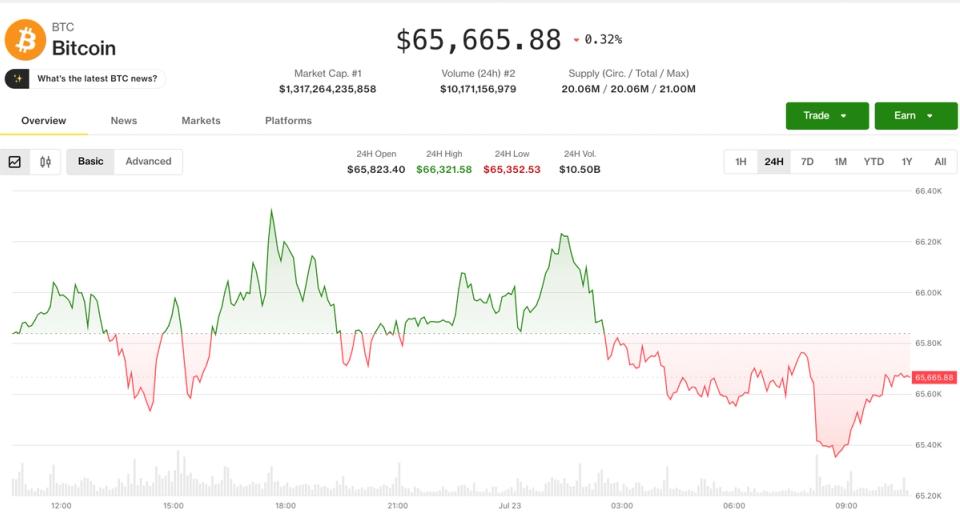
Bitcoin traded in a narrow range on Thursday, holding between $64,000 and $66,800 for a third consecutive session after gaining more than 13% from its July 1 low of $57,750. The latest price action followed Tuesday’s unsuccessful attempt to break convincingly above the $66,000 resistance level, suggesting the market is waiting for a fresh catalyst before establishing its next direction.
The broader crypto market remained in consolidation mode. Bitcoin (BTC) was down a modest 0.62% since midnight UTC at $65,674, while the asset continued to move within the $64,000 to $66,800 band that has contained trading over the past week. For traders, that range has become the immediate reference point: a sustained move outside it would offer clearer evidence that momentum is shifting, while continued trading inside it points to indecision after July’s rebound.
Traditional markets provided limited directional signals. Nasdaq 100 and S&P 500 futures were both lower by about 0.3%, the dollar index (DXY) was broadly flat, and gold and silver pulled back after Wednesday’s safe-haven rally. The combination left crypto without a clear macroeconomic tailwind or headwind.
The market’s pause comes after bitcoin’s more than 13% rally from the July 1 low. With the Tuesday move above $66,000 failing to hold convincingly, near-term trading has shifted toward sideways consolidation rather than a sharp move in either direction. That matters for the rest of the digital asset market because bitcoin often sets the tone for liquidity and risk appetite across large-cap tokens and smaller altcoins.
Derivatives positioning
The crypto futures market also showed signs of stasis. Twenty-four-hour trading volumes were down just 1% at $147 billion, while open interest (OI) held steady near $111 billion. The 24-hour long-short ratio, which measures taker volume, was nearly balanced. Taker volume refers to buy and sell trades executed immediately at prevailing market prices, and the current balance indicates a lack of aggressive directional conviction among traders.
Bitcoin futures open interest has fallen back to 743K BTC from highs above 760K BTC earlier this week. The decline points to an unwinding of existing positions as the rally stalls and valuations ease slightly. One possible positive interpretation for bullish traders is that the drop in OI suggests the price weakness is being driven by long liquidations rather than a wave of new short positions betting on a deeper decline.
ETH open interest, by contrast, increased during the overnight price decline. Even so, the price action continued to be led by buyers using market orders rather than passive limit orders, as shown by ETH’s positive 24-hour OI-adjusted cumulative volume delta (CVD). The divergence between BTC and ETH positioning shows that traders were not treating the overnight pullback uniformly across the two largest crypto assets.
Across altcoins, aggressive trading flows were mixed. ZEC, HBAR, LTC, AVAX and SUI were among the coins posting positive CVDs, indicating taker-buy pressure. At the same time, several prominent tokens, including BTC, XLM, DOGE and SHIB, showed negative CVDs, signaling that aggressive sellers remained active in those markets.
Bitcoin’s 30-day implied volatility index, BVIV, rose for a fifth consecutive day. Since the launch of spot ETFs, bitcoin’s spot price and BVIV have maintained a consistently negative correlation. Under that pattern, an increase in BVIV has often served as a warning sign for a possible price decline. Ether’s volatility index, EVIV, remained relatively stable.
Options flows on Deribit and through the OTC desk Paradigm showed notable demand for the BTC $70,000 call option expiring Aug. 7. Some traders positioned for upside while others bought longer-duration puts as downside hedges. Ethereum options also saw broad demand for upside exposure. More broadly, market fear appeared to be fading as put-call skews for both BTC and ETH moved toward zero. ETH’s one-week skew briefly turned negative on Wednesday, marking a temporary bullish shift in sentiment in which calls became more expensive than puts.
Token talk
WLFI was the strongest mover on Thursday, rising 12.18% to $0.063. The Donald Trump family-linked token has recovered to a $2 billion market capitalization, though it remains far below its all-time high.
MORPHO extended its recent gains, rising nearly 4% to $1.989 and remaining among the more consistent AI outperformers of the past two weeks.
Ethena (ENA) gained 2% to $0.092, continuing a quiet recovery that has seen it outperform most DeFi peers over the past week, even as it remains more than 90% below its September 2025 peak.
Lighter (LIT) continued to decline, falling 2.96% as profit-taking weighed on the token for a third straight session following its rally of more than 200% between May and early July.
CoinMarketCap’s altcoin season indicator remained at 51/100 as the market awaited a more decisive move from bitcoin. The neutral reading was consistent with Thursday’s mixed token flows, with selective strength in individual names but no broad confirmation that altcoins were taking leadership from BTC.

