Crypto Stabilizes as Institutional Banking and CFTC Attention Shifts
Key Takeaways
- •Taurus has connected commercial banking systems to SWIFT's shared ledger, allowing member banks to process tokenized deposit transactions continuously without modifying their existing real-time gross settlement environments.
- •A pilot group of 17 institutions, including HSBC, Citi, and Standard Chartered, is testing the tokenized workflows, and HSBC and Standard Chartered have executed the ledger's first live cross-border transfer.
- •Advocacy groups linked to Hyperliquid's perpetual derivatives ecosystem filed a joint petition with the CFTC seeking approval for 24/7 energy perpetual futures on WTI Crude, Brent Crude, and Henry Hub Natural Gas under the existing Commodity Exchange Act.
- •The Hyperliquid Policy Center reported that in nearly 75% of analyzed weekend market closures, oil perpetual prices on decentralized venues predicted Sunday opening prices more accurately than Friday's legacy settlement benchmarks.
- •Glassnode data shows Bitcoin testing a supply wall near the $80,000 level, which closely matches the aggregate cost basis of US spot ETF holders, while Solana has risen above $100 and Ethereum remains above $2,500.
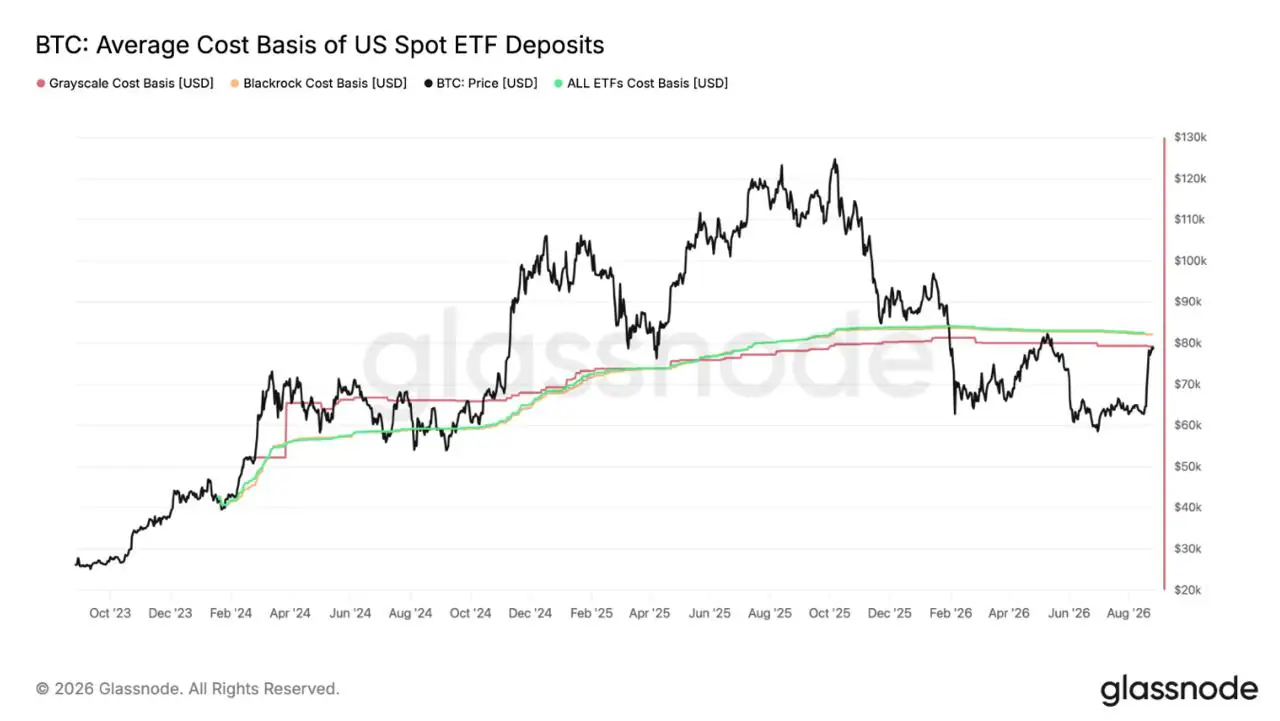
With Bitcoin holding firm around $79,600, market attention has shifted away from short-term spot dynamics toward major infrastructure developments in traditional finance and regulatory policy. The move underscores how crypto market structure is increasingly being shaped not just by price action, but by the plumbing that determines how assets, collateral, and liquidity can move across banking and derivatives systems.
Despite that shift, on-chain data from Glassnode shows BTC continuing to test a strong supply wall around the key $80,000 psychological threshold. That price zone closely matches the aggregate cost basis of US spot ETF holders, creating heavy overhead resistance as institutional buyers seek to de-risk or return to breakeven after recent market volatility.
While spot markets face technical resistance, institutional adoption is advancing at the infrastructure level. Swiss digital asset infrastructure provider Taurus recently finalized a direct integration connecting commercial banking systems with SWIFT’s shared ledger framework. At the same time, the push for continuous, round-the-clock liquidity is extending into derivatives markets, where decentralized finance advocates have formally asked federal regulators to bring perpetual futures into traditional energy markets.
Institutional Banking Integrates SWIFT Shared Ledger
Taurus’s integration allows member financial institutions to process tokenized commercial bank deposit transactions continuously without overhauling underlying real-time gross settlement, or RTGS, environments. Built to interoperate with SWIFT’s shared ledger architecture — unveiled at Sibos and designed alongside 40 global financial institutions — the system serves as a coordination layer for bank-to-bank asset movement.
The framework keeps tokenized liabilities directly on participating institutions’ balance sheets rather than moving funds into third-party, uncollateralized stablecoins. Existing Taurus clients can deploy the connectivity within days, while institutions that are not blockchain-native can connect through EVM-compatible node arrangements.
A pilot group of 17 first-mover banking institutions, including HSBC, Citi, and Standard Chartered, has already begun testing these tokenized workflows. Standard Chartered and HSBC recently completed the ledger’s first live cross-border transfer, showing that institutional liquidity can move continuously outside legacy banking hours while still meeting compliance, anti-money-laundering, and balance-sheet requirements. That kind of settlement design matters for banks that want faster transfer finality without abandoning existing controls, especially as tokenized deposits and shared ledgers move from pilot environments toward live transaction flows.
Hyperliquid Submits CFTC Petition for Commodity Perps
Reflecting similar developments in banking infrastructure, advocacy groups tied to Hyperliquid’s perpetual derivatives ecosystem have filed a joint petition with the US Commodity Futures Trading Commission (CFTC). The filing offers regulatory recommendations to allow 24/7 energy perpetual futures contracts in the United States under the existing Commodity Exchange Act framework.
The submission focuses on WTI Crude, Brent Crude, and Henry Hub Natural Gas contracts, and proposes continuous cash settlement backed by stablecoins or tokenized US Treasuries as eligible collateral. Advocates say perpetual structures improve price discovery during off-market hours and weekend geopolitical events, when traditional trading venues such as CME and ICE are closed.
Citing market data, the Hyperliquid Policy Center said that in nearly 75% of analyzed weekend market closures, oil perpetual prices on decentralized venues predicted Sunday opening prices more accurately than Friday’s legacy settlement benchmarks. By allowing programmatic, real-time margin adjustments on-chain, institutional hedgers can manage energy exposure around the clock without taking on weekend gap risk. The filing now places the discussion squarely in the hands of regulators, who will have to weigh whether existing futures rules can accommodate continuous trading formats without changing the basic market oversight framework.
Market Overview and Asset Snapshot
As institutional infrastructure advances, spot prices across major trading pairs have largely stabilized. Bitcoin has recovered above the $79,500 threshold, Solana has surged past $100, and Ethereum remains above $2,500. Meanwhile, Hyperliquid’s native token HYPE continues to trade near $82 alongside expanding derivatives volume.
Key Triggers to Watch Next
Market participants are watching several milestones in the coming sessions:
- SWIFT Production Transactions: Initial live transaction volumes across Taurus-connected banks on the SWIFT ledger are expected within days.
- CFTC Public Ruling: The market is awaiting official regulatory feedback or a public consultation opening regarding 24/7 continuous commodity perpetuals.
- Bitcoin Resistance Retest: Traders are watching whether BTC can hold support at $79,500 and build momentum toward the key $80,000 psychological level.
