Bitcoin Steadies Near $78K as Middle East Tensions Rise and ETF Flows Turn Mixed
Key Takeaways
- •Bitcoin returned 23% in August, outperforming gold (9%) and the Nasdaq (4%) as the month's strongest asset class.
- •Spot Bitcoin ETFs recorded $201.9M in net outflows on August 28, ending a nine-session run of positive inflows that had reached $242.3M the previous day.
- •Large holders accumulated more than 39,154 BTC, roughly $3 billion, over the past seven days, diverging from negative ETF flows.
- •BlackRock's spot Bitcoin and Ethereum ETFs collectively drew over $1.58 billion in the prior week, and Ethereum ETFs logged $102.1M in inflows on August 28, their tenth straight positive session.
- •Analysts identify resistance at $79,400–$80,800 and support near $75,000–$77,000, with hawkish Fed remarks pricing a 58% chance of a September rate hike.
Key Highlights
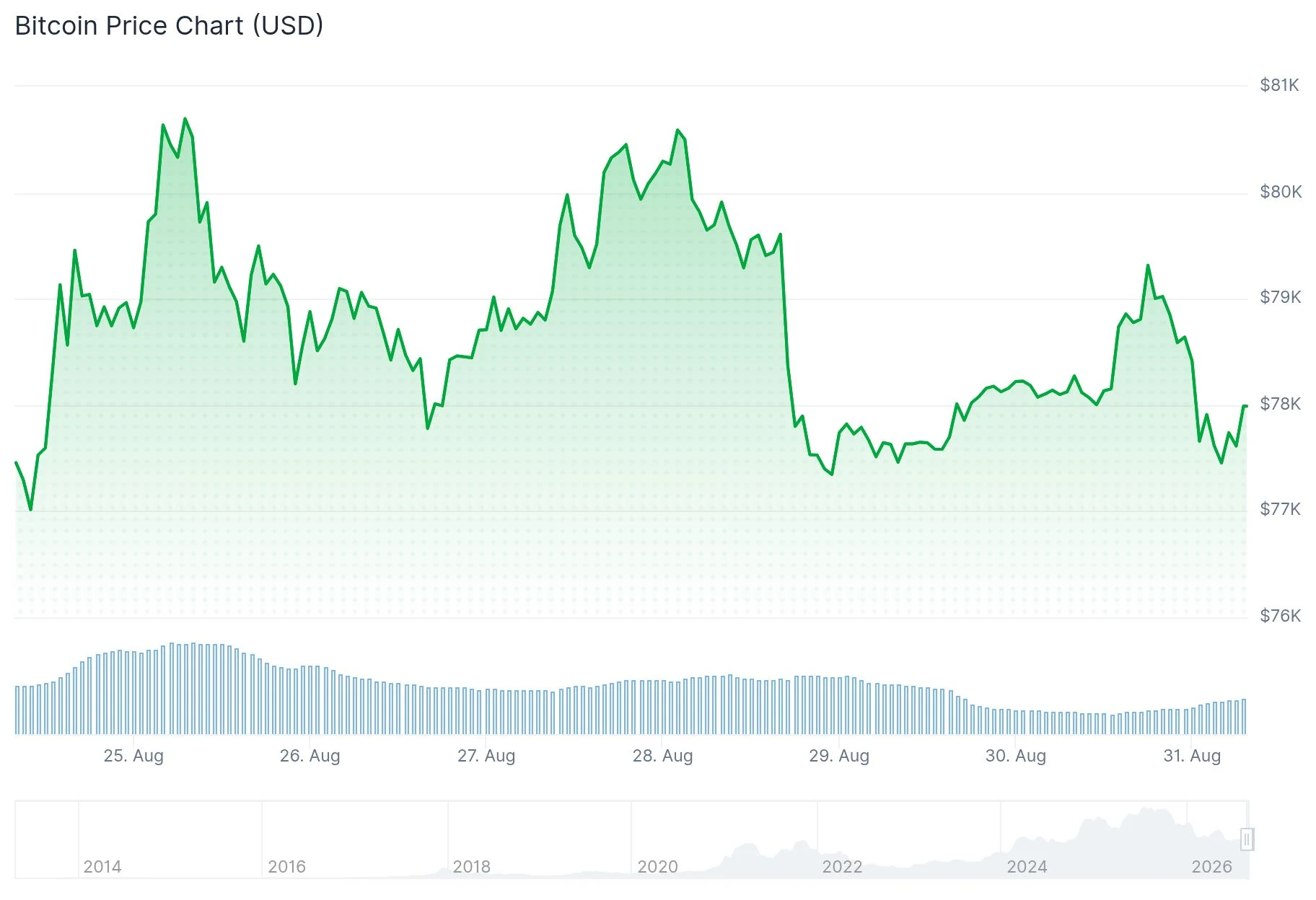
- BTC held steady within the $77,580–$78,800 range as U.S.-Iran conflict pushed oil prices roughly 2% higher
- Bitcoin was August's top-performing asset with 23% gains, outpacing gold's 9% rise and the Nasdaq's 4% advance
- After $242.3M in ETF inflows on Aug 27, Bitcoin ETFs saw $201.9M in outflows on Aug 28, ending a nine-session positive streak
- BlackRock's spot Bitcoin and Ethereum ETFs accumulated more than $1.58B over the previous seven days
- Critical resistance sits at $79,400–$80,800; key support zones are near $77,000–$75,000
The world's leading cryptocurrency has held its position between $77,580 and $78,800 as new geopolitical developments unfolded across global markets. Following a U.S. military strike on an Iranian island in the Strait of Hormuz—a critical passage for global oil transport—energy markets reacted sharply. WTI crude oil surged nearly 2% to $85.10 per barrel, while Brent crude advanced to $92.39. The Strait of Hormuz handles a significant share of the world's seaborne petroleum trade, which is why military activity near the waterway routinely feeds into global energy prices and broader risk sentiment.
Gold, meanwhile, slipped 0.8% to settle at $4,418 per ounce, and Nasdaq futures fell 0.5%. Bitcoin, by contrast, showed notable stability with minimal price movement—behavior more consistent this session with its growing integration into mainstream portfolios than with its earlier reputation as a purely risk-off-independent asset.
Over the course of August, BTC has delivered a commanding 23% return, making it the month's strongest-performing asset class. In the same period, gold gained 9% while the technology-heavy Nasdaq managed only a 4% advance.
Market analyst Ted Pillows observed on X that Bitcoin remains "hovering around the $78,000 level" with weakening momentum indicators, suggesting a potential pullback to $74,000 before BTC can mount another challenge above $81,000.
bitcoin:native is hovering around the $78,000 level. Momentum is weakening a bit, which shows the correction isn't over yet. IMO, BTC will tap the $74,000 zone before it breaks above $81,000 again. pic.twitter.com/FhyWt9IfnR — Ted (@TedPillows) August 30, 2026 (https://x.com/TedPillows/status/2093991706190324139?ref_src=twsrc%5Etfw)
On-chain data tells a contrasting story. On-chain specialist Ali Charts documented that large-scale investors acquired more than 39,154 BTC—approximately $3 billion in value—over the past seven days. When whales accumulate while ETF flows turn negative, it points to divergent behavior between large self-custodied holders and exchange-traded fund investors—two distinct sources of demand that do not always move together.
Bitcoin ETF Investment Patterns Turn Volatile
Data from Farside Investors shows spot Bitcoin exchange-traded funds registered $242.3 million in net inflows on August 27. That positive momentum reversed sharply on August 28 with $201.9 million in outflows, ending a nine-day consecutive inflow period. Since their U.S. launch in January 2024, spot Bitcoin ETFs have become one of the largest structural channels for institutional exposure to BTC, which is why daily flow prints like these are now closely watched as a gauge of demand.
$3 BILLION IN BITCOIN BOUGHT BY WHALES. Whales accumulated more than 39,154 bitcoin:native over the past week, signaling continued interest by large investors. pic.twitter.com/vEPbSJiv73 — Ali Charts (@alicharts) August 30, 2026 (https://x.com/alicharts/status/2094014780482769184?ref_src=twsrc%5Etfw)
Ethereum ETFs behaved differently, recording $102.1 million in net inflows on August 28—their tenth consecutive session of positive flows.
Investment giant BlackRock's spot Bitcoin and Ethereum ETF products collectively attracted more than $1.58 billion over the previous week. Strategy's Michael Saylor shared his Bitcoin tracking metrics on August 30 with the message "We're back," suggesting the company may be preparing another acquisition. Strategy has historically used debt and equity issuance to fund Bitcoin purchases, and its posts of this kind have preceded disclosed BTC acquisitions in the past.
Critical Economic Indicators to Watch This Week
Federal Reserve Chair Kevin Warsh delivered hawkish remarks at Jackson Hole. His assessment indicated that inflation remains above target levels and that current monetary conditions are not sufficiently restrictive. Market pricing now reflects a 58% probability of an interest rate increase in September. Tighter monetary policy is widely viewed as a headwind for risk assets, including cryptocurrencies, because higher rates reduce liquidity and pressure valuations across markets.
BREAKING: Fed Chair Kevin Warsh sounded hawkish at Jackson Hole – Inflation is still too high – The 2% target remains the priority – The economy is still strong – Rates may not be restrictive enough – Rate cuts could be harder to come by. Bottom line: September rate-cut… pic.twitter.com/7UuqM0vqZy — ardizor (@ardizor) August 28, 2026 (https://x.com/ardizor/status/2093341086026465339?ref_src=twsrc%5Etfw)
The upcoming economic calendar features several key releases: ISM Manufacturing PMI alongside JOLTS job openings data on Tuesday, ADP employment figures and the Federal Reserve Beige Book on Wednesday, and the comprehensive nonfarm payrolls report on Friday. These labor and activity prints feed directly into the Fed's rate decision, making them the next scheduled catalysts for crypto and broader markets.
Vikram Subbaraj, CEO of Giottus, indicated that Bitcoin maintains critical support around $77,000 while facing notable resistance between $79,400 and $80,800. A daily close above $81,800 would open a pathway toward the $85,000 target, while a break below the $75,000 support level could expose Bitcoin to a decline toward $70,000.
The ETF outflow recorded on August 28 marked the end of nine consecutive sessions of positive flows, introducing a more cautious outlook as markets transition into September—historically a month in which risk assets have seen muted or negative returns.
