Bitcoin (BTC) Price: BTC Holds Near $78,000 As Geopolitical Tensions Rise and ETF Flows Shift
Key Takeaways
- •Bitcoin gained 23% in August, outperforming gold (up 9%) and the Nasdaq (up 4%) to lead all major assets for the month.
- •Spot Bitcoin ETFs recorded $242.3 million in inflows on August 27, but $201.9 million in outflows on August 28 ended a nine-day streak of positive flows.
- •On-chain data shows whales accumulated more than 39,154 BTC, worth roughly $3 billion, over the past week.
- •Fed Chair Kevin Warsh struck a hawkish tone at Jackson Hole, and markets now price a 58% chance of a September rate hike, a potential headwind for Bitcoin.
- •Technically, Bitcoin faces resistance at $79,400–$80,800 with support near $77,000, and losing $75,000 could open a path to $70,000.
Key Points
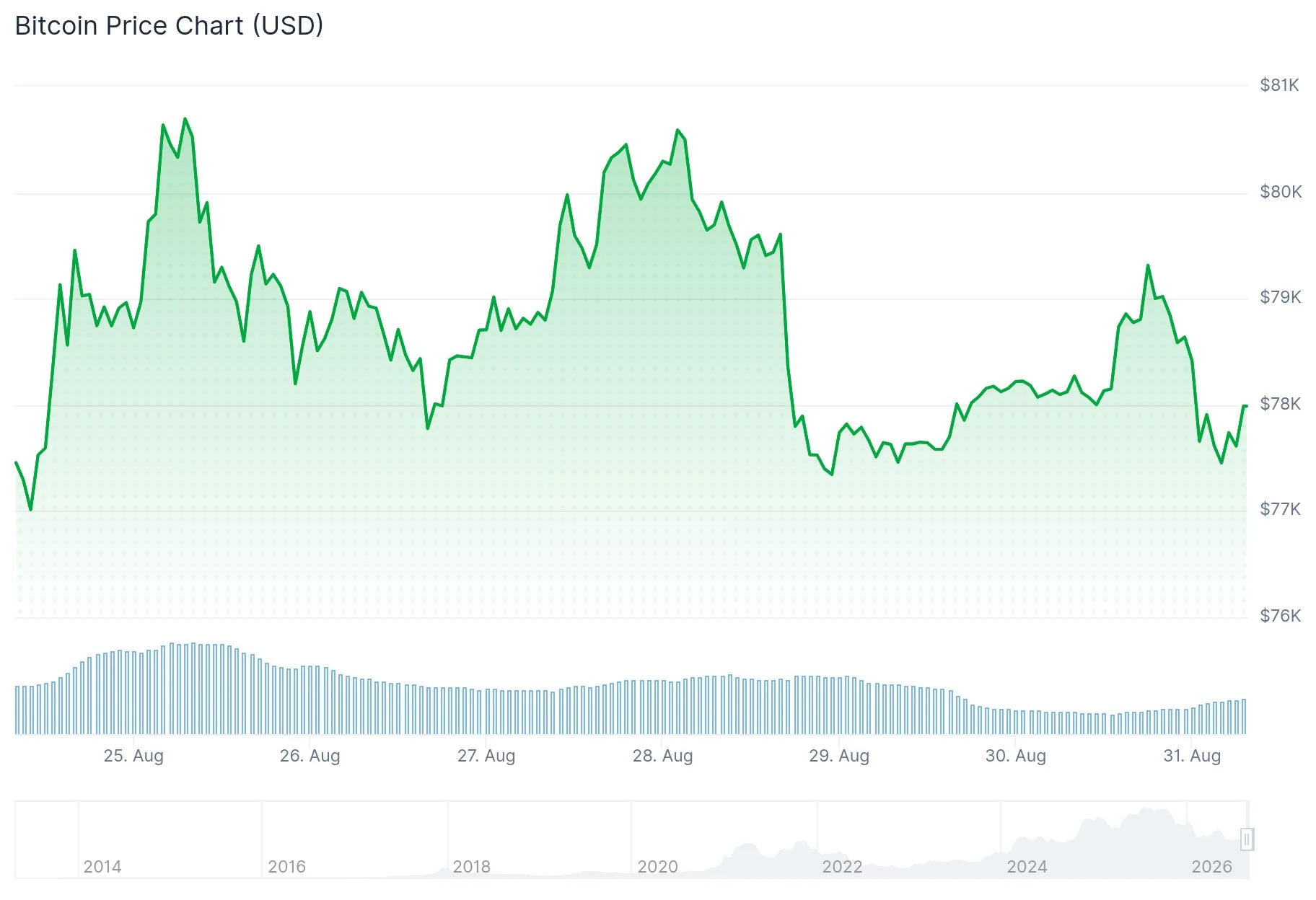
- Bitcoin held near $77,580–$78,800 despite U.S.-Iran tensions pushing oil prices up nearly 2%.
- BTC is August's best-performing asset, up 23% versus gold's 9% and Nasdaq's 4%.
- Bitcoin ETFs saw $242.3M in inflows on Aug 27, followed by $201.9M in outflows on Aug 28, ending a nine-day inflow streak.
- BlackRock's spot Bitcoin and Ethereum ETFs attracted over $1.58B in the past week.
- Key resistance sits at $79,400–$80,800; support near $77,000–$75,000.
Bitcoin is holding steady in the $77,580 to $78,800 range even as fresh geopolitical tension entered the market. The U.S. struck an Iranian island in the Strait of Hormuz, a key oil tanker route. Oil prices jumped in response, with WTI crude rising nearly 2% to $85.10 and Brent climbing to $92.39.
Gold dropped 0.8% to $4,418 per ounce, while Nasdaq futures slipped 0.5%. Bitcoin, by contrast, barely moved. The Strait of Hormuz is one of the world's most heavily trafficked chokepoints for seaborne oil, which is why flare-ups there tend to ripple quickly through energy prices — and, in past episodes such as Middle East conflicts in 2024 and 2025, through broader risk sentiment as well.
BTC has gained 23% in August, making it the top-performing asset of the month. Over the same period, gold gained 9% and the Nasdaq rose 4%. That outperformance comes even though Bitcoin is often traded as a high-beta risk asset, and the month's gains have unfolded against a backdrop of continued institutional adoption — most visibly through the U.S. spot ETF channel launched in January 2024, which has since become a persistent structural source of demand when flows are positive.
Analyst Ted Pillows noted on X that Bitcoin is "hovering around the $78,000 level" and that momentum is weakening. He suggested BTC could dip to $74,000 before breaking above $81,000 again.
bitcoin:native is hovering around the $78,000 level. Momentum is weakening a bit, which shows the correction isn't over yet. IMO, BTC will tap the $74,000 zone before it breaks above $81,000 again. pic.twitter.com/FhyWt9IfnR — Ted (@TedPillows) August 30, 2026
Whale activity tells a different story. On-chain analyst Ali Charts reported that whales accumulated over 39,154 BTC — worth roughly $3 billion — in the past week. Large-holder accumulation of this kind is typically read by on-chain analysts as a sign that bigger investors are absorbing supply during consolidations rather than distributing into them.
ETF Flows Show Mixed Signals
Spot Bitcoin ETFs brought in $242.3 million on August 27, according to Farside Investors. That streak ended on August 28, when outflows hit $201.9 million, snapping nine straight days of positive flows.
$3 BILLION IN BITCOIN BOUGHT BY WHALES — Whales accumulated more than 39,154 bitcoin:native over the past week, signaling continued interest by large investors. pic.twitter.com/vEPbSJiv73 — Ali Charts (@alicharts) August 30, 2026
Ethereum ETFs moved in the opposite direction, pulling in $102.1 million on August 28 — their tenth straight day of inflows. Because spot ETF creations and redemptions translate directly into Bitcoin buying and selling, these daily flow prints have become one of the most closely watched demand indicators for BTC since the products launched.
BlackRock's spot Bitcoin and Ethereum ETFs attracted over $1.58 billion combined in the past week. Separately, Michael Saylor posted his Bitcoin tracker on August 30 with the message "We're back," hinting at another Strategy purchase. Strategy, the software firm formerly known as MicroStrategy, is the largest corporate holder of Bitcoin and has used successive debt- and equity-funded purchases to add to its position since 2020.
What Macro Data Could Move BTC This Week
Fed Chair Kevin Warsh spoke at Jackson Hole and struck a hawkish tone. He said inflation is not yet under control and that current financial conditions are not restrictive enough. Markets now price in a 58% chance of a rate hike in September. Tighter monetary policy historically weighs on liquidity-sensitive assets, and Bitcoin has often traded in sympathy with rate expectations since ETFs tied institutional flows more directly to macro conditions.
🚨 BREAKING: 🇺🇸 Fed Chair Kevin Warsh sounded hawkish at Jackson Hole – Inflation is still too high – The 2% target remains the priority – The economy is still strong – Rates may not be restrictive enough – Rate cuts could be harder to come by. Bottom line: September rate-cut… pic.twitter.com/8UuqM0vqZy — ardizor 🧙♂️ (@ardizor) August 28, 2026
This week's economic calendar includes ISM Manufacturing PMI and JOLTS job openings on Tuesday, ADP payroll data and the Fed Beige Book on Wednesday, and nonfarm payrolls on Friday. The nonfarm payrolls report in particular is a recurring volatility catalyst across risk assets, as it feeds directly into rate-expectation repricing ahead of the Fed's September meeting.
On the technical picture, Giottus CEO Vikram Subbaraj said Bitcoin has immediate support near $77,000, with resistance between $79,400 and $80,800. A daily close above $81,800 would be needed to target $85,000, while losing $75,000 support could open the door to $70,000.
The most recent ETF outflow on August 28 ended nine consecutive positive sessions and introduced caution heading into September — a month in which Bitcoin has historically posted mixed returns, including declines in September 2024 and 2025 after weaker summer stretches.
Source: CoinCentral
