Bitcoin Price Analysis Tracks $83,000 Support as Sequans Completes Treasury Exit
Key Takeaways
- •Sequans Communications sold its final 34 bitcoin in September, ending its corporate treasury strategy with no crypto assets or outstanding debt left on its balance sheet, a move the company framed as balance-sheet restructuring rather than a judgment on bitcoin.
- •Bitcoin changed hands near $84,165, about 33.2% below its October 2025 record of $126,080, yet remained up 3.64% over seven days and 8.85% across two weeks.
- •On-chain figures indicate around 16.3 million BTC, roughly 81% of circulating supply, has not moved in at least six months, so tests of the $83,000 level are being carried by a smaller pool of actively traded coins.
- •Corporate bitcoin strategies are diverging: Strategy returned to buying after summer sales, Strive lifted holdings to 25,000 BTC, while Empery Digital sold 1,400 BTC for about $87 million earlier in the year.
- •Technically, losing $83,000 could expose support between $80,000 and $81,144, while clearing resistance at $85,500-$86,000 would put the recent $87,374 rejection back in view, with daily moving averages still showing a bullish rating of 13 positive readings.
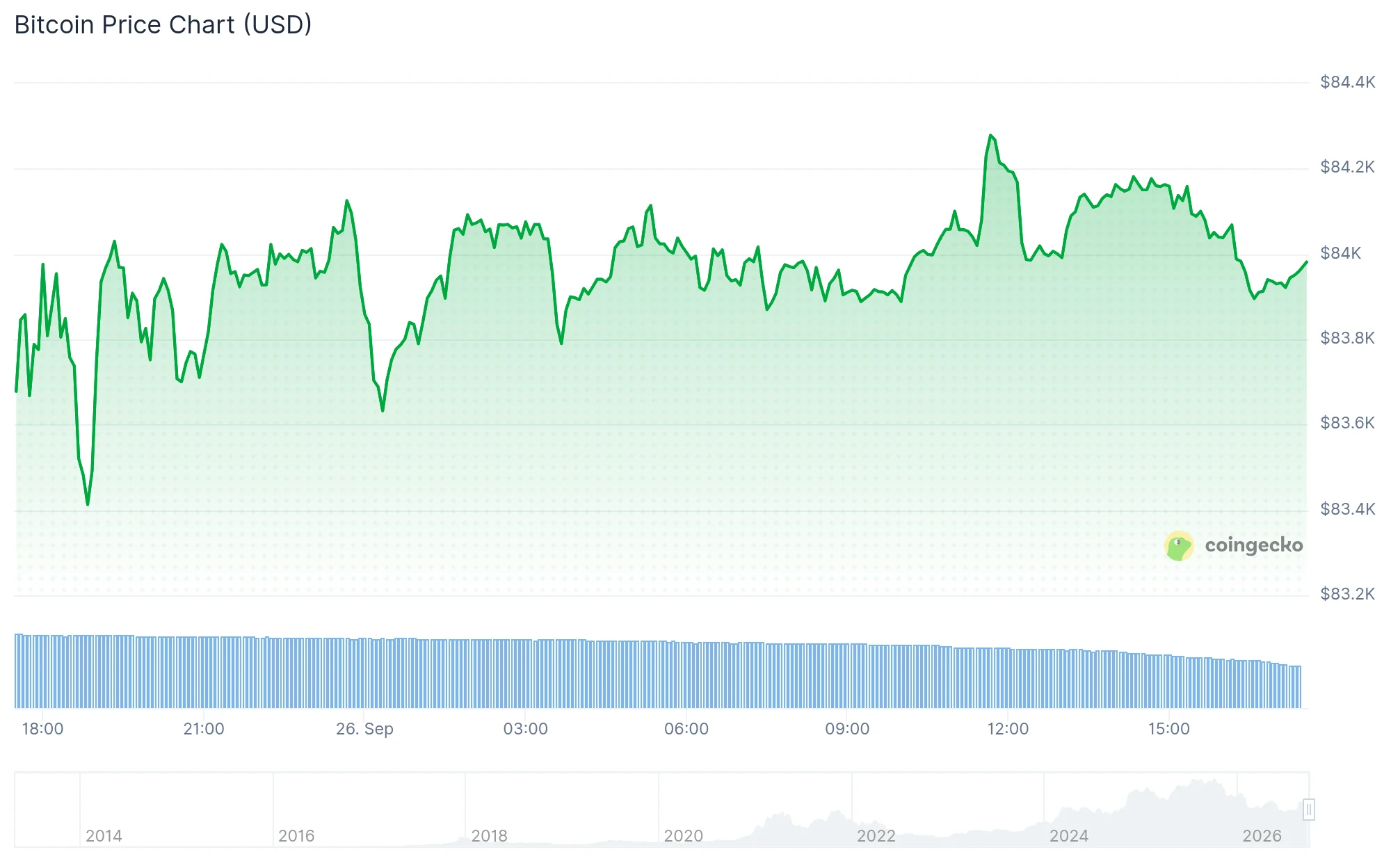
Bitcoin traded near $84,165 on Saturday, September 26, holding above the $83,000 support level that has become the market's immediate focal point after a recent pullback. The asset sits roughly 33.2% below its October 2025 record of $126,080, though it remains up 3.64% over the past seven days and 8.85% across the past two weeks.
The current picture combines two distinct signals: the completed wind-down of a corporate bitcoin treasury on one side, and on-chain data showing that a large share of bitcoin's supply has remained untouched for months on the other. The interplay between the two helps explain why the $83,000 level has drawn attention.
Sequans Completes Its Bitcoin Treasury Exit
Sequans Communications, a semiconductor company listed on the NYSE, sold its final 34 BTC in September, completing the staged exit from its bitcoin treasury strategy that the company began earlier this year. According to an official announcement, Sequans now reports no crypto assets on its balance sheet and no outstanding debt, aside from obligations tied to government-funded research programs.
Chief Executive Georges Karam said the company had monetized its holdings carefully and would now concentrate on a semiconductor growth strategy. Sequans framed the move as balance-sheet restructuring rather than a judgment against bitcoin.
The reduction began in May, when the company used bitcoin to redeem all of the convertible debt it had issued in July 2025, at which point it still held roughly 658 BTC. Holdings fell to 314 BTC by June 30, before the final 34 BTC were sold in September. When the wind-down was announced, Sequans said its treasury strategy had ended and that remaining bitcoin would be sold over time.
The wind-down traces a full arc for a corporate bitcoin position — treasury accumulation, use of the asset to retire debt, staged sales, and a clean exit — during the same stretch in which buyers such as Strategy and Strive were adding to their positions.
Underlying business results provide context for the pivot back to its core industry: second-quarter product revenue rose more than 80% year over year, and the company's six-month product backlog more than tripled.
Other Corporate Holders Take Different Paths
Sequans' decision does not reflect a uniform shift among public bitcoin holders. Satsuma Technologies dismantled its treasury vehicle, while Empery Digital sold 1,400 BTC for about $87 million earlier this year. Strategy departed from its buy-only policy with several consecutive sales over the summer, then resumed purchases in late August and again last week. Strive, by contrast, continued accumulating, reaching 25,000 BTC this month and buying an additional 1,355 BTC last week.
These examples underline that Sequans' exit is not a sector-wide move. Treasury decisions offer only one lens on broader market positioning: Sequans' exit reflects one company's balance-sheet priorities, while wallet data describe the behavior of the wider market. The companies' subsequent purchase and sale disclosures will show whether that divergence persists.
Dormant Supply and the $83,000 Test
Analyst Crypto Patel noted in an X post that about 16.3 million BTC — roughly 81% of circulating supply — had not moved for at least six months. The same post said long-term holders have added more than 3 million BTC since 2020.
Other on-chain figures show supply moving at the margins even as the bulk stays dormant. Roughly 300,000 BTC shifted out of older wallets in the first half of 2026, while retail holders reportedly sold about 140,000 BTC over the same period before buying back more than 107,000 BTC in the third quarter. Such figures describe supply movement rather than a fixed measure of sellable coins: dormant coins can move at any time, and wallet age alone does not reveal an owner's intentions.
With such a large share of supply stationary, day-to-day tests of levels like $83,000 are effectively carried by the smaller portion of coins actively changing hands — the untouched majority only becomes a factor if and when its holders choose to move.
Technical Levels in Focus
Bitcoin's 24-hour range ran from $83,230 to $84,662 after the price was rejected at $87,374. Market capitalization stood near $1.69 trillion, with daily trading volume at $27.86 billion.
For price analysis, $83,000 is the immediate level to watch. The $83,230 low sat just $230 above it, and break below could expose support between $80,000 and $81,144. On the upside, buyers face resistance between $85,500 and $86,000; reclaiming that zone would put the prior $87,374 rejection back in view.
Daily moving averages continue to show a bullish rating, with 13 positive readings. That technical score sits alongside a market still trading well below its October 2025 peak and a nearby support test. Holding $83,000 would preserve the current trading range, while a loss of the level could shift attention toward the lower support cluster.
This analysis was originally published by Blockonomi.

