Bitcoin Holds Near $78,000 as Older Coins and Weak Spot Demand Test Support
Key Takeaways
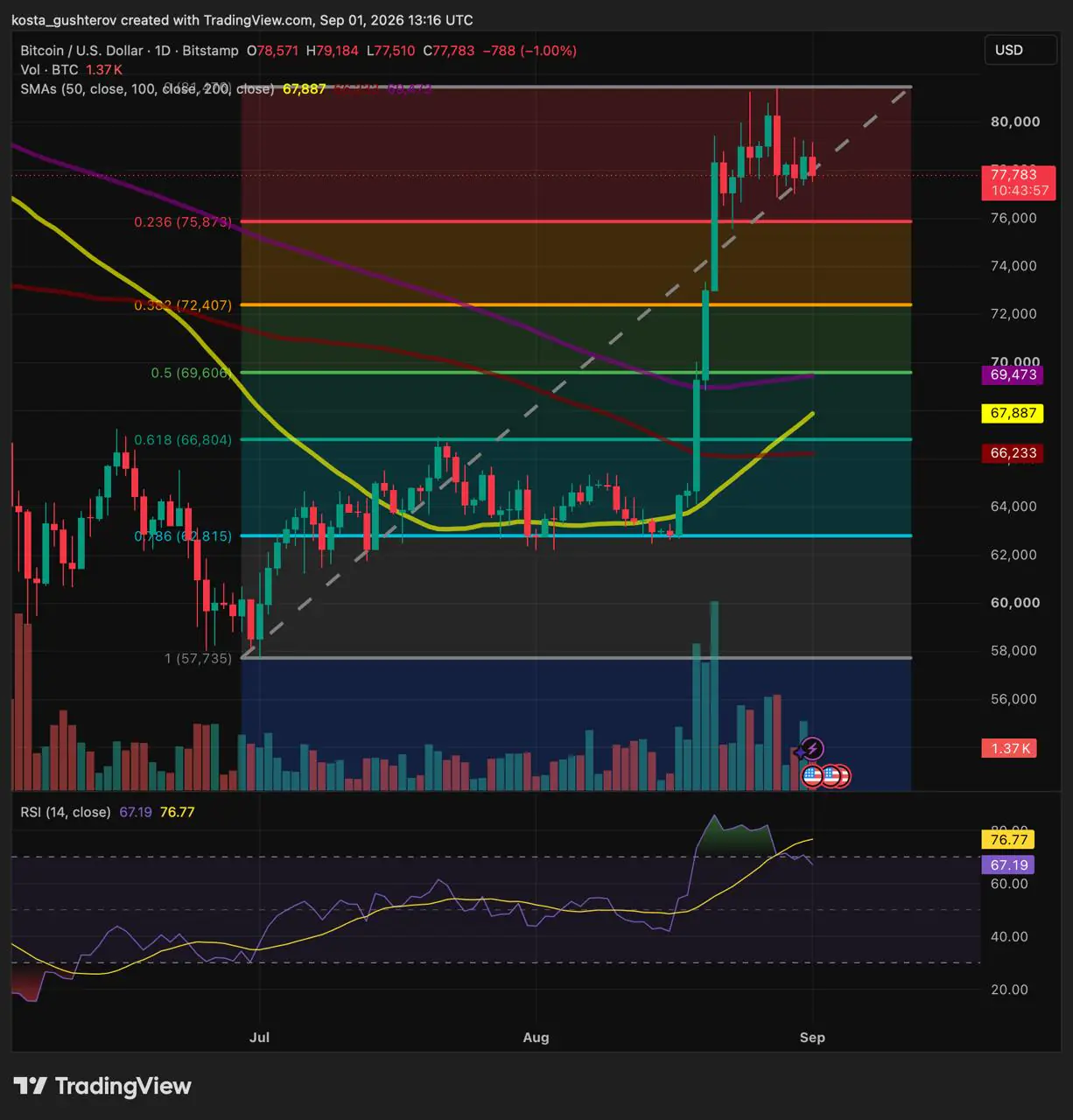
- •Bitcoin traded near $77,800 after reaching an intraday high of $79,180 and remained below the $80,000-$81,000 resistance area.
- •Nearest daily support was identified around $75,870, and Bitcoin continued to trade above its 50-day, 100-day, and 200-day simple moving averages.
- •CryptoQuant reported that long-term-holder distribution increased from 174,500 BTC to 281,900 BTC between August 18 and August 28, the highest reading since the start of 2026.
- •Spot-demand growth was negative for two consecutive sessions, while perpetual-futures demand growth stayed positive and rose in the latest reading.
- •A daily close above $80,000-$81,000 would be stronger if spot-demand growth returned above zero, while a break below $75,870 could expose support near $72,400.
Bitcoin remains above its nearest daily support as long-held coins become more active and spot-demand growth briefly turns negative, even while futures demand stays positive during the latest consolidation. The setup highlights a familiar split in crypto markets: price can hold up while the mix of participants behind that move changes, and that mix often matters when a rally runs into resistance.
Bitcoin is holding, but $80,000 remains unfinished business
Bitcoin traded near $77,800 around 13:30 UTC on September 1 after reaching an intraday high of $79,180. The price stayed below the recent resistance zone between $80,000 and $81,000, where multiple attempts to extend the recovery have stalled.
On the daily chart, nearest support was located at about $75,870, the 0.236 Fibonacci retracement of the move from $57,750. Bitcoin was also trading above its 50-, 100- and 200-day simple moving averages, which were positioned between roughly $66,200 and $69,500.
The daily RSI had eased to 67.19 after moving above 70 during the rally. Momentum has cooled, but the chart has not shown technical damage. Bitcoin is consolidating above support without yet reclaiming its recent highs.
Older coins became more active during the rally
According to CryptoQuant, the 30-day sum of long-term-holder distribution rose from 174,500 BTC to 281,900 BTC between August 18 and August 28, a gain of 61.5%. The August 28 reading was the metric’s highest since the beginning of 2026.
The measure tracks activity among coins held for longer periods; it does not mean 281,900 BTC were sent to exchanges or sold. Some of the movement may reflect profit realization, custody changes, or other transfers.
Bitcoin’s advance from about $64,000 toward $80,000 created a more attractive range for holders with accumulated gains. The increase in distribution suggests that some chose to act during that window. Price holding near $78,000 indicates that demand has so far absorbed those flows, but another push toward resistance will require that balance to continue.
Gate deposits raise the possibility of profit-taking
Retail-sized Bitcoin deposits to Gate increased shortly after the rally. Between August 23 and August 30, CryptoQuant recorded more than 11 notable spikes, with hourly deposits reaching $11.33 million on August 29, the highest level of 2026.
That caution has not been limited to Gate. Coindoo recently found that Binance reserves were rising while short-term holders realized modest profits. The newer readings bring long-term holders into the same supply-side discussion just as spot-demand growth has weakened.
Spot and futures demand growth are moving apart
CryptoQuant’s 30-day demand-growth measure fell below zero for spot trading during two consecutive sessions. Over the same period, perpetual-futures demand growth remained positive and increased in the latest reading.
That pattern points to stronger growth in derivatives positioning than in direct coin purchases. Futures let traders gain Bitcoin exposure without taking delivery of the asset, often with leverage. These positions can expand quickly during a rally, but they can also unwind faster when price moves against them.
That is why renewed spot participation matters for the quality of any breakout. Direct buyers must take ownership of the Bitcoin available in the market, creating a more durable counterweight when older holders or exchange users bring additional coins to market.
The sample remains short and overlaps with the end of August, when lower liquidity may have influenced the spot reading. Two negative sessions are not enough to establish a lasting demand shift. The concern would become more meaningful if spot-demand growth stayed below zero while holder distribution remained elevated.
The next breakout needs spot confirmation
The latest readings leave Bitcoin with three identifiable outcomes:
- Above $80,000-$81,000: A daily close through recent resistance would carry more weight if spot-demand growth also moved back above zero.
- Between $75,870 and $80,000: Bitcoin would remain in consolidation while the market waits for a clearer balance between available supply and direct demand.
- Below $75,870: A confirmed daily breakdown would weaken the recovery and expose the next Fibonacci support near $72,400.
Bitcoin has preserved its structure despite heavier activity from older coins. That is the constructive part of the current setup. The open question is who finances the next leg: buyers taking ownership of Bitcoin or traders adding leveraged exposure.
A breakout accompanied by positive spot-demand growth would answer that question more convincingly than another increase in futures activity alone.
This article is for informational purposes only and does not constitute financial or investment advice.
The post Bitcoin Holds $78K as Old Coins Test Spot Demand appeared first on Coindoo.
