Bitcoin Halving by the Numbers: Block Reward Cuts, Key Dates and Price History
Key Takeaways
- •Four Bitcoin halvings have occurred on November 28, 2012, July 9, 2016, May 11, 2020 and April 20, 2024, cumulatively reducing the block reward from 50 BTC to 3.125 BTC.
- •The next halving is projected for around April 2028 at block 1,050,000, when the reward will fall to 1.5625 BTC and daily issuance will drop to approximately 225 BTC.
- •Roughly 20,097,597 BTC of the 21 million-coin cap are already in circulation, leaving about 902,403 BTC to be mined.
- •Bitcoin gained 282%, 563% and 35% in the 12 months after the 2016, 2020 and 2024 halvings respectively, with cycle peaks arriving 17 to 18 months after each event at $19,650, $67,510 and $124,720.
- •Each post-halving peak was followed by a decline of 84%, 76.7% and 53.0%, with the 2024 cycle producing the smallest and shortest downturn at roughly nine months.
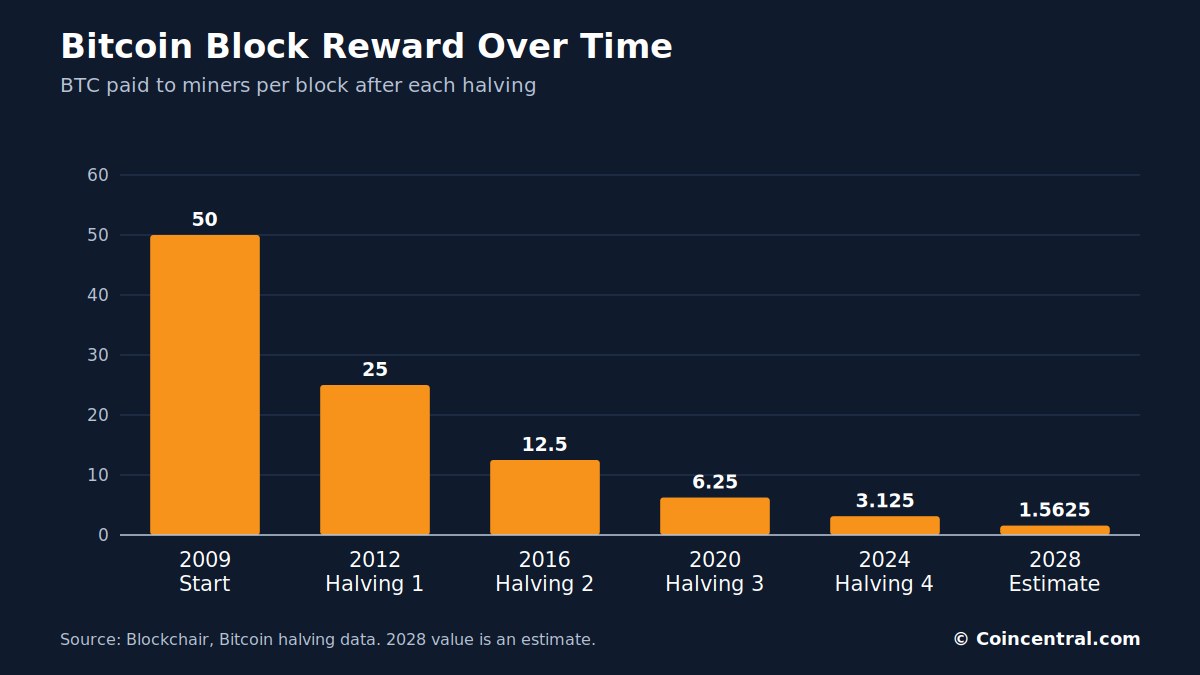
A Bitcoin halving halves the reward miners receive for adding a block to the blockchain. The subsidy started at 50 BTC in 2009 and now stands at 3.125 BTC — a cumulative reduction of 93.75% across four halvings.
This report compiles the dates, block rewards, supply figures and price history tied to each halving. It draws on several published datasets and flags where they diverge.
Key Bitcoin Halving Statistics
Four halvings have taken place: November 28, 2012, July 9, 2016, May 11, 2020 and April 20, 2024. The current block reward is 3.125 BTC, and roughly 450 BTC are mined each day.
The next halving is projected for around April 2028 at block 1,050,000, when the reward falls to 1.5625 BTC.
The supply cap is 21 million BTC. Of that total, 20,097,597 BTC are in circulation and 902,403 BTC remain to be mined.
Twelve months after the 2016, 2020 and 2024 halvings, bitcoin was up 282%, 563% and 35%, respectively. Cycle peaks arrived 17 to 18 months after each event, at $19,650, $67,510 and $124,720, before prices fell 84%, 76.7% and 53.0% from those highs.
The block reward offers the clearest view of how halvings operate: each cut reduces the payout to half its prior value, and the cuts arrive every 210,000 blocks.
These figures come from block data and daily price series. Supply numbers are fixed by code, while price figures depend on the exchange and the data provider; where two sources disagree, both are named. Because the reward halves each cycle, the cuts shrink in coin terms — the 2012 halving removed 25 BTC from each block reward, while the 2024 halving removed 3.125 BTC.
How Bitcoin Halving Works and How Much Supply Is Left
Bitcoin's code sets a hard limit of 21 million coins. New coins enter circulation only as rewards paid to miners, and every 210,000 blocks that reward is cut in half.
The network aims for one block roughly every 10 minutes. At that pace, 210,000 blocks take about four years. Blocks sometimes arrive faster, so halvings tend to land slightly earlier than a simple calendar count suggests.
Half of all bitcoin had been issued by the first halving in 2012, and another 25% followed by the second. Each later cut releases a smaller share of the total.
The core rules are brief: no more than 21 million BTC will exist, blocks arrive about every 10 minutes, and the reward halves every 210,000 blocks from an initial 50 BTC per block. Changing these rules would require agreement across the entire network, which is why the schedule has not moved since launch.
According to the latest tracker data, 20,097,597 BTC are in circulation — about 95.7% of the cap — leaving 902,403 BTC to be mined.
Some of the circulating supply cannot be spent. One estimate puts roughly 3 million BTC as lost to forgotten wallet details, broken hard drives and wallets of deceased owners, and most of that is not expected to be recovered. The 3 million figure is an estimate, not a count.
The last satoshi is projected to be mined around 2140, just before the 33rd halving. At that point the block reward reaches zero and miners will depend on transaction fees. Some analysts describe bitcoin as deflationary on that basis: coins are lost over time even as new issuance keeps shrinking.
Bitcoin Halving Dates and Block Heights
The first halving took place on November 28, 2012, at block 210,000, cutting the reward from 50 to 25 BTC. Some sources list the date as November 27, 2012.
The most recent halving occurred on April 20, 2024, at block 840,000. It happened at 12:09 AM UTC and cut the reward from 6.25 to 3.125 BTC.
Block height counts blocks since the first block, and halvings are tied to that count rather than a calendar date — which is why every date after 2024 is an estimate.
The gap between halvings has been slightly under four years each time: about 3 years and 7 months from 2012 to 2016, about 3 years and 10 months from 2016 to 2020, and about 3 years and 11 months from 2020 to 2024.
Dates for 2028 and beyond are estimates. Current sources place the next halving between April 12 and April 17, 2028, and the estimate shifts as blocks arrive faster or slower than every 10 minutes. Blocks tend to arrive faster when mining power grows, which is why halvings usually land a little earlier than a straight calendar projection; network difficulty then adjusts to pull the average back toward 10 minutes.
Block Rewards, Daily Issuance and Miners
The block reward sets how many new coins reach the market each day. With about 144 blocks a day, the original 50 BTC reward meant roughly 7,200 BTC daily. The 2024 halving cut daily issuance from about 900 to about 450 BTC, and lowered yearly issuance from about 1.7% of existing supply to about 0.85%.
Because the base of coins is much larger than it was in 2012, each halving is smaller in relative terms.
For miners, every halving cuts block reward revenue in half when measured in BTC. Running a mining site is costly, and operations with high costs may shut down if the price does not make up the difference. When miners switch off, the network's hashrate can fall and block times can slow until the difficulty adjusts; hashrate can return if the price rises and mining becomes profitable again.
Miners can respond to a halving in several ways: hunt for cheaper electricity, buy more efficient machines or shut down. Over time, this pushes the industry toward lower costs.
Tracker data listed network hashrate at about 998 EH/s and difficulty at 132.72 T, with a next-block fee of 1.07 sat/vB, or about $0.12. Fees are a small part of miner income today but are meant to replace the block reward in the long run.
Bitcoin Price on Each Halving Day
Two price series inform the halving-day figures. CoinMarketCap data covers 2012, 2016 and 2020, while the Coinbase series published by FRED starts in December 2014, so it covers 2016, 2020 and 2024.
The two series differ by less than 3% on the same day, which is common since each exchange sets its own price. The gap does not change the pattern.
The halving-day price rose from $12.20 in 2012 to $64,906 in 2024 — more than 5,000 times higher. Because the figures come from two different series, the comparison is a rough guide. Halving-day prices are a snapshot, not a forecast.
The 2024 halving came after a 130% rise in the prior 12 months, while the 2012 halving came when bitcoin traded at just $12.20. After the 2024 halving, the price first slipped to $53,930 in September 2024, then rose to $124,720 in October 2025.
Bitcoin Price 6, 12 and 18 Months After a Halving
Daily price data exists for the 2016, 2020 and 2024 halvings, and bitcoin was higher 12 months after each one: gains of 282% in 2016, 563% in 2020 and 35% in 2024.
The first six months were quiet in all three cycles — gains of 37% in 2016, 84% in 2020 and 4% in 2024 — and prices dipped before the larger moves, to $537 in August 2016 and to $53,930 in September 2024.
The largest moves came after the first half year. In the 2020 cycle, the price went from $15,724 at six months to $56,719 at 12 months. In the 2016 cycle, it went from $2,509 at 12 months to $14,481 at 18 months. The 2024 cycle was smaller, moving from $67,346 at six months to $87,522 at 12 months, then to $108,362 at 18 months.
By month 18, the 2016 cycle was up 2,102%, the 2020 cycle was up 657% and the 2024 cycle was up 67%. The peak gain was 2,888% in the 2016 cycle, 689% in the 2020 cycle and 92% in the 2024 cycle.
Cycle Peaks and Price Drops After Each Halving
Each cycle peaked 17 to 18 months after the halving, with highs of $19,650 on December 16, 2017, $67,510 on November 8, 2021 and $124,720 on October 5, 2025.
Each decline was smaller than the one before: drops of 84%, 76.7% and 53.0%. The 2024 cycle also had the shortest decline, at about nine months, with lows on December 15, 2018, November 21, 2022 and June 30, 2026.
In DataPorium's cycle map, the period 24 to 30 months after a halving was a bear market twice; in the third cycle, the drop was shallower and a recovery followed. By September 22, 2026, bitcoin had recovered to $86,172 in DataPorium's series — 31% below the October 2025 peak and 33% above the 2024 halving-day price.
Why the 2024 Cycle Was Weaker
The 2024 cycle had the smallest 12-month gain of the three. Several factors may explain this, and the data cannot show which one matters most.
One factor is size. The 2024 cut halved a flow that was already a small share of a much larger supply, so the relative supply shock was smaller than in 2016 or 2020.
Another factor is timing. Bitcoin rose 130% in the 12 months before the 2024 halving; the same measure was 144% before 2016 and 19% before 2020. Spot bitcoin ETFs also launched in the months before the halving, bringing demand in ahead of the event rather than after it.
Halving dates are fixed and public. If traders buy ahead of the date, part of the price effect may arrive early. The smaller post-halving gains fit that idea, though three data points cannot prove it.
The 18-month peaks may also reflect global liquidity cycles that happened to line up with the halvings. A fixed supply schedule does not steady demand; falling demand is what drove the declines of 84%, 76.7% and 53.0%.
The market view is that a rule-based issuance schedule is a strength, because no committee can change it, and that predictability is part of why institutional products were built on it. The counterpoint is that the schedule cannot control demand.
Next Bitcoin Halving: Countdown and Progress
The next halving is expected around April 2028 at block 1,050,000. The reward will fall from 3.125 to 1.5625 BTC, and daily issuance will drop about 450 to about 225 BTC.
At the time of the tracker data, the chain stood at block 971,230, leaving 78,770 blocks to go, and the countdown showed 547 days. The current halving period, which began at block 840,000 and ends at block 1,050,000, was 62.49% complete.
After the 2028 halving, the reward will be 1.5625 BTC — about 225 BTC per day at 144 blocks daily. Miners will receive half the new coins they receive now, and fees will matter more as rewards shrink. Over time, fees are expected to replace the block reward as the incentive that keeps the network secure.
The tracker lists 28 halvings remaining after the four that have passed. After the last one, around 2140, the reward is zero. Estimates for the next date range from April 12 to April 17, 2028 and update with each new block.
Bitcoin Price Today and Volatility
On September 22, 2026 — about 29 months after the 2024 halving — bitcoin closed at $86,172 in DataPorium's series, while the Coinbase series showed $86,250 that day. The price had been $58,559 on June 30, and a 6.7% gain on September 21 alone helped the recovery. The 52-week range ran from $57,748 to $126,198.
A separate price tracker showed $83,258.62 when its data was captured, down 0.20% over 24 hours. Prices differ across sources and move through the day.
Bitcoin remains volatile. Annualized volatility of daily returns was about 43% over the year to September 22, 2026, and 46% over three years. Volatility matters for anyone using halving dates as a guide: a cycle view that is right on direction can still be wrong on timing, and a buyer who entered at a peak faced a decline of 53% or more in each cycle.
This article is not financial advice. Three halving cycles are a small sample, and past results do not guarantee future ones.
What the Halving Statistics Show
Four halvings have cut the block reward from 50 to 3.125 BTC, and about 95.7% of the 21 million coins have been mined. Every halving since 2016 was followed by a 12-month gain and a peak about 17 to 18 months later, with gains of 282%, 563% and 35%. Each peak was followed by a drop of 53% or more. The next halving, expected around April 2028, will cut the reward to 1.5625 BTC.
The supply schedule is fixed by code. Price outcomes are not.
Sources
- Bitcoin Halving: Dates, Block Height and Supply (Blockchair data)
- Bitcoin Halving Cycles: What History Shows About the 12 to 18 Months After a Halving (DataPorium)
- Bitcoin Halving 2028 Countdown (BitRef)
- Coinbase Bitcoin, FRED series CBBTCUSD (Federal Reserve Bank of St. Louis)
- CoinMarketCap Bitcoin Historical Data
This article first appeared on CoinCentral.

