Bitcoin and Gold Rank as 2026's Worst-Performing Major Assets
Key Takeaways
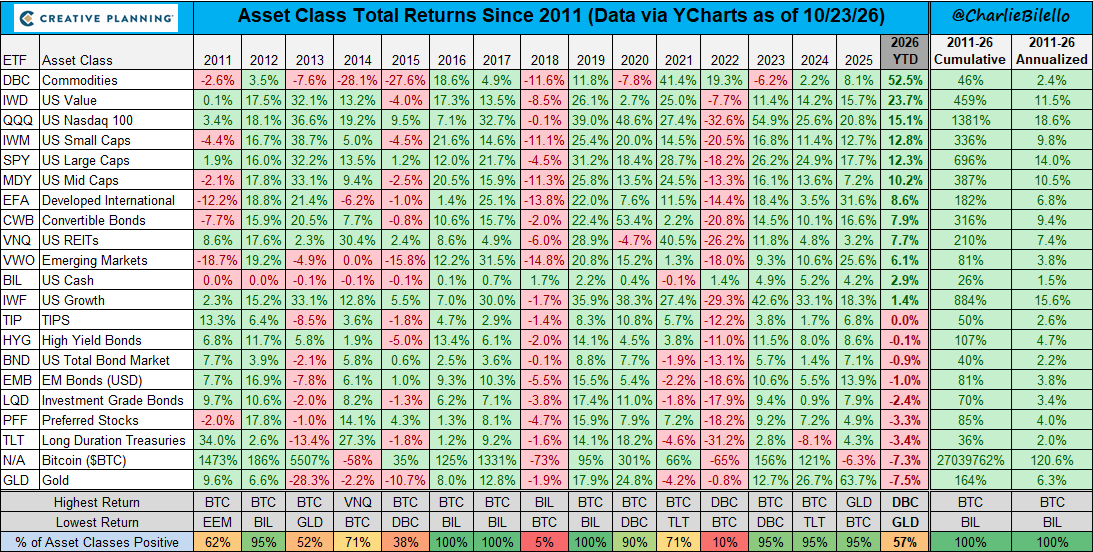
- •Bitcoin and gold have declined 7.3% and 7.5% respectively in 2026 through October 25, the first time both assets ranked last together in Charlie Bilello's records dating back to 2011.
- •Gold dropped below $4,000 an ounce on Friday for the first time since July, leaving it more than a quarter below its early-2026 peak above $5,400, before recovering slightly on Monday.
- •Bitcoin trades around $80,472, roughly 35% below its record above $126,000, and 2026 is on track to become its second consecutive negative year after a 6.3% decline in 2025.
- •Rising expectations for higher US interest rates and Brent crude reaching $116 per barrel amid US-Iran tensions have increased the appeal of interest-earning assets, with short-term Treasury bills returning 2.9% this year.
- •Galaxy's October snapshot classified about 11.1 million BTC, roughly 55% of total supply, as unattributed despite growing Wall Street involvement in Bitcoin.
Bitcoin and gold are having the kind of year their strongest advocates usually warn everyone else about. Both assets sit at the bottom of the major investment rankings for 2026, while cash parked in short-term US Treasury bills is quietly earning positive returns.
Creative Planning strategist Charlie Bilello, who published the comparison on X, puts Bitcoin's loss at 7.3% and gold's at 7.5% through October 25. According to Bilello, his records have never shown the two assets ranked together in last place during any calendar year.
Bitcoin and gold lose while stocks and commodities climb
The contrast becomes starker when measured against the alternatives available to investors this year. A broad commodities basket has jumped 52.5% in 2026, large US stocks have gained 12.3%, and short-term Treasury bills have returned 2.9%.
That final figure is particularly uncomfortable for anyone who bought Bitcoin or bullion to escape the pitfalls of ordinary money.
Bilello has tracked 21 asset classes going back to 2011, and only 57% of them are showing positive returns in 2026, so the year has not been easy across the board. Even so, the two assets most often marketed as protection against inflation and economic upheaval have ended up trailing even the most conservative investments.
Gold's reversal has been especially abrupt. The metal surged 63.7% in 2025 — the strongest year in Bilello's table — then climbed above $5,400 an ounce early in 2026. By Friday, spot prices had fallen to $3,995.81, dropping below $4,000 for the first time since July and leaving bullion more than a quarter below its early-year high.
Bullion recovered slightly on Monday. Spot gold rose 0.3% to $4,008.70 by 0755 GMT, while US gold futures for December delivery advanced 0.3% to $4,021.90. The rebound followed a 4% weekly decline, the steepest since June, which took spot prices to their lowest level since mid-July.
Bitcoin has offered little comfort either. The cryptocurrency trades at $80,472, roughly 35% below its record above $126,000 set last October. If its losses hold, 2026 will become its second consecutive negative year, following a 6.3% decline in 2025.
That does not erase its longer track record. Since 2011, Bilello calculates an average yearly return of 120.6% for Bitcoin, compared with 6.3% for gold. Historical averages, however, do not pay this year's bills.
Higher rate expectations and oil pressure weigh on both assets
The mechanics of the squeeze are straightforward: neither Bitcoin nor gold earns interest. When US interest rates are expected to move higher, bonds and all other interest-earning investments become more attractive, raising the cost of holding either asset — a gap made explicit this year by the 2.9% return on short-term Treasury bills.
Oil is adding further pressure on inflation expectations. Brent crude reached $116 per barrel on Friday as tensions escalated between the United States and Iran. High energy prices could lift consumer prices and give the Federal Reserve another reason to maintain tight monetary policy.
ING analysts noted that the precious metal could not even benefit from a selloff in technology shares. Instead, they said the market “appears more focused on higher oil prices and what it could mean for inflation.”
Efforts to defuse the situation are underway. Qatari mediators were in Tehran on Sunday, coordinating with the United States to ease regional tensions.
The October 27-28 FOMC meeting is the next major event on the calendar. Investors expect interest rates to remain unchanged for now, but expectations for an increase in December have risen significantly: according to one CME FedWatch estimate, a measure derived from fed funds futures pricing, the probability is currently 68%, while another is as high as 79%.
Thursday's PCE inflation data release is another event to watch, as one of the indicators the Fed in pursuing its 2% inflation target.
Most Bitcoin remains unattributed despite Wall Street's involvement
There is another wrinkle in Bitcoin's story. Despite Wall Street's growing involvement, researchers still cannot identify the owners of most coins. Galaxy, a digital-assets financial services firm, classified 11.1 million BTC — roughly 55% of total supply — as unattributed in its October snapshot.
Galaxy's head of research, Alex Thorn, wrote on X:
“More than half of all BTC supply is sitting in addresses with no known attribution despite all the institutionalization and centralized ownership over the years, still a ton of bitcoin (maybe even most) is held by individuals in self-custody.”
The figure is not conclusive evidence that every unknown wallet is owned by an individual. Some could be institutional accounts that Galaxy was unable to identify, as well as coins whose private keys were lost by their owners. Estimates of this kind are how researchers gauge how far institutional ownership has actually reached into Bitcoin's supply.
In other metals trading, silver climbed 0.2% to reach $54, platinum declined 0.3% to $1,546.18, and palladium fell 0.5% to $1,038.85.
Only two months remain before the end of 2026 — the window either asset has left to climb out of last place before Bilello's year-to-date table closes the books on the calendar year.

