Bitcoin and Gold Rally as Geopolitical Tensions Ease: Analysts Eye Key Resistance Levels
Key Takeaways
- •Bitcoin is trading near $67,500, and a decisive break above $67,000 would confirm a bullish trend reversal by establishing a higher high after that level capped both June and July peaks.
- •U.S. spot Bitcoin ETFs recorded $244 million in net inflows on August 5, with BlackRock's iShares Bitcoin Trust alone attracting $196.83 million, signaling renewed institutional participation.
- •Gold surpassed $4,250 for the first time since June after a single-session gain of $180, and veteran trader Peter Brandt's proprietary chart pattern projects an upside target between $4,517 and $4,830.
- •Chinese gold-backed ETFs attracted approximately $1.2 billion over 14 consecutive trading sessions, reversing a prolonged weakness period during which net outflows occurred in 38 of the prior 44 sessions.
- •A trader retains a 1,400 BTC short position valued at roughly $90.44 million with a liquidation price of $64,998.73 after partially closing 200 BTC at a loss to reduce liquidation risk.
As the US-Iran conflict nears its end and global oil prices decline, Bitcoin and Gold have returned to the forefront of investor attention. Both assets are demonstrating notable strength, with Bitcoin approaching a move past $65,000 while gold has surged above $4,200. The simultaneous strength in both a traditional safe-haven asset and the leading cryptocurrency underscores a broader appetite for scarce, non-sovereign stores of value as geopolitical uncertainty fades and risk sentiment normalizes.
Over the past six months, both assets have undergone price and time corrections, entering what analysts describe as an accumulation zone—a phase typically characterized by range-bound trading and gradual capital inflows before a directional breakout.
Bitcoin Targets Breakout Above $67,000
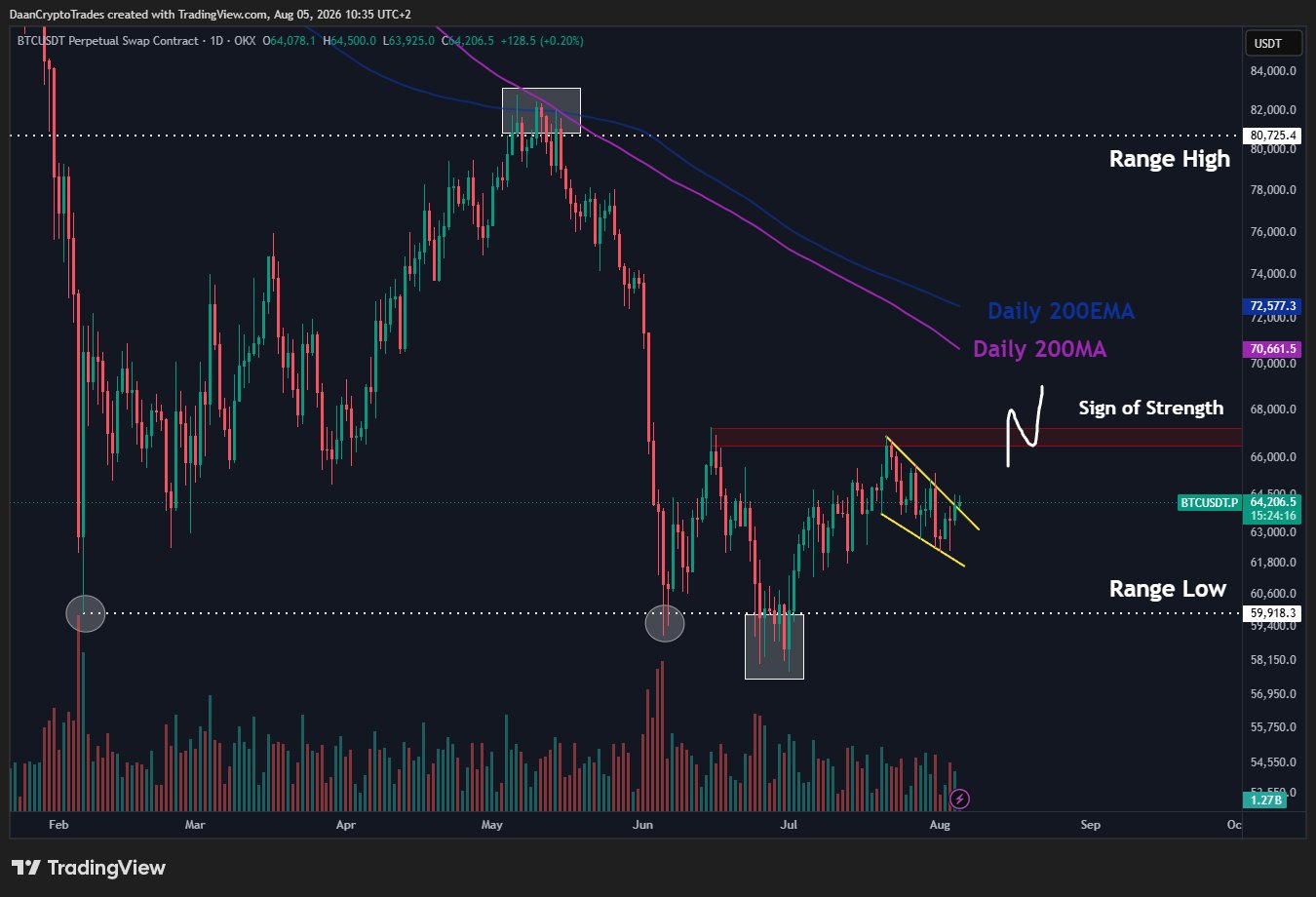
With Bitcoin holding firmly around $67,500, market optimism is regaining traction. Analyst Daan Crypto Trades emphasized that BTC must break above $67,000 to confirm a bullish shift in its daily market structure. According to the analyst, $67,000 marked the highs for both June and July, meaning a decisive move above that threshold would establish a higher high and signal a potential trend reversal in favor of bulls.
On the downside, Daan identified $60,000 as the key high-timeframe support level—the most critical threshold to watch should BTC face renewed selling pressure.
LookonChain reported that a trader holding a substantial Bitcoin short position closed 200 BTC, worth approximately $12.92 million, realizing a loss of about $146,500 to reduce liquidation risk. Despite this partial close, the trader retains a 1,400 BTC short position valued at roughly $90.44 million. The position's updated liquidation price stands at $64,998.73. Large open short positions like this are closely watched by traders, as liquidation events can trigger cascading price movements.
Crypto analyst Ali Martinez observed that a bullish divergence between Bitcoin's price and net capital flows has reappeared, suggesting the market may be approaching another major bottom. Martinez noted that the last time this divergence emerged, it marked a cycle low, after which Bitcoin rallied from approximately $15,000 to an all-time high of $126,000. A similar on-chain signal is now visible, according to Martinez.
Institutional Demand Returns to Bitcoin ETFs
Bitcoin ETF inflows have risen consistently over the past three trading sessions, signaling renewed institutional participation following the previous week's net outflows. U.S. spot Bitcoin ETFs, which launched in January 2024, have become a primary vehicle for institutional exposure to BTC, and their flow patterns are widely tracked as a barometer of broader demand.
On Wednesday, August 5, U.S. spot Bitcoin ETFs registered $244 million in net inflows. BlackRock's iShares Bitcoin Trust (IBIT) led the surge, attracting $196.83 million—equivalent to approximately 3,035 BTC—according to data from Farside Investors.
Other funds also saw meaningful inflows: ARK 21Shares' ARKB recorded $37.63 million, Fidelity's FBTC took in $11.28 million, Bitwise's BITB attracted $10.56 million, and Morgan Stanley's MSBT added $2.79 million. The remaining U.S.-listed ETFs reported zero net flows.
BitMEX co-founder Arthur Hayes recently published an essay titled "Situationship," in which he argued that excessive spending on data centers and AI infrastructure could eventually produce an AI bubble resembling the 2008 global financial crisis more closely than the 2000 dot-com crash. Hayes added that any resulting monetary easing and liquidity expansion from central banks would likely create a favorable macroeconomic environment for a Bitcoin price rally. The potential for central bank intervention in response to financial instability has historically been viewed by Bitcoin proponents as a catalyst for the asset, given its fixed supply.
Gold Breaks Above $4,250
Gold has resumed its rally alongside Bitcoin, surging past $4,250 for the first time since June after gaining $180 in a single session. Veteran trader Peter Brandt noted that gold continues to follow a technical setup based on his proprietary Cw/O chart pattern, which currently points to a potential upside target between $4,517 and $4,830. Brandt stated that the existing chart structure remains consistent with the bullish setup.
Chinese investors are also redirecting capital into gold. Over the past 14 consecutive trading sessions, Chinese gold-backed ETFs have attracted approximately $1.2 billion. This renewed demand follows an extended period of weakness during which China's gold ETFs recorded net outflows in 38 of the previous 44 trading sessions, as reported by The Kobeissi Letter. China is one of the world's largest gold consumers, and shifts in Chinese investment flows are closely monitored as an indicator of global demand for the metal. The parallel strength in gold buying from Chinese investors and Bitcoin inflows from Western institutions reflects geographically differentiated but concurrent demand for assets perceived as hedges against monetary debasement.

