Bitcoin Tests Key Support as BTC Faces Fourth Consecutive Weekly Loss
Key Takeaways
- •Bitcoin, Ethereum, and XRP were headed for a fourth straight weekly decline, extending a pullback that began in early October.
- •Bitcoin has lost more than 2.5% this week, while Ethereum and XRP have declined over 4% and 5%, respectively.
- •Bitcoin briefly dipped below its 100-day EMA near $77,814, which now marks the first resistance buyers must reclaim, followed by the 50-day EMA around $80,585 and a barrier at $85,000.
- •The 200-day EMA at $76,423 is Bitcoin's next major support, and defending it is considered essential to keeping the broader upward structure intact.
- •Bitcoin's RSI sits at 34, close to the oversold threshold of 30, and a negative MACD reinforces the cautious short-term outlook.
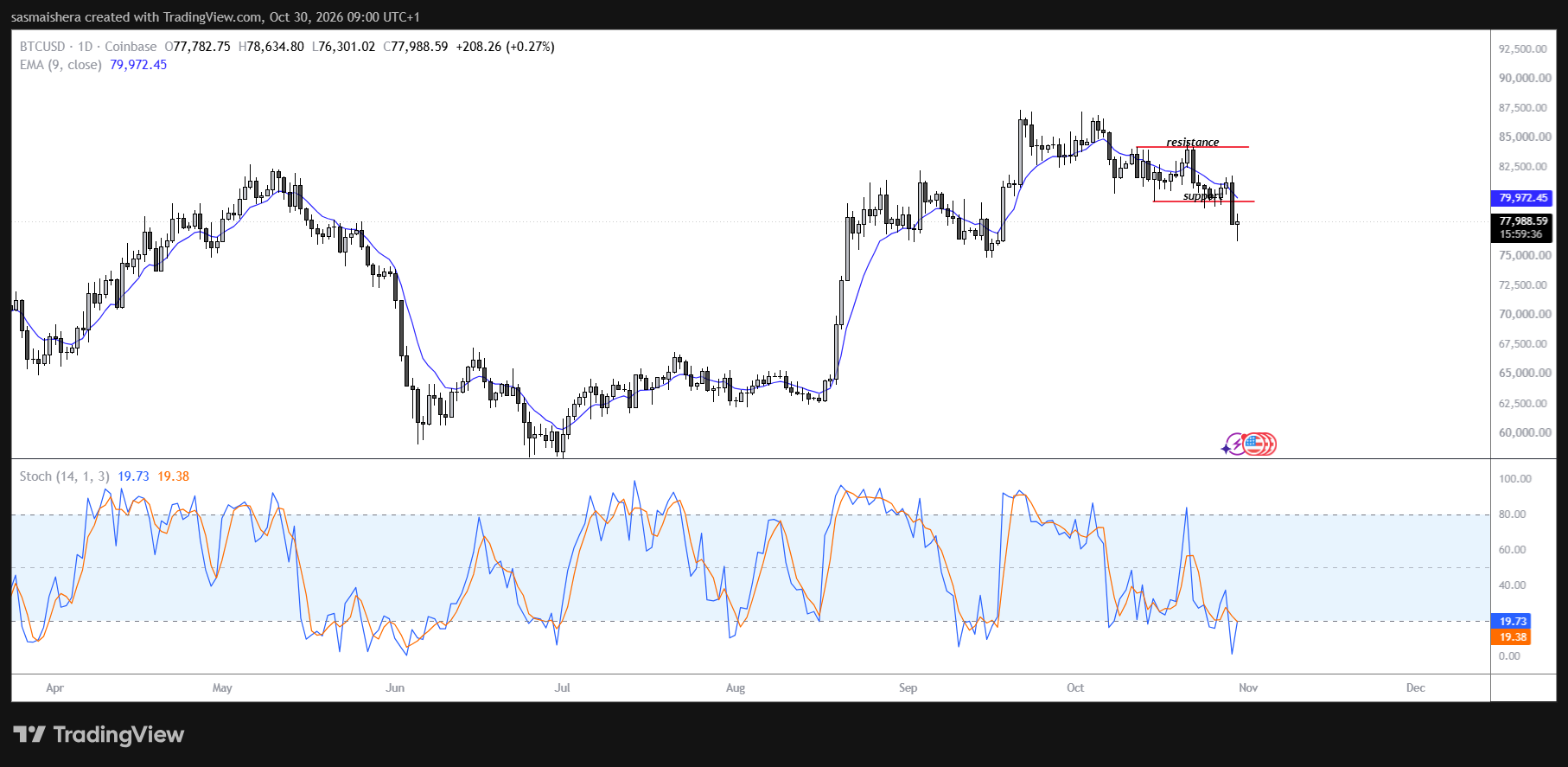
Bitcoin, Ethereum, and XRP remained under pressure on Friday, placing all three major cryptocurrencies on course for a fourth consecutive weekly loss since early October. The streak of declines extends a pullback that began at the start of the month.
Bitcoin has declined more than 2.5% so far this week, while Ethereum and XRP have fallen over 4% and 5%, respectively, underscoring continued weakness across major digital assets. Bitcoin traded around $77,900 at points on Friday and hovered near $77,477, just above its 100-day Exponential Moving Average at approximately $77,814. ETH slipped below $2,215, while XRP traded under $1.230, leaving buyers facing an important test of longer-term support.
Bitcoin slips below its 100-day EMA
Bitcoin's near-term technical outlook on the daily chart weakened after it briefly slipped below the 100-day EMA at roughly $77,814 — a moving average that weights recent prices more heavily and is closely watched as a gauge of the medium-term trend. That level now stands as the first resistance buyers need to reclaim. Above it, the 50-day EMA near $80,585 presents the next obstacle, followed by the horizontal barrier at $85,000.
A recovery above $77,814 would ease immediate selling pressure and improve the prospect of consolidation within the recent range. A more sustained rebound, however, would require Bitcoin to overcome those higher resistance levels. For now, its position below the shorter moving averages keeps recovery attempts vulnerable.
200-day EMA comes into focus
Bitcoin remains just above its 200-day EMA at $76,423, which provides the next significant technical support. The 200-day average is one of the most widely referenced tools for assessing whether a longer-term trend remains intact, a reason reactions at this level tend to draw close scrutiny during corrections. Holding that average would preserve an important element of the broader upward structure despite the ongoing correction. A sustained break below it, by contrast, would weaken that structure and increase the risk of a deeper pullback.
The reaction around $76,423 could therefore help determine whether Bitcoin stabilizes or extends its October decline.
Momentum indicators remain weak
Bitcoin's Relative Strength Index stands at 34, approaching the conventional oversold threshold of 30 — a reading that indicates persistent selling pressure. The RSI is a momentum oscillator measured on a scale from 0 to 100, and readings at or below 30 are traditionally where traders assess whether conditions have become stretched. Although stretched momentum can precede a corrective bounce, proximity to oversold territory does not establish that a reversal is underway.
The Moving Average Convergence Divergence indicator, which tracks the relationship between two moving averages of price, also remains negative, reinforcing the cautious near-term outlook.
With momentum still weak, buyers need to defend the 200-day EMA and reclaim the 100-day average to demonstrate that immediate downside pressure is easing.
This article is based on a report originally published by CoinJournal.

