Bitcoin Fell in the Month After 12 of the Fed's 16 Rate Hikes Since 2018 as Traders Price 79% Odds of a December Hike
Key Takeaways
- •A 99Bitcoins analysis covering every Federal Reserve decision since January 2018 found that Bitcoin posted lower prices 30 days after 12 of the central bank's 16 rate hikes in that span.
- •Markets currently assign a 79% probability to a rate hike at the Fed's December 9 meeting, while Chair Kevin Warsh declined to offer any guidance on the committee's next move.
- •Following Wednesday's 10–2 vote to hold rates at 3.75% to 4%, Bitcoin climbed to $81,788 within two hours but fell to $79,710 overnight as Asian tech stocks sold off after Samsung's chip unit missed estimates.
- •Historical records and the current cycle point in opposite directions: rate hikes carry a median 30-day Bitcoin loss of 3.5%, yet after September's hike, the only one of this cycle, Bitcoin gained 11.3% in a week and 7.2% in a month.
- •Bitcoin is holding roughly $1,200 above its rising 50-week EMA at $78,637, with resistance at $84,898 and $87,396 and further support at $74,968 heading into the December meeting.
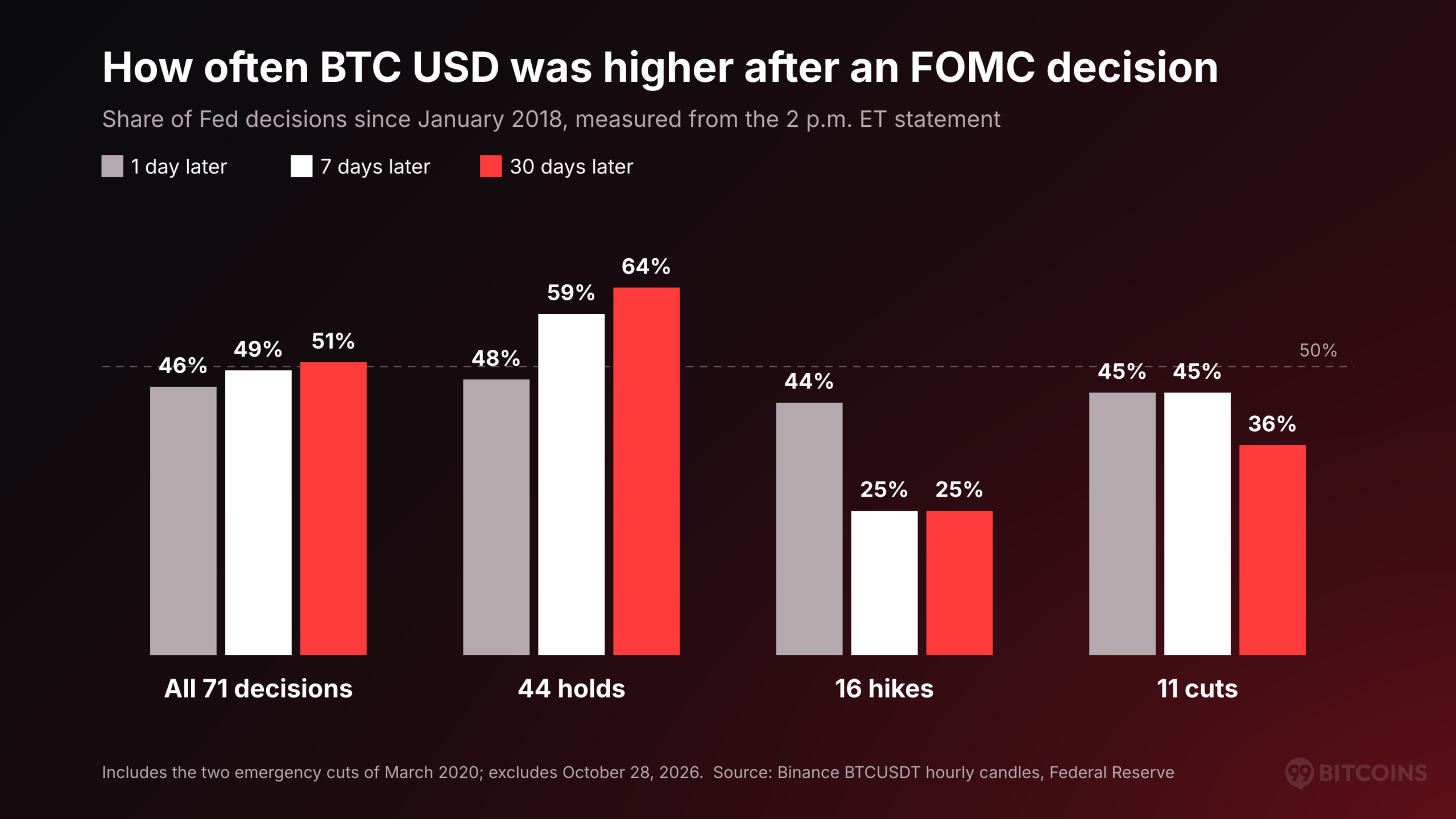
Bitcoin (BTC USD) has traded lower 30 days after 12 of the Federal Reserve's 16 rate hikes since 2018, according to a 99Bitcoins review of all 71 Fed decisions since January of that year. With traders now pricing in a 79% chance of another hike at the central bank's December 9 meeting, that historical record is back in focus.
Wednesday's decision to hold rates offered little relief. Bitcoin rose for two hours after the statement, then handed back the entire gain overnight. The asset trades at $79,792, down 1.4% in 24 hours and 5% over 30 days, and sits 36.7% below its October 2025 record of $126,080.
That leaves one question hanging over the market: what does Bitcoin usually do after a Fed meeting, and what does the record say about a December hike?
TRADERS CONTINUE TO PRICE 80% CHANCE OF FED HIKE IN DECEMBER pic.twitter.com/4QP4f35oNU
— Walter Bloomberg (@DeItaone) October 28, 2026
How Does BTC USD Perform After an FOMC Meeting?
On the day itself, the outcome is close to a coin flip. What happens over the following month depends largely on what the Fed decided.
The 99Bitcoins study measured Bitcoin from the hourly candle at each 2 p.m. ET statement, across every decision since January 2018. The sample includes the two emergency cuts of March 2020 but excludes Wednesday's meeting, which is too recent to score. The results:
- All 71 decisions: BTC was higher 24 hours later after 33 of them, or 46%, with a median move of -0.16%. The first hour moved the price 1.1% on average, but the full day moved it 3%, meaning most of the reaction comes after the press conference, not during it — the chair takes reporters' questions starting 30 minutes after the 2 p.m. ET statement.
- 44 holds: Bitcoin was higher a month later after 28, with a median gain of 5.7%.
- 16 hikes: it was higher a week later after only four, and a month later after only four, with a median 30-day loss of 3.5%.
- 11 cuts: it was higher a month later after just four, with a median loss of 5%. All three late-2025 cuts, in September, October, and December, were followed by lower prices 30 days later: down 7.8%, 19%, and 1.8%, respectively.
The hike numbers come with a caveat. Fifteen of the 16 hikes came during the 2018 and 2022–23 tightening cycles, when Bitcoin was already falling or only starting to recover. The lone hike of the current cycle, on September 16, went the other way: BTC rose 11.3% in a week and 7.2% in a month. With a sample size of one for this cycle, the historical record and the September precedent point in opposite directions — which is why the 79% December odds cannot be read straight off the averages.
What Did Bitcoin Do After This Week's Fed Meeting?
It went up, then down. The Federal Reserve held rates at 3.75% to 4% on Wednesday in a 10–2 vote, with Governor Lisa Cook and Cleveland Fed President Beth Hammack voting for a quarter-point hike. BTC was at $80,860 at 2 p.m. ET and climbed to $81,788 over the next two hours.
Chair Kevin Warsh gave no hint about December. "I don't believe in forward guidance, absent exigent circumstances, absent a crisis," he told reporters.
The drop came overnight, after Samsung's chip unit missed estimates and tech stocks sold off in Asia, and Bitcoin fell to $79,710 by 02:00 UTC.
That fits the year so far. After this year's first six decisions, BTC was lower 24 hours later three times, by anywhere from 2.4% to 6.8%, and up only slightly the other three times. The worst came after January 28's hold: down 6.8% in a day and 18% in a week.
The next decision is due December 9. Before then come September's PCE inflation reading — the Fed's preferred inflation gauge — and third-quarter GDP today at 8:30 a.m. ET, the October jobs report on November 6, and consumer prices on November 10. Those are the releases traders will weigh as they update the 79% odds before the meeting.
A December rate hike seems very likely. Summary of Fed Chair Kevin Warsh: 1) It was a 'hawkish skip' today. He kept saying the job isn't done on inflation. 2) He called the US economy 'strong' 3) He does not think economy is overheating 4) He reiterated that he thinks it's… pic.twitter.com/zkABQXt07b
— Heather Long (@byHeatherLong) October 28, 2026
BTC USD Price Analysis: Can Bitcoin Hold Its 50-Week EMA Into December?
So far, yes, but only by about $1,200. On the weekly chart, BTC trades at $79,850 on Binance, just above its 50-week exponential moving average (EMA) at $78,637 — a slow-moving average of weekly closes that traders watch as a long-term trend line. It has closed six straight weeks above that line since mid-September, and the line itself has been rising again since August after falling for most of the year.
The three-year view shows what is at stake. The 50-week EMA acted as the floor through the 2024 bull run. Bitcoin lost it in November 2025 and spent most of 2026 below it, sinking as low as $57,800 in July.
The key levels into the December meeting:
- Resistance: $84,898, the October 21 high, then $87,396, the September 21 high and the highest price since January.
- Support: the 50-week EMA at $78,637, then $74,968, the September 15 low set the day before the Fed's hike. Below that sits the 200-week EMA at $69,524.
History leans against Bitcoin when the Fed hikes, but the only hike of this cycle broke the pattern. For BTC USD into December 9, the weekly close against the 50-week EMA will say more than the historical record does, and the first test is today's PCE report.

