Crypto Market Slumps as Yen Intervention Warning Hits Risk Assets
Key Takeaways
- •A Reuters report indicated the U.S. Treasury notified several banks through the New York Fed to prepare for potential yen market intervention, though no confirmed action had been taken.
- •Bitcoin dropped 3.5% to around $62,400, falling below a technical support zone defined by its 50-day simple moving average near $63,400 and the 0.236 Fibonacci retracement near $63,600.
- •The S&P 500 briefly erased nearly $1 trillion in market value within approximately 40 minutes of the yen report before recovering to a modest gain later in the session.
- •Apple shares fell roughly 9% despite reporting record fiscal third-quarter revenue of $109.4 billion, as investors reacted to a below-consensus September-quarter growth forecast of 9% to 11% and warnings about chipmaking and memory supply constraints.
- •Major altcoins including Ethereum, Zcash, XRP, Solana, and Dogecoin all posted losses ranging from approximately 1.9% to 4.3%, while the cryptocurrency market failed to mirror the subsequent recovery seen in U.S. equities.
Bitcoin dropped 3.5% over 24 hours as losses spread across most major cryptocurrencies, triggered by a Reuters report on possible U.S. intervention in the yen market and compounded by Apple's sharp decline despite record quarterly revenue. While U.S. equities recovered much of their initial slide, Bitcoin remained below its previous support area.
The yen headline revived concerns over yen-funded carry trades and prompted a sudden reversal in U.S. equities. The yen has long served as a preferred funding currency for carry trades because Japan has maintained lower interest rates than most other major economies, making it comparatively inexpensive to borrow. Apple added further pressure during the same session, falling roughly 9% in regular trading even after reporting record fiscal third-quarter revenue.
Stocks Recovered After the Yen Headline
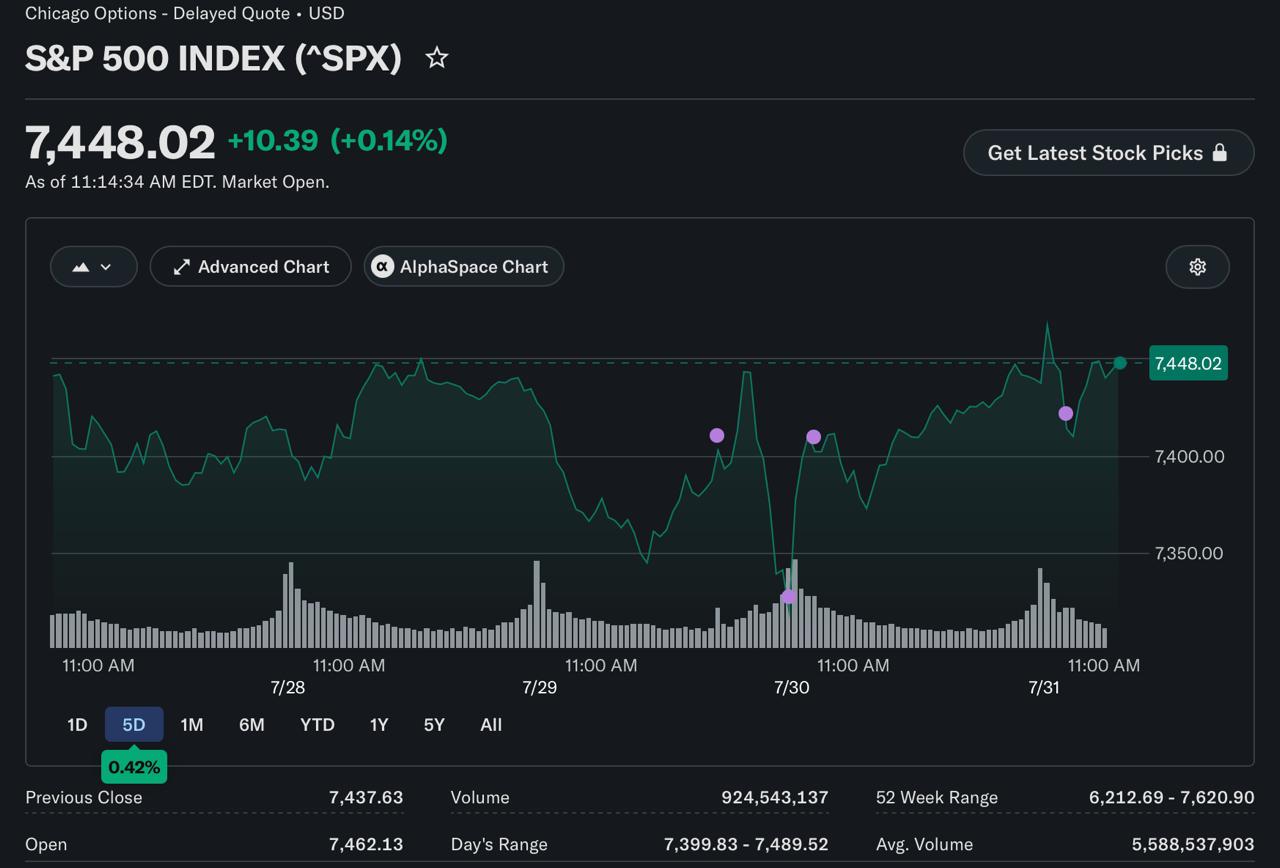
A widely circulated post from Bull Theory illustrated the S&P 500 swinging from a 0.7% intraday gain to a 1.2% loss within approximately 40 minutes of the Reuters report.
🚨 Nearly $1 TRILLION wiped off US stocks in 40 minutes after Reuters reported a possible intervention by the US in the YEN market. The S&P 500 was up 0.70% on the day and had added $540 billion to its market cap. Then it crashed 1.20% in just 40 minutes, wiping out $920… pic.twitter.com/djAklecP6u — Bull Theory (@BullTheoryio) July 31, 2026
🚨 Nearly $1 TRILLION wiped off US stocks in 40 minutes after Reuters reported a possible intervention by the US in the YEN market.
The S&P 500 was up 0.70% on the day and had added $540 billion to its market cap.
Then it crashed 1.20% in just 40 minutes, wiping out $920… pic.twitter.com/djAklecP6u
— Bull Theory (@BullTheoryio) July 31, 2026
The selling pressure subsequently eased. At approximately 11:14 a.m. EDT, Yahoo Finance data showed the index at 7,448, up 0.14%, after touching an intraday low of 7,399. The recovery makes it difficult to interpret the initial decline as evidence of a sustained liquidation across U.S. equities. The report prompted a sharp reduction in risk, but the selling did not continue at the same intensity.
Crypto Did Not Follow the Equity Recovery
Bitcoin traded at $62,400 according to CoinMarketCap data, down 3.5% over 24 hours.
Other major cryptocurrencies posted losses:
- Zcash: −4.30% at $454.79
- Ethereum: −3.3% at $1,853.13
- XRP: −2.8% at $1.06
- Solana: −2.4% at $72.82
- Dogecoin: −1.9% at $0.06914
Hyperliquid remained 0.3% higher, while BNB and TRON limited their declines to less than 1%.
The recovery in U.S. equities did not extend into the cryptocurrency market. Gains in companies such as Amazon could offset Apple's fall within the S&P 500, whereas Bitcoin had no comparable counterweight. Crypto derivatives markets also continued trading throughout the reaction, allowing downward pressure to persist after selling in the cash equity market had begun to subside.
Bitcoin also moved below the support area that had contained its previous pullbacks. The band was defined by the 50-day simple moving average near $63,400 and the 0.236 Fibonacci retracement around $63,600. Trading near $62,410 placed BTC beneath both levels. Reclaiming that zone would diminish the significance of the breakdown, while continued trading below it would leave the near-term technical structure in a weaker position.
Why Possible Yen Intervention Matters
Reuters reported that the U.S. Treasury had informed several banks, through the Federal Reserve Bank of New York, that they should be prepared for possible intervention in the yen market. The report described preparations for potential action and did not confirm that the United States had already entered the currency market. Direct U.S. participation in yen intervention would be unusual; the Treasury's Exchange Stabilization Fund has been used for currency intervention only sparingly, and coordinated action with Japan has historically been reserved for episodes of extreme volatility.
Investors can borrow at relatively low rates in yen and deploy the capital into assets offering higher returns. If intervention strengthens the Japanese currency, the dollar value of those liabilities rises, making leveraged positions more expensive to maintain. Reducing that exposure may require investors to sell liquid assets and purchase yen to repay the original funding. The synchronized market reaction is consistent with a broader reduction in risk, although the available data does not identify which investors sold or reveal how their positions were financed.
Apple's Supply Warning Overshadowed Record Results
Apple entered the session after reporting its strongest June quarter on record. Revenue reached $109.4 billion, up 16% year over year, while iPhone, Mac, and Services each set June-quarter revenue records.
The market's concern centered on the months ahead rather than the quarter Apple had just completed. The company projected revenue growth of 9% to 11% for the September quarter, below Wall Street expectations of approximately 12%. Apple also warned that limited advanced chipmaking capacity and memory shortages were constraining its ability to meet demand. Higher memory costs added an additional concern for future margins.
The company characterized the issue as a supply constraint rather than weak customer demand. Nevertheless, the warning suggested that Apple might be unable to convert all available demand into sales during the following quarter.
The latest data showed Apple trading near $302, down 9.2% at 11:26 a.m. EDT — a regular-session reading rather than the initial after-hours response. Shares had fallen roughly 5.5% after hours before the decline widened during Friday morning trading. The 9.3% move should therefore not be interpreted as a rejection of Apple's quarterly performance. The results exceeded expectations, but investors were weighing slower projected growth, supply limitations, and their potential impact on future revenue and margins.
Because of Apple's weight in major U.S. indexes, the decline added pressure during the same period that markets were reacting to the yen report. Gains elsewhere, including Amazon's post-earnings rally, later helped the broader index recover.
Carry-Trade Risk Not Yet Confirmed
The market reaction demonstrates that the mere possibility of yen intervention was sufficient to trigger rapid de-risking. It does not, however, establish that a sustained carry-trade unwind had already begun. The S&P 500 stabilized after its initial decline, the Reuters report described preparation rather than completed intervention, and there is no direct evidence that cryptocurrency sellers were closing yen-funded positions.
A continued rise in the yen, renewed weakness across global equities, and falling crypto open interest alongside large long liquidations would provide stronger evidence of a broader deleveraging event. Bitcoin remaining below the $63,400–$63,600 support area would add technical weight to that interpretation.
Until such signals materialize, the move is best understood as a sharp reaction to overlapping risks: concern over global funding conditions, pressure from one of the market's largest technology companies, and Bitcoin's break below short-term technical support.
Disclaimer: This article is for informational and analytical purposes only and does not constitute financial or investment advice. Currency intervention, equity-market volatility, and leveraged crypto trading can produce rapid price movements.

