Bitcoin Falls to $77,161 as Iran-U.S. Tensions Lift Oil and Treasury Yields
Key Takeaways
- •Bitcoin fell over 2% to a low of $77,171 before recovering to roughly $77,813 amid U.S.-Iran military escalation in the Strait of Hormuz.
- •Brent crude rose more than 2% above $90 per barrel and WTI climbed past $85.50 after Iran reportedly struck the Saudi oil tanker SIDR with anti-ship cruise missiles.
- •The 10-year Treasury yield hit 4.76%, its highest since January 2025, while the 30-year yield reached 5.269%, pressuring risk assets including crypto.
- •Analyst Rekt Capital warned of a hidden bearish divergence on Bitcoin's daily RSI, which stood at 70.7 in overbought territory, with key support at the 50-week EMA of $77,269.
- •U.S. spot Bitcoin ETFs recorded $217 million in net inflows on Aug. 31, led by BlackRock's IBIT with about $206 million, while spot Ether ETFs took in $87.68 million.
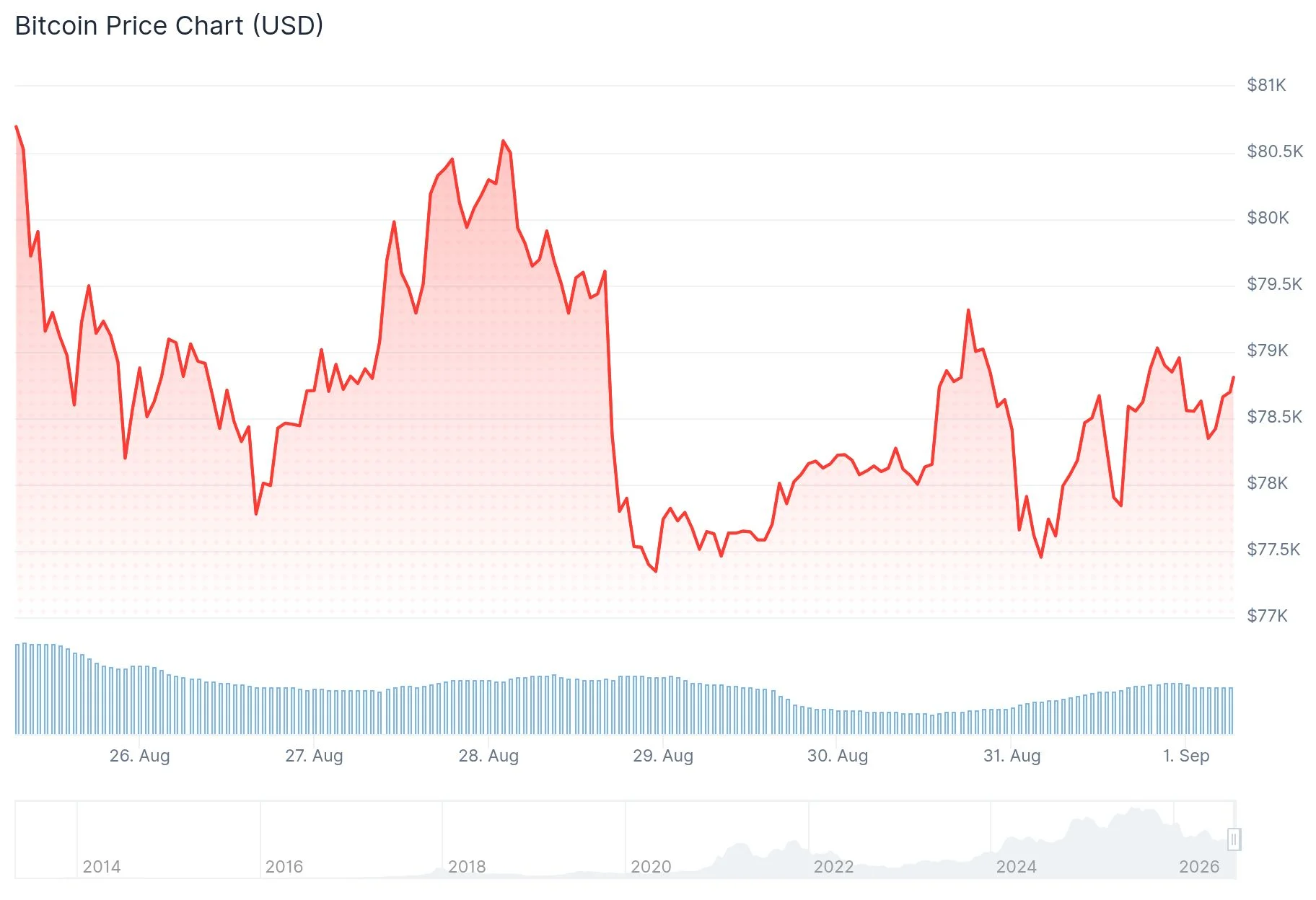
Bitcoin fell more than 2% to a low of $77,171 on Monday as escalating geopolitical tensions between the United States and Iran unsettled financial markets. The price later recovered modestly to about $77,813.
The sell-off followed U.S. strikes on two IRGC missile launchers on Larak Island in the Strait of Hormuz. Iran responded by launching ballistic missiles at multiple U.S. military bases across the Middle East. Fox News reported that nearly all incoming missiles were intercepted and that no major damage was recorded.
US Central Command (CENTCOM) rejected Iran’s description of the U.S. strike as an “act of aggression,” saying U.S. forces carried out “limited, precise action” against minelaying operations that posed an “imminent threat.”
BREAKING: Iran has just struck an oil tanker with 3 anti-ship cruise missiles in the US-backed southern Omani corridor while completing an outbound transit in the Strait of Hormuz under US escort, per UKMTO. The vessel is the Saudi VLCC oil tanker "SIDR." — The Hormuz Letter (@HormuzLetter) August 31, 2026
Oil markets reacted quickly to the conflict. Brent crude futures rose more than 2% to trade above $90 per barrel, while WTI crude climbed past $85.50. The Strait of Hormuz is one of the world’s most important oil chokepoints, handling roughly a fifth of global petroleum liquids consumption, which is why shipping incidents there tend to move energy prices sharply. Goldman Sachs had previously said oil flows through the Strait of Hormuz had recovered to around two-thirds of normal levels.
Bitcoin briefly moved back above $79,000 on earlier developments, but the reported Iranian retaliation pushed prices lower again. The moves underscore how Bitcoin has in recent years frequently traded in line with risk assets such as equities during periods of geopolitical stress rather than as a traditional safe haven like gold. Trading volume increased 50% over 24 hours, reflecting heavier activity in the market.
Bond Yields Add More Pressure
Pressure from U.S. bond markets added another layer of strain. The 10-year Treasury yield reached 4.76%, its highest level since January 2025. The 30-year yield climbed to 5.269%, just six basis points below its highest level since January 2007. Rising long-term yields tend to weigh on risk assets broadly by making safer income-generating assets relatively more attractive.
There it is. 12 days since US Treasury intervention in the bond market was announced and yields are up to a new 19-month high. The 10Y Note Yield is now just 2 basis points away from its highest level since 2007. The bond market appears to be completely ignoring the US… pic.twitter.com/PS2XG655Rr — The Kobeissi Letter (@KobeissiLetter) August 31, 2026
The Kobeissi Letter wrote on X: “There it is. 12 days since US Treasury intervention in the bond market was announced and yields are up to a new 19-month high. The 10Y Note Yield is now just 2 basis points away from its highest level since 2007. The bond market appears to be completely ignoring the US…”
US Treasury Secretary Scott Bessent told CNBC that he had not yet acted to support the long end of the yield curve. The Treasury had announced plans to double debt buyback transactions to $4 billion from September, but yields still rose.
Ray Dalio also said investors should underweight bonds and overweight gold, with “a bit of Bitcoin,” as a hedge against a possible U.S. debt crisis.
The U.S. dollar index rose to around 99.6, adding further pressure to crypto assets. U.S. stocks also declined, with the S&P 500 and Nasdaq each falling about 0.4%.
Analyst Flags Bearish RSI Signal
Analyst Rekt Capital pointed to a hidden bearish divergence on Bitcoin’s daily RSI, warning that if the daily RSI continues to post lower highs, it could signal “mounting weakness.” Bitcoin’s daily RSI was 70.7 on Monday, still in overbought territory.
Analyst CryptoXLarge posted on X that Bitcoin has never closed September in the green immediately after a green August, calling it a “historical extreme” worth watching as September begins.
$BTC IS ABOUT TO TEST A VERY WEIRD SEPTEMBER PATTERN August is closing green but the problem i am watching rn is Bitcoin has never managed to post a green September immediately after a green August That doesn’t mean September HAS to dump But when a market is sitting at a… pic.twitter.com/XxH9WFiOrN — ᴄʀʏᴘᴛᴏ xʟᴀʀɢᴇ (@cryptoxlarg) August 30, 2026
Bitcoin’s 50-week exponential moving average was at $77,269, a level analysts have identified as key support. BTC futures open interest rose 0.65% to $53.88 billion in the last hour of trading, indicating increased activity in derivatives markets.
U.S. spot Bitcoin ETFs recorded $217 million in net inflows on Aug. 31, led by BlackRock’s IBIT with about $206 million. Spot Ether ETFs took in $87.68 million, with BlackRock’s ETHA accounting for roughly $59.94 million.
