Bitcoin Slides for Fourth Day as ETF Outflows Resume and Rate Hike Bets Climb
Key Takeaways
- •Bitcoin fell for a fourth straight session to $63,963, retreating from the week's high of $67,000 amid multiple bearish headwinds.
- •US spot Bitcoin ETFs recorded over $240 million in outflows on Friday, ending an eight-day streak of consecutive inflows.
- •Escalating US-Iran tensions have pushed gasoline prices to $4.111 per gallon and raised implied odds of a Fed rate hike at the upcoming Wednesday meeting to 38%.
- •Mining companies such as MARA Holdings, Riot Platforms, CleanSpark, and Hut 8 hold substantial Bitcoin reserves that could add selling pressure as they shift operations toward AI.
- •Technical analysis reveals a double-top pattern at $67,018 alongside bearish RSI and MACD signals, with traders watching $60,000 as a key downside support level.
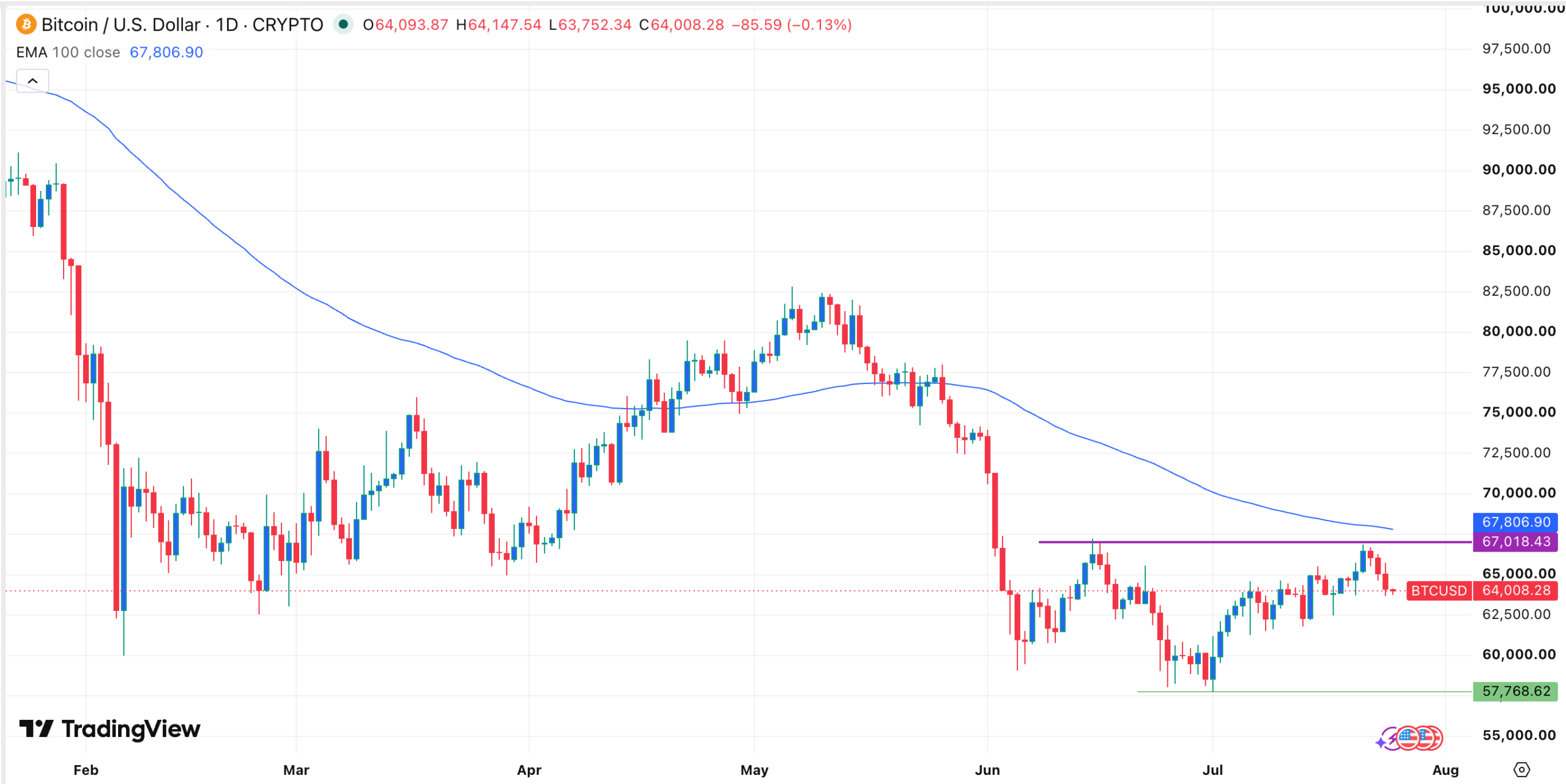
Bitcoin extended its losing streak to a fourth consecutive session as traders weighed mounting headwinds from resurgent spot ETF outflows and shifting expectations around Federal Reserve policy. BTC fell to $63,963, retreating modestly from the week's high of $67,000.
Spot Bitcoin ETF Outflows Resume
Data compiled by SoSoValue shows that spot Bitcoin ETFs shed over $240 million in assets on Friday. A day earlier, these funds saw redemptions totaling $225 million. The back-to-back outflows brought an end to an eight-day streak of consecutive inflows.
Spot Bitcoin ETF flows are closely watched because the products have become a major regulated channel for Bitcoin exposure in US markets. Sustained inflows can indicate stronger institutional and adviser demand, while redemptions may remove a source of spot-market support.
Despite the recent withdrawals, cumulative inflows for the month remain at over $233 million. That figure, however, pales in comparison to the $6.8 billion in outflows recorded during May and June combined.
Friday's outflows were led by BlackRock's IBIT, which lost over $212 million in assets, followed by Fidelity's FBTC, which shed $28 million. Other spot Bitcoin ETFs reported no activity on the day.
Earnings Season and Geopolitical Tensions Drive Rate Hike Speculation
The renewed ETF outflows have coincided with the start of the corporate earnings season and an escalation of the US-Iran conflict. Several major American companies have already released their quarterly results, with market reactions skewing negative.
Tesla shares declined after the company reported negative free cash flow tied to continued spending on artificial intelligence initiatives. Intel initially rallied on stronger-than-expected growth figures before reversing course to end the session 8% lower. Google parent Alphabet also saw its stock drop after announcing an increase in annual capital expenditure to $205 billion.
Meanwhile, the escalation of the US-Iran conflict has prompted investors to price in a higher probability of Federal Reserve interest rate hikes to counter inflationary pressures. According to AAA data, gasoline prices have climbed to $4.111 per gallon, while Brent crude has reached $100 and West Texas Intermediate (WTI) has risen to $94.
Market data indicates that the implied odds of a Fed rate hike at the upcoming Wednesday meeting surged to 38%, up from 13% previously. On Polymarket, the probability of a rate hike occurring sometime this year has exceeded 70%.
The underlying assumption among traders is that the military conflict will drive a renewed surge in inflation, potentially forcing the Fed to act. Christopher Waller, traditionally viewed as one of the Federal Reserve's most dovish policymakers, recently stated he would support raising interest rates if core inflation were to rise.
For Bitcoin, the rate backdrop matters because higher policy rates typically tighten financial conditions and increase the relative appeal of yield-bearing assets. That can weigh on demand for non-yielding assets during periods when investors are already reducing exposure to riskier markets.
Mining Companies Pose Additional Selling Pressure
Another risk factor for Bitcoin is the potential for large holders, particularly mining companies, to offload their holdings. MARA Holdings currently holds 36,303 BTC, having sold a portion of its stash from a peak of over 53,000 coins. Riot Platforms, CleanSpark, and Hut 8 also hold substantial Bitcoin reserves.
These companies are increasingly shifting their operational focus from cryptocurrency mining toward artificial intelligence, a transition that demands significant capital investment. Because miners can hold large BTC balances on their balance sheets, changes in treasury strategy, capital spending needs, or financing conditions are often monitored by traders as potential sources of additional supply.
Technical Analysis Points to Further Downside
From a technical standpoint, Bitcoin's retreat followed the formation of a double-top pattern at $67,018, representing the highest price levels reached in both June and July. This pattern typically indicates reluctance among buyers to push prices above that threshold.
The decline also coincided with Bitcoin approaching its 100-day Exponential Moving Average (EMA), a level that served as substantial resistance. Both the Relative Strength Index (RSI) and the MACD indicator have reversed course and turned downward.
On the downside, traders are watching the $60,000 level as a key support target. Conversely, a decisive move above the $67,018 double-top would negate the bearish technical setup and suggest potential for further gains.

