Bitcoin Risks Slide Toward $67,000 as US Spot Bitcoin ETF Outflows Reach $1.3 Billion
Key Takeaways
- •Bitcoin's 24-hour trading volume surged by more than 200% as the price fell toward $75,000, driven by deteriorating sentiment and forced liquidations of leveraged positions.
- •US spot Bitcoin ETFs recorded approximately $1.3 billion in net outflows over the past week, with a further $201.80 million withdrawn on Monday.
- •The Crypto Fear and Greed Index dropped to 27, placing the market in Fear territory, down from a reading of 80 indicating Extreme Greed roughly 45 days earlier.
- •Bitcoin now trades below its 200-day Exponential Moving Average, and its daily Relative Strength Index has fallen below 40, indicating sellers remain in control.
- •A decisive break below the $71,500 support zone could expose the next major support near $67,000, with a deeper correction toward $60,000 possible if that level fails.
Bitcoin (BTC) remains under heavy selling pressure, with trading activity surging and investors reassessing the cryptocurrency market's outlook following the US midterm elections. The world's largest cryptocurrency recently fell toward $75,000, a move that triggered a sharp increase in market activity.
Bitcoin's trading volume jumped more than 200% over 24 hours, reflecting heightened volatility as traders reacted to deteriorating sentiment and significant liquidations of leveraged positions. Liquidations occur when exchanges forcibly close leveraged positions after losses exhaust a trader's collateral, and the resulting forced selling can amplify volatility during steep declines.
Bitcoin ETF outflows reach $1.3 billion as institutional investors retreat
Institutional demand for Bitcoin has weakened sharply, with US spot exchange-traded funds (ETFs) recording substantial withdrawals during the latest market correction. According to data from SoSoValue, Bitcoin ETFs experienced approximately $1.3 billion in net outflows over the past week.
Spot ETFs hold Bitcoin directly, and their daily inflows and outflows are widely tracked as an ongoing gauge of institutional appetite for the asset.
The redemptions continued into the new trading week, with a further $201.80 million withdrawn from the funds on Monday.
The persistent outflows suggest institutional investors are becoming increasingly defensive amid regulatory uncertainty and broader cryptocurrency market weakness. Sustained withdrawals can weigh on market sentiment and potentially add to selling pressure. The latest figures also indicate that Wall Street investors are adopting a more cautious stance toward cryptocurrency investments.
Sentiment swings from Extreme Greed to Fear
The deterioration in market mood is also visible in the Crypto Fear and Greed Index. The widely followed sentiment indicator has declined to 27, placing the cryptocurrency market firmly in Fear territory. On the index's scale, readings between 25 and 44 denote Fear, while values above 75 indicate Extreme Greed.
That marks a substantial reversal from roughly 45 days earlier, when the index stood at 80, a reading indicating Extreme Greed. The sharp swing suggests investors have moved from aggressive risk-taking toward a more defensive approach. The Fear and Greed Index incorporates several market indicators, including volatility, momentum, trading activity and broader investor sentiment.
Technical outlook: BTC risks falling toward $67,000
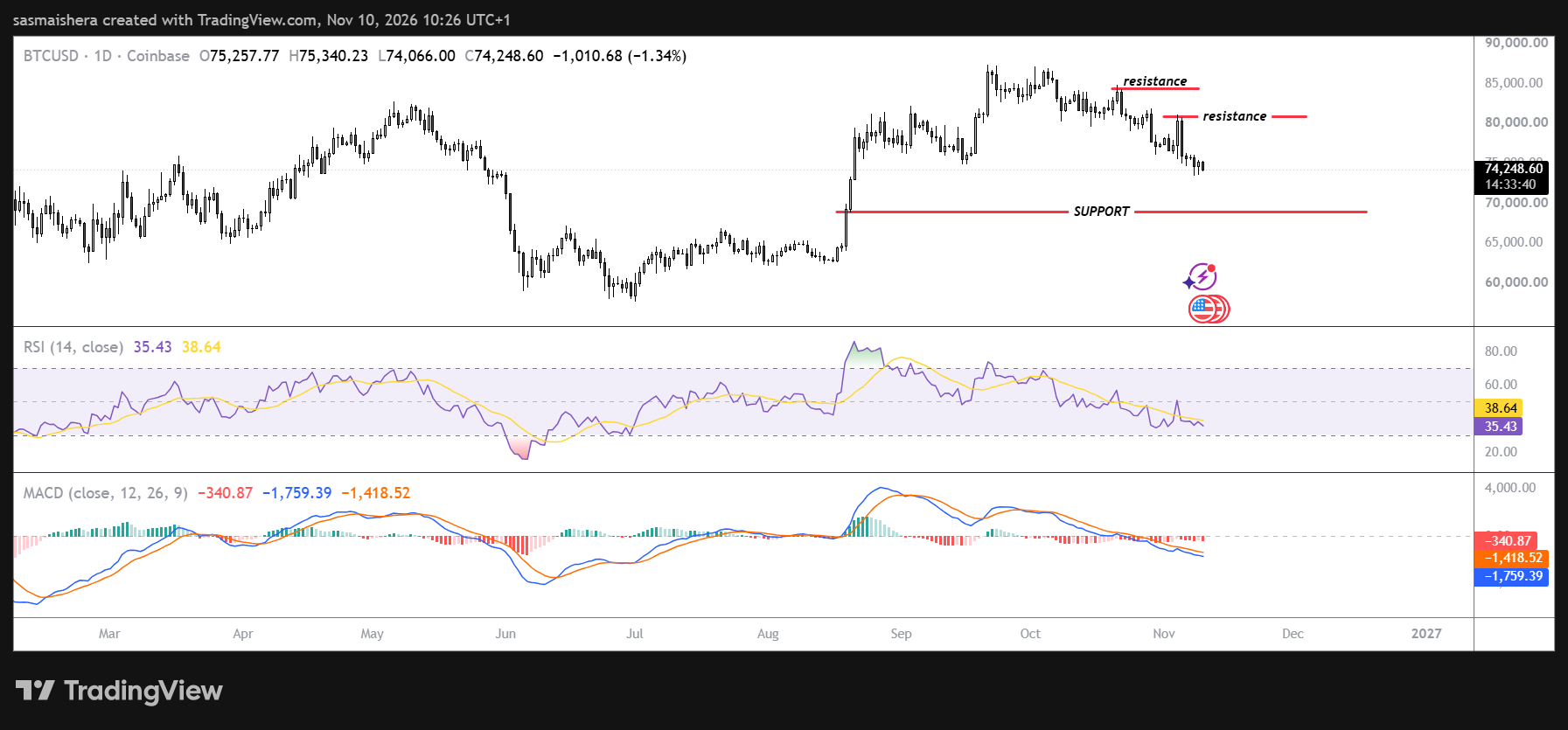
Bitcoin's technical picture has weakened considerably following its recent decline toward $75,000. The cryptocurrency briefly rebounded from that psychological support level during the latest trading session, but its broader structure remains bearish after falling below the 200-day Exponential Moving Average (EMA). The 200-day EMA is a long-term trend gauge that many traders use to separate bullish and bearish market phases.
Trading below this moving average suggests Bitcoin's previous bullish momentum has faded, potentially encouraging additional selling.
Momentum indicators reinforce the negative outlook. The daily Relative Strength Index (RSI) has dropped below 40, pointing to deteriorating buying momentum and indicating that sellers remain in control. The RSI is a momentum indicator on which readings above 70 are typically considered overbought and below 30 oversold.
If Bitcoin fails to reclaim the $75,000 resistance level, the next significant downside target lies around $71,500. That region corresponds to a fair value gap (FVG) formed during the August rally, where previous price imbalances could attract buying interest.
A decisive break below $71,500 would expose the next major support zone near $67,000. Both levels represent important technical areas that could determine whether Bitcoin stabilizes or extends its broader correction.
Key levels to watch
Bitcoin's ability to hold the $71,500 and $67,000 support zones could prove critical for its near-term trajectory. A successful rebound from either zone could help stabilize sentiment and potentially encourage a recovery toward $75,000.
However, failure to defend $67,000 would constitute a more significant technical setback. Such a breakdown could open the door to a deeper correction toward $60,000, a major psychological support level associated with previous market activity.
Conversely, a sustained recovery above $75,000, accompanied by stronger trading demand and improving ETF flows, would provide an early sign that selling pressure is easing.
For now, Bitcoin's technical outlook remains bearish as BTC struggles below its 200-day EMA, with $71,500 and $67,000 emerging as the most important downside support levels.

