Bitcoin Slides Below $80,000 as Strong Jobs Data Revives Fed Rate-Hike Bets and Trump Demands Lower Rates
Key Takeaways
- •The U.S. economy added 162,000 jobs in August, far above the roughly 56,000 economists expected, with the unemployment rate steady at 4.1%.
- •Bitcoin dropped more than 2% to trade near $79,500 after briefly rising above $82,000 ahead of the jobs report.
- •Market pricing puts the probability of a quarter-point Fed rate increase at the September 15-16 meeting at roughly 65%.
- •President Trump publicly renewed pressure on the Federal Reserve to lower interest rates, though rate decisions rest with the independent FOMC.
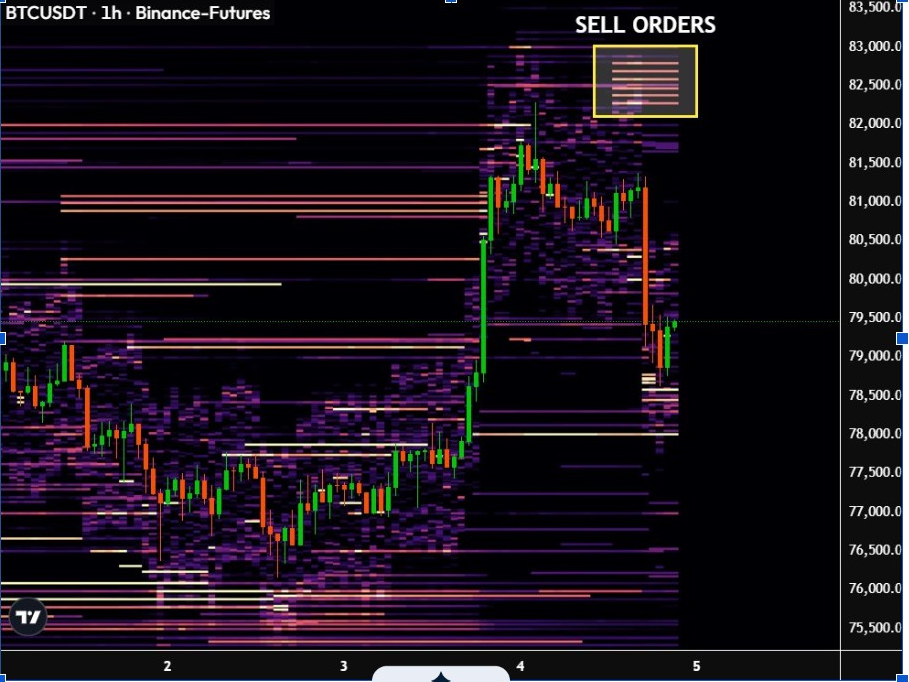
- •Futures data shows a concentrated sell wall between approximately $82,300 and $82,700, marking key resistance for any Bitcoin recovery.
Bitcoin erased its latest rally on Friday after stronger U.S. employment data pushed Treasury yields higher and revived expectations for another Federal Reserve rate increase.
BTC had climbed above $82,000 ahead of the jobs report but reversed sharply once the Bureau of Labor Statistics released its August figures. During the sell-off, Bitcoin fell below $78,700 before recovering toward $79,500 later in the session. The reversal came as traders increased bets that the Federal Reserve could raise interest rates at its September 15–16 meeting. President Donald Trump responded by again demanding lower borrowing costs despite the stronger labor-market numbers. Higher rates and rising yields have historically weighed on risk assets such as cryptocurrencies, because they raise the opportunity cost of holding non-yielding assets — a dynamic that helps explain Bitcoin's sensitivity to macroeconomic data releases.
Bitcoin Price Falls Below $80K After Jobs Report
Bitcoin had risen above $82,000 before the Bureau of Labor Statistics published its August employment report. The cryptocurrency then dropped more than 2% and traded near $79,500 as Treasury yields moved higher.
The U.S. economy added 162,000 jobs in August, while the unemployment rate held steady at 4.1%. Economists had expected roughly 56,000 new jobs, leaving the official result well above forecasts. Average hourly earnings rose 0.3% in August and 3.1% year over year. Payroll figures for June and July were also revised upward by a combined 55,000 jobs.
The stronger labor data has increased expectations that the Fed could hike rates at its September meeting. After the report, market pricing moved the probability of a quarter-point increase to roughly 65%. A hotter labor market is typically read by policymakers as a signal of residual economic strength that could sustain inflationary pressure, which is why employment figures feed directly into rate expectations.
Donald Trump Calls for Lower Interest Rates
Trump responded to the stronger jobs numbers by renewing pressure on the Federal Reserve to reduce borrowing costs, arguing that stronger U.S. economic conditions should support lower interest rates.
"Lower the interest rates because the U.S.A. is a much stronger credit," Trump wrote after the employment figures were released. He also called for U.S. borrowing costs to rank among the lowest in the world.
Trump has additionally linked his tariff demands to U.S. trade policy and to countries running trade surpluses with the United States. Monetary policy decisions, however, rest with the independent Federal Open Market Committee, and public pressure from the White House does not bind the Fed's choices — a separation designed to insulate rate decisions from political cycles.
The Fed has scheduled its next two-day meeting for September 15 and 16. Governor Christopher Waller has said that improving inflation could support keeping rates unchanged, while weaker inflation progress could argue for a rate increase. The latest employment figures add another consideration for policymakers ahead of that decision.
Bitcoin Faces $82,300 to $82,700 Sell Wall
Bitcoin's short-term structure has weakened after buyers failed to hold the move above $82,000. Futures data shows concentrated sell-side liquidity between approximately $82,300 and $82,700, where several large resting orders remain. That makes the zone a key resistance area for any renewed recovery attempt, with additional liquidity also appearing around $83,000.
Bitcoin would first need to regain $80,000 before challenging the recent area near $81,500. Clearing those levels would put the $82,300–$82,700 sell wall back in focus. Resting futures orders can be changed or canceled before execution, however, so the heatmap shows visible liquidity rather than confirming another rejection.
What Comes Next for Bitcoin Price?
Following the latest decline, Bitcoin is testing liquidity between roughly $78,500 and $79,500. Holding that area could support another attempt to reclaim $80,000. A break below $78,500 could shift attention toward $77,500–$78,000, and further selling could expose the larger liquidity zone around $75,500–$76,500.
Meanwhile, Fidelity has remained cautious despite Bitcoin's strong August rally, saying the recovery does not yet confirm that the bear market has ended. The firm is watching whether Bitcoin could form another cycle bottom around November 2026, based on its historical four-year pattern. Fidelity also notes that past cycles have not followed an exact schedule, so the market could still move in either direction. Beyond the Fed meeting, upcoming inflation prints and further labor-market data will be the next scheduled inputs likely to shape rate expectations — and with them, Bitcoin's macro backdrop.
This article is for informational purposes only and does not constitute financial advice. Cryptocurrency markets can experience sharp price movements.
Source: The Market Periodical
