Bitcoin Rejected at $81,500 as Whales Build Massive Sell Wall Near $81K
Key Takeaways
- •Bitcoin briefly reached $81,455 before reversing sharply and falling to a low of $76,877.
- •The decline reduced bitcoin’s weekly gain to 2% and cut its market capitalization to $1.58 trillion.
- •Bitcoin’s failed breakout triggered $107 million in liquidations across long and short positions, according to Coinglass.
- •Order-book data shows about $5.7 billion in liquidity between $75,000 and $78,500, compared with about $2.8 billion above $81,500.
- •Federal Reserve Chair Kevin Warsh rejected forward guidance in his Jackson Hole speech and said policy should adjust as conditions evolve.
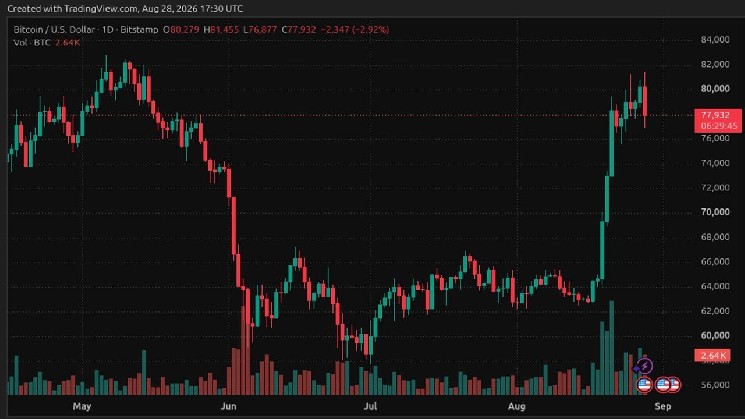
Bitcoin's advance stalled soon after it pushed above $81,000, as markets turned their attention to Federal Reserve Chair Kevin Warsh's inaugural Jackson Hole speech — the Kansas City Fed's long-running annual symposium, a fixture of the monetary-policy calendar where Fed chairs have historically used the podium to frame the policy outlook. Bitcoin has in recent years increasingly traded in step with rate-sensitive risk assets, and Fed communication has become a recurring source of volatility for crypto markets. The cryptocurrency slipped back after striking the key resistance level for the second time this week, in a move that mirrored the Aug. 25 pullback, when bitcoin topped $80,000 for the first time in more than three months.
Market data shows bitcoin peaked at $81,455 shortly after 9:30 p.m. Thursday, briefly shaking off bearish pressure that had been building since Tuesday. The rally proved short-lived: a sharp sell-off followed, erasing gains from Aug. 27 and dragging the asset to a session low of $78,442 around 10:15 a.m. Just over an hour after Warsh's address, bitcoin fell to a fresh low of $76,877 before quickly reclaiming $77,000 and testing $78,000.
The retreat trimmed bitcoin's weekly gain to 2% and pulled its market capitalization down to $1.58 trillion from more than $1.61 trillion. Even so, bitcoin remains on track for double-digit monthly gains, supported by the sharp rally recorded between Aug. 19 and Aug. 21.
Liquidations Mount as Bitcoin Fails to Hold $80,000
On the derivatives market, bitcoin's reversal — coming less than 24 hours after it reclaimed $80,000 — triggered $107 million in liquidations across long and short positions. Liquidations occur when exchanges force-close leveraged positions once losses exhaust a trader's margin, a mechanism that tends to magnify price moves during failed breakouts. Coinglass data shows a near-even split, with $50 million in longs and $57 million in shorts wiped out. Across the broader crypto market, roughly $300 million in leveraged positions evaporated.
Market analysis outlet Cryptoreviewing put the damage even higher, estimating that bitcoin's early-morning surge to $81,500 and immediate drop below $79,300 contributed to $465 million in 24-hour liquidations — far above the standard derivatives wipeout implied by exchange data alone. In a post on X, Cryptoreviewing noted that bitcoin swept the upside liquidity zone between $80,400 and $81,600 almost perfectly but failed to hold $80,000, weakening short-term momentum and flipping the near-term bias back toward caution.
Order-Book Imbalances
The same post highlighted that liquidity distribution now skews heavily downward, with roughly $5.7 billion resting between $75,000 and $78,500. That contrasts with approximately $2.8 billion sitting overhead between $81,500 and $84,000. According to Cryptoreviewing, this imbalance suggests a deeper pullback remains a meaningful risk on higher timeframes.
On lower timeframes, the largest liquidity pockets are clustered at $78,600 and $79,100 below, and at $81,300 and $81,900 above — identified in the post as the most likely sweep zones in the near term.
Turning to order flow, Cryptoreviewing noted that whales are maintaining heavy sell walls between $80,800 and $83,000, while large bids remain stacked around $78,000 to $79,000 and lower — a sign that institutional buyers continue purchasing dips but face a formidable ceiling for continuation. Sell walls — dense clusters of resting limit sell orders — are watched by traders as potential ceilings for rallies, which is what gives the overhead stack its significance. Meanwhile, open interest has rebuilt, futures traders are adding exposure, and the Coinbase Premium has turned positive; the premium, the price gap between Coinbase and other major venues, is a widely followed proxy for U.S.-based demand. Spot demand, however, is weakening, indicating that leverage is returning faster than organic buying.
Fed Chair Warsh Rejects Forward Guidance
In his address, Warsh reiterated his rejection of forward guidance — the signaling strategy favored by previous Fed chairs, under which the central bank telegraphs the likely path of interest rates to shape market expectations — arguing that sticky inflation still threatens economic momentum despite recent positive data. He emphasized a return to traditional central banking: adjusting interest rates as conditions evolve in order to anchor price stability without destabilizing employment.
While the Iran war and surging crude prices have clouded the U.S. growth outlook, Warsh struck a resilient tone, pointing to unprecedented corporate spending on technology and AI infrastructure as a powerful counterweight.
For now, the market's near-term map remains the one sketched by the order book — liquidity pools near $78,600 and $79,100 below, $81,300 and $81,900 above, and the contested $80,000 handle in between — while a Fed that declines to pre-signal its rate path keeps macro data releases on crypto traders' screens alongside the chart.
Source: BTC Rejects $81,500 as Whales Build Massive Sell Wall at $81K
