Bitcoin Trades Near $80,000 as Peter Schiff Sees $75,000 as Next Level
Key Takeaways
- •Bitcoin broke below $80,000 on Saturday, touching intraday lows between $79,146 and $79,263 before a later price reading showed levels near $80,300.
- •Liquidations reached $239.65 million in Bitcoin and $820.78 million across the broader crypto market over 24 hours, forcing out 196,033 traders, with longs making up 93.1% and 83.7% of the respective totals.
- •U.S. spot Bitcoin ETFs posted $635.5 million in outflows on Oct. 22, their largest daily withdrawal since June 25, led by BlackRock's IBIT at $254.1 million and Fidelity's FBTC at $217.5 million, followed by another $137.9 million on Oct. 23.
- •Peter Schiff claimed $75,000 could be the next stop if Bitcoin stays below $80,000, though Strategy's more than 640,000 BTC at an average cost of $73,981 would retain a paper gain of roughly $1,019 per coin at that price.
- •Because U.S.-listed ETF shares cannot trade over the weekend, holders must wait until Monday's reopening to respond, with the Federal Reserve's rate decision scheduled for Oct. 28 after its two-day meeting.
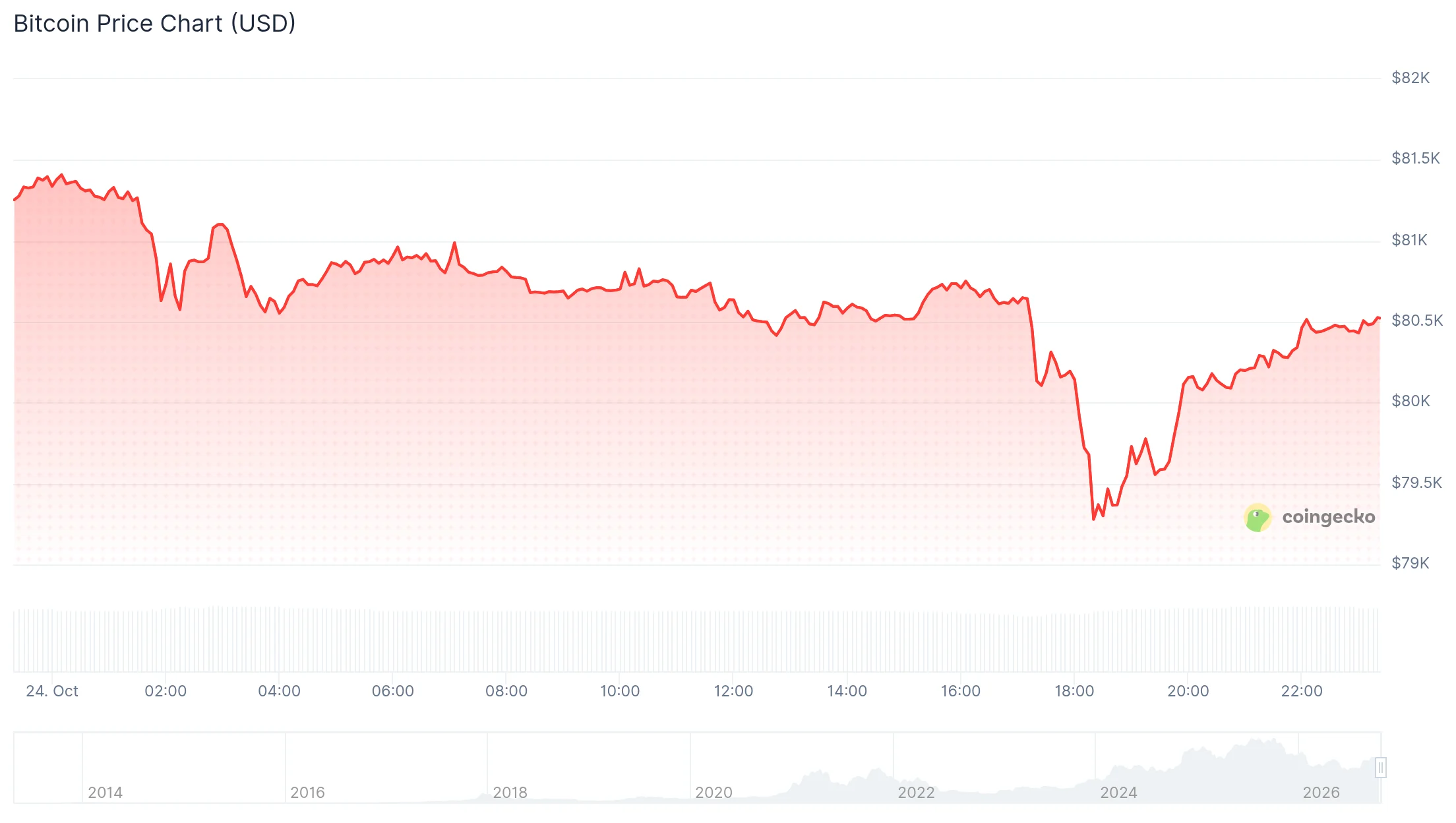
Bitcoin fell below $80,000 on Saturday, extending a volatile decline that pushed the market into a key support zone. Reported intraday lows ranged from $79,146 to $79,263, while a later price reading showed BTC near $80,300. Peter Schiff, the longtime Bitcoin critic and chief executive of Euro Pacific Capital, said $75,000 could become the next significant level if buyers fail to defend support.
Leveraged liquidations accelerated the selloff, with long positions accounting for the vast majority of forced closures across crypto markets. U.S. spot Bitcoin ETFs had also posted two consecutive days of outflows. Because ETF investors cannot sell U.S.-listed shares over the weekend even as Bitcoin trades, they must wait until Monday to respond.
Liquidations Pile Up as Bitcoin Breaks $80,000
CoinGlass recorded $239.65 million in Bitcoin liquidations over 24 hours. Long positions made up $223 million, or 93.1% of the total, while shorts accounted for $16.65 million. Across the broader crypto market, liquidations reached $820.78 million, and 196,033 traders were forced out. Longs represented $686.93 million, or 83.7%, of the market-wide total.
Liquidations occur when a leveraged position's losses exhaust its margin, forcing the exchange to close the trade. The figures indicate traders were positioned for gains before Bitcoin broke lower. Forced closures then added sell orders as BTC slipped through the $81,000-to-$80,000.
Bitcoin also fell below its 50-day simple moving average near $81700 to $81,800, a level that had held for about two months. The 50-day average is a widely followed trend indicator in technical analysis, a reference point chart watchers use to gauge medium-term momentum. Near-term support sits near $78,400 and $77,876. A wider support zone runs from $76,700 to $72,500, placing $75,000 inside that lower band.
ETF Outflows Add Headwind
ETF flows offered another headwind. U.S. spot Bitcoin funds, which hold the coin directly, lost about $635.5 million on Thursday, Oct. 22, their largest daily outflow since June 25. BlackRock's IBIT accounted for $254.1 million of the total, while Fidelity's FBTC lost $217.5 million. Funds shed another $137.9 million on Friday, Oct. 23, after three sessions of inflows above $1 billion, a run that included $528.4 million on Oct. 21. The outflows further weakened institutional demand.
The reversal pulled Bitcoin toward $81,668 on Friday before the weekend break. ETF shareholders could not trade their shares on Saturday or Sunday as Bitcoin continued moving; they could only respond when U.S. markets reopened Monday.
Technology stocks and energy prices also weighed on risk appetite. The Nasdaq Composite fell 2.6% on Thursday, its steepest daily drop since June 5, as investors questioned whether large technology companies could sustain artificial intelligence spending. Brent crude climbed above $117 amid Middle East tensions, renewing inflation concerns ahead of the Federal Reserve's Oct. 27-28 meeting.
Arthur Hayes said he closed Maelstrom's directional book and took profits on ETH, ENA, and UNI, citing macro and geopolitical uncertainty.
Schiff Sees $75,000 as Next Stop, ETF Holders Sidelined Until Monday
Schiff, Euro Pacific Capital's chief executive and chief global strategist, argued that Bitcoin had finally broken down. The longtime Bitcoin critic said $75,000 was likely the next stop if prices stayed below $80,000, and that failure at $75,000 would make the weekend difficult for ETF investors, who cannot trade before Monday.
pic.twitter.com/O9B10CvYwS — Dan Held (@danheld) October 24, 2026
Schiff's message underscored the structural difference between Bitcoin and ETF shares. Bitcoin trades continuously, but U.S.-listed funds trade on stock-market schedules. ETF shareholders therefore cannot adjust their positions during a weekend selloff and can only react when trading resumes.
Schiff also said a $75,000 Bitcoin price could erase Strategy's paper gains. The company's reported average cost basis complicates that claim: Strategy holds more than 640,000 BTC at an average cost of $73,981. At $75,000, Bitcoin would remain about $1,019 above that basis per coin, before other considerations. The decline would narrow the paper-gain buffer but would not erase it on a simple average-cost comparison.
Schiff has also warned that Strategy's premium could turn into a discount and has criticized its share dilution.
Traders are watching whether Bitcoin reclaims $80,000 and retakes its 50-day average. If support fails, Schiff's $75,000 call sits between nearby levels at $77,876 and $72,500. Monday's reopening of U.S. markets will also give ETF holders their first opportunity to respond to the weekend move. The Federal Reserve's rate decision is scheduled for Oct. 28, following the two-day meeting that begins Oct. 27.
Source: Blockonomi

