Bitcoin Falls Below $77,000 as Chip Selloff Hits Stocks Ahead of U.S. Midterms
Key Takeaways
- •Bitcoin dropped 2% to just under $77,000 in Asian morning trading on Tuesday, wiping out Monday's rebound and falling below the $77,600 level reached late Sunday.
- •Analyst Ted Pillows noted that Bitcoin has closed four consecutive weekly candles red and, since 2011, has never closed five straight red weekly candles during a bull run, meaning the current week must close higher if the bull run is intact.
- •A gauge of U.S. chipmakers extended its selloff to 12% over three days and the Nasdaq 100 fell 10% from its peak, a drop traders characterize as a correction, while the S&P 500 slipped 0.5%.
- •Binance said $6.3 billion was stolen in what it described as the largest crypto exchange hack, attributed to North Korean group TraderTraitor, and the exchange covered $6 billion of the loss internally while freezing $3 billion in stolen assets and resuming withdrawals.
- •U.S. spot Bitcoin ETFs recorded $399 million in net outflows on Nov. 2 and spot Ether ETFs saw $140 million in outflows, following Friday's $643.3 million in withdrawals, the largest single-day outflow in four months.
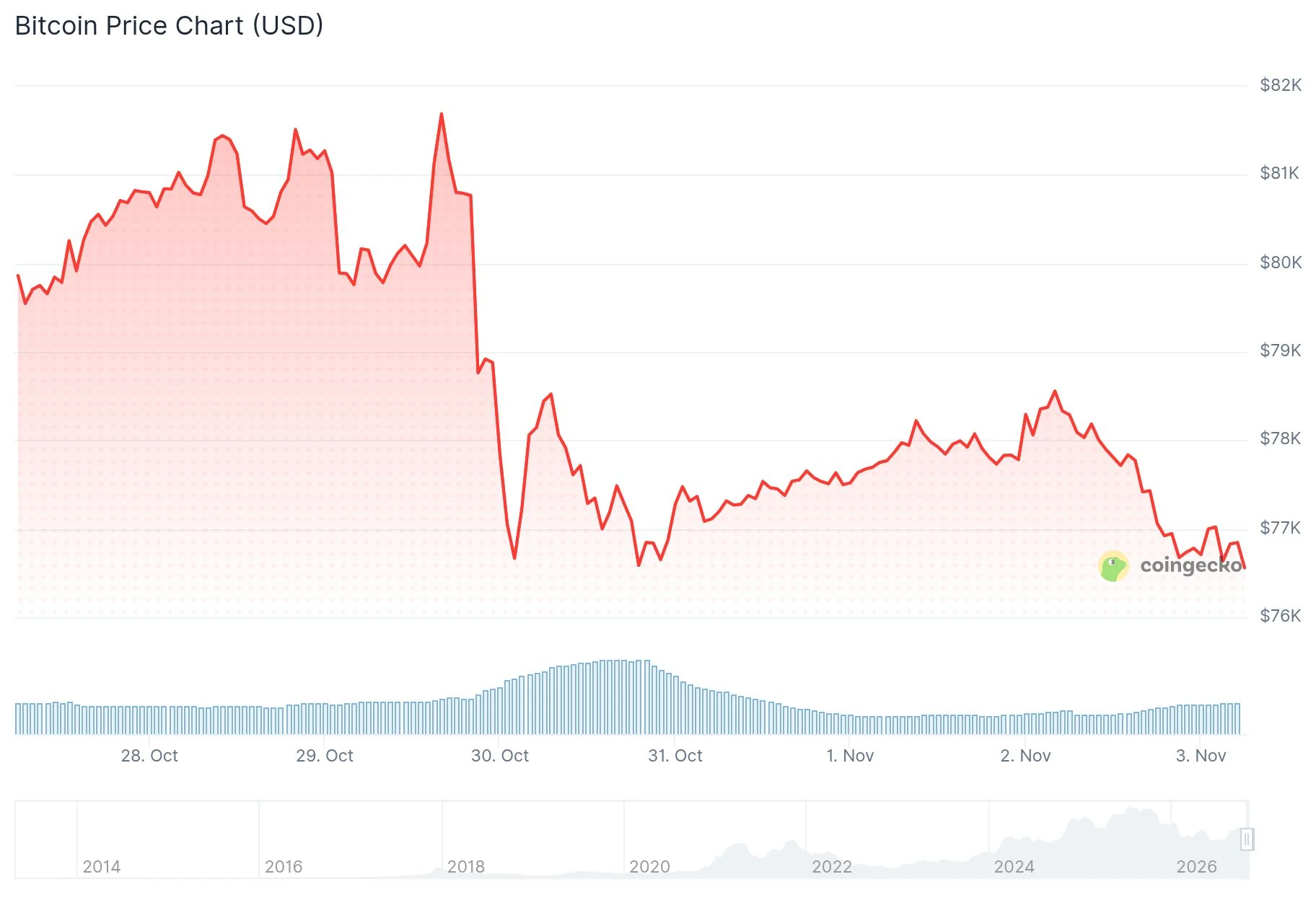
Bitcoin (BTC) fell 2% to just under $77,000 during Asian morning trading on Tuesday, wiping out the previous day’s rebound. The decline pushed the cryptocurrency below the $77,600 level it reached late Sunday, after buyers briefly stepped in before selling resumed.
Analyst Ted Pillows highlighted Bitcoin’s weekly performance, noting that BTC has closed four consecutive weeks in the red. According to Pillows, Bitcoin has not closed five consecutive weekly candles in red during a bull run since 2011. He said that if Bitcoin has entered a bull run, the current week must close higher.
$BTC has closed 4 consecutive weeks in red. Since 2011, Bitcoin has never closed 5 consecutive weekly candles in red during a bull run. If BTC has really entered a bull run, this week must close in green. pic.twitter.com/y73pPdZU7B — Ted (@TedPillows) November 2, 2026
The post was published on X by Ted. The original post is also available through its X link.
Other major cryptocurrencies also declined. ZEC dropped nearly 10% to approximately $1,140, reversing part of the gains recorded by the token on Monday. HYPE fell 5% to about $84, while SOL declined 3% to roughly $92. BNB slipped below $700 after losing 2%. Ether and DOGE each fell about 2%, with ether trading just above $2,250. XRP held at $1.25, while TRX was the only major cryptocurrency listed to advance, gaining about 2%.
Chip Selloff Spreads Across Markets
The broader market decline began on Wall Street. A gauge of U.S. chipmakers extended a three-day selloff to 12%, while the Nasdaq 100 fell 10% from its peak, a decline traders characterize as a correction, the conventional term for a drop of 10% or more from a recent high. The S&P 500 slipped 0.5%.
The weakness extended into Asian markets, where South Korea’s Kospi fell more than 3% and the MSCI Asia Pacific Index declined almost 1%. Bitcoin, which investors commonly classify as a risk-sensitive asset alongside technology shares, traded lower alongside equities during the session.
Oil prices dropped sharply on Monday as expectations increased for a diplomatic resolution to the U.S.-Iran war. WTI crude, the U.S. benchmark grade, fell more than 7% and reached $95.15, its lowest level since Oct. 15. Brent crude, the international benchmark, declined 9% to approximately $103.30.
Secretary of State Marco Rubio said President Donald Trump would prefer to end the conflict through diplomacy. Bitcoin did not rally following the news.
Gold, an asset investors have traditionally treated as a haven in periods of market stress, rose 2% to above $3,950 per ounce after reaching a 13-month low of $3,891 on Friday. Earnings from Apple and Palantir were also due.
Binance Hack and ETF Outflows
The cryptocurrency market was also dealing with the effects of what Binance described as the largest hack involving a crypto exchange. Binance said $6.3 billion was stolen in a breach attributed to the North Korean group TraderTraitor.
Binance has resumed withdrawals on several major blockchains. The exchange said it covered $6 billion of the loss using internal funds and froze $3 billion in stolen assets. CoinCentral previously reported on the Binance hack and the restoration of exchange services.
Wu Blockchain, citing SoSoValue, reported that U.S. spot Bitcoin exchange-traded funds recorded $399 million in net outflows on Nov. 2. Fidelity’s FBTC led individual fund inflows with $6.68 million, while spot Ether ETFs recorded $140 million in outflows. Net outflows mean redemptions across a fund group outweighed new money coming in on the day, even as individual products such as FBTC still attracted inflows.
U.S. Bitcoin ETFs Shed $399 Million, Ether Funds Lose $140 Million According to SoSoValue, U.S. spot Bitcoin ETFs recorded $399 million in net outflows on November 2, while Fidelity's FBTC led individual fund inflows with $6.68 million. Spot Ethereum ETFs saw $140 million in net… pic.twitter.com/vfZXIZ7TNa — Wu Blockchain (@WuBlockchain) November 3, 2026
The figures were published by Wu Blockchain on X, with the original post available here.
The latest outflows followed $643.3 million in withdrawals on Friday, the largest single-day outflow in four months.
U.S. voters are scheduled to cast ballots in the midterm elections on Tuesday, with the first results expected to arrive as Asian markets open on Wednesday. The original report was published by CoinCentral.

