Bitcoin Slides Below $77,000 as Warsh's Jackson Hole Remarks Spark $488 Million in Crypto Liquidations
Key Takeaways
- •Bitcoin dropped as low as $76,909 before recovering to $77,712, leaving it down about 4% on the day.
- •Traders increased the perceived probability of a September Federal Reserve rate hike to about 60% after Warsh's remarks.
- •CoinGlass recorded $487.68 million in liquidations across the crypto market over 24 hours, affecting 97,691 traders.
- •Long positions accounted for more than $360 million of the liquidations, and Bitcoin positions made up about $141 million of the total.
- •The two-year Treasury yield rose to a one-month high as investors priced in a more hawkish policy outlook.
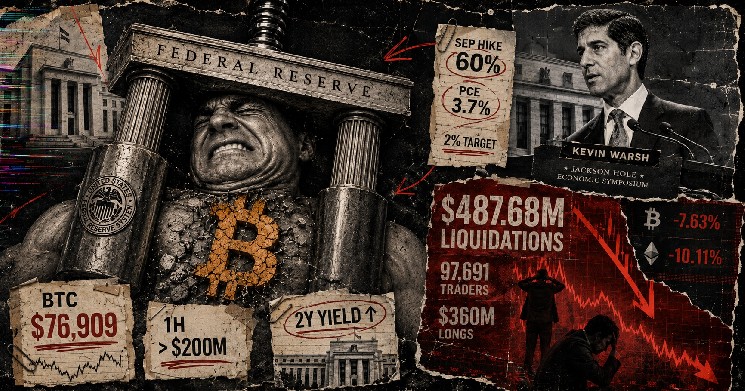
Bitcoin slipped below $77,000 on Friday after Federal Reserve Chair Kevin Warsh revived the prospect of higher interest rates in remarks at Jackson Hole, setting off a wave of deleveraging that erased nearly $488 million from leveraged derivatives traders.
The setting carried weight of its own: the Kansas City Fed's annual symposium in Jackson Hole, Wyoming, has for decades served as a stage where Fed chairs signal policy shifts to global markets — Jerome Powell used his 2022 keynote there to brace investors for a prolonged tightening campaign — and traders have learned to parse every word that comes out of the mountain retreat.
Data from CryptoSlate shows the largest cryptocurrency fell as low as $76,909 before recovering to $77,712 at press time, down roughly 4% over the previous 24 hours.
The selloff followed a sharp repricing of Federal Reserve expectations. Traders raised the probability of a September rate increase to about 60%, up from roughly 35% before Warsh spoke, while short-term Treasury yields climbed and the dollar strengthened.
Warsh: financial conditions may still be too loose
Warsh gave markets several reasons to doubt that the Fed was pivoting toward easier policy, arguing that inflation remains too high despite more encouraging price readings over the summer.
The Fed's preferred personal consumption expenditures price index is running at 3.7% over the past year and at a 4.1% annualized pace over the past six months — both well above the central bank's 2% target.
The recent inflation reports did not convince Warsh that the underlying trend has changed. “We must be confident that underlying inflation is moving to our objective, clearly and at sufficient speed. Otherwise, we have work to do,” he said.
He also pushed back on the notion that current borrowing conditions are already restraining demand enough. Credit markets show few signs of policy restraint, corporate bond spreads remain historically narrow, and bank lending standards are relatively easy.
“I would be hard pressed to describe broad financial conditions as restrictive,” Warsh added.
The combination landed as a hawkish signal. Warsh described labor conditions as consistent with full employment, pointed to healthy consumer spending and strong business investment, and said the Fed's “predominant focus right now should be on prices.”
For crypto traders, the implications were immediate: a resilient economy gives the Fed more room to keep policy tight, while persistent inflation raises the possibility that its next move could be another increase rather than the easier financial conditions risk assets had been anticipating.
The two-year Treasury yield, among the parts of the bond market most sensitive to expectations for the Fed's policy path, climbed to a one-month high after the remarks as investors increased bets on another rate increase.
Leveraged traders absorb nearly $488 million hit
The shift struck a crypto market that entered Friday carrying substantial leveraged exposure after Bitcoin's recent rally above $80,000.
CoinGlass recorded $487.68 million in liquidations across the market over the previous 24 hours, affecting 97,691 traders. More than $200 million of those positions were closed within one hour of the speech.
Liquidations occur when an exchange forcibly closes a leveraged position because adverse price moves have exhausted the trader's posted margin; because those closures add selling pressure of their own, episodes like Friday's can compound quickly once momentum turns.
Long positions accounted for over $360 million of the losses, showing that traders positioned for further gains absorbed most of the reversal. Bitcoin positions generated roughly $141 million of the liquidations, while the largest single liquidation was an $11.66 million ETH-USDT position on Binance.
The speech also rippled through precious metals: reports indicated that gold and silver lost more than $700 billion of their market value following the remarks.
Higher rate expectations create several simultaneous headwinds for crypto. Rising Treasury yields lift the returns available on dollar-denominated assets, and a stronger dollar typically tightens financial conditions for speculative markets. Expectations of more restrictive policy can also drain the liquidity backdrop that helped fuel Bitcoin's recent advance.
Bitcoin's sensitivity to the rate cycle is well established: during the Fed's 2022 tightening campaign, when the policy rate rose from near zero to above 4%, the cryptocurrency lost more than 60% of its value alongside a broad retreat in risk assets.
Friday's reaction demonstrated how quickly that relationship can reassert itself. Bitcoin had been trading near $80,000 before Warsh's speech became the market's dominant macro catalyst, with contemporaneous reports showing the cryptocurrency falling more than 3% as rate-hike expectations climbed.
A quieter Fed could leave crypto facing more rate volatility
Warsh offered little certainty about what the Fed will actually do next. The chairman has moved away from the heavy forward guidance favored by his predecessors, arguing that telegraphing policy paths can distort markets and constrain the central bank when economic conditions change. He also rejected the idea of providing investors with a mechanical reaction function that would dictate how rates should respond to individual economic reports.
That approach could make upcoming inflation and employment releases more consequential for Bitcoin and other risk assets, because traders will receive fewer signals from the Fed about how policymakers intend to respond.
Apollo Global Management Chief Economist Torsten Slok has argued that such a regime could push more interest-rate moves outside Fed meeting days, as investors continuously reprice economic data instead of waiting for policymakers to validate their expectations. Slok noted that since the Fed began raising rates in 2022, much of the increase in longer-term Treasury yields has occurred outside FOMC meetings, as inflation reports, employment data, Treasury issuance and the term premium became larger drivers of the bond market.
Warsh reinforced that philosophy on Friday, saying markets should form their own expectations rather than look primarily to the Fed for their “next trade.”
For Bitcoin, Friday offered an early preview of what that environment could look like. Warsh stopped short of committing to a September increase, leaving incoming data to determine whether the Fed follows through. But his insistence that inflation remains too high, that financial conditions are not particularly restrictive, and that interest rates remain the central bank's main policy tool was enough to revive fears of tightening.
The next checkpoints are already on the calendar: the monthly employment and inflation reports due ahead of the Fed's September policy meeting, the gathering for which traders now see a rate increase as more likely than not, will offer the first read on whether that repricing holds.
