Bitcoin Price Retreats Below $76,000 as Weak Spot Demand Stalls $80,000 Recovery
Key Takeaways
- •US spot Bitcoin and Ether ETFs recorded $530.1 million in combined outflows on November 5, with Bitcoin funds accounting for $430.2 million and Ether products $99.9 million.
- •Fidelity's FBTC led redemptions with a $199.9 million withdrawal, while BlackRock's IBIT lost $105 million in its fifth consecutive session of net outflows, bringing its withdrawals since October 30 to roughly $1.04 billion.
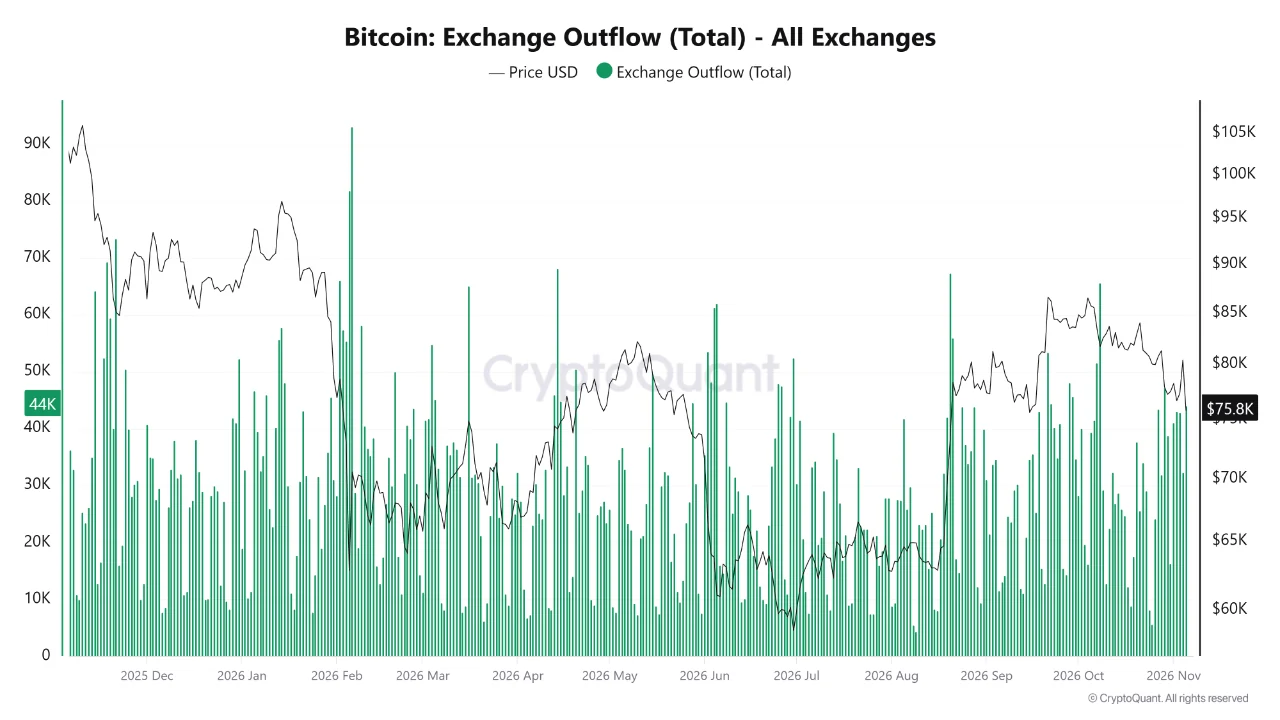
- •On-chain data pointed in different directions, as net exchange withdrawals reached 11,003 BTC and the 60-day accumulation measure for wallets holding more than 10,000 BTC turned positive, while retail-sized Binance deposits increased sharply.
- •Bitcoin ETFs recorded $869.8 million in net outflows across the first four November sessions, erasing Wednesday's $74.6 million inflow, and XWIN Japan flagged $73,000–$76,000 as the support zone to watch.
- •The Nasdaq 100 fell 6.4% and lost approximately $2.5 trillion to enter correction territory nearly 12% below its October peak, while US semiconductor shares crashed 12% and Nvidia dropped about 9% on concerns that Democratic midterm gains could tighten scrutiny of AI data center construction.
Bitcoin fell back below $76,000 on Thursday after a recovery above $80,000 failed to hold. Weak spot demand left the rebound vulnerable as technology stocks sold off and investors pulled money from crypto funds, sending the asset back into the $75,000–$76,000 range and unwinding the brief climb above the $80,000 level.
The US spot Bitcoin and Ether ETFs — funds that hold the underlying coins directly and whose daily flows are widely tracked as a gauge of institutional demand — recorded $530.1 million in combined outflows on November 5, according to Farside Investors data. Bitcoin funds accounted for $430.2 million of the total, while Ether products lost $99.9 million. CryptoQuant data showed that temporary improvements in futures positioning had failed to attract sufficient spot buying, returning attention to support levels, exchange transfers, and the sources of fresh capital needed for a recovery.
The day's action pulled together the strands that had defined recent trading: a rebound that could not attract fresh spot capital, continued redemptions from US-listed crypto funds, and a sharp sell-off in technology shares that weighed on appetite for risk assets.
On-Chain Signals Point in Different Directions
Market contributor XWIN Japan placed BTC in the $75,000–$76,000 range after the failed rebound and flagged $73,000–$76,000 as the support zone to watch during the renewed decline. The futures market had shown temporary signs of improvement, yet spot demand remained weak. For Bitcoin, that gap suggested there was not enough buying pressure to sustain the rally.
Several blockchain readings pointed in different directions. Net exchange withdrawals reached 11,003 BTC on November 5, following outflows of 4,235 BTC one day earlier. The 60-day accumulation measure for wallets holding more than 10,000 BTC turned positive. Those readings suggest some large holders may be adding exposure, although they do not establish that every exchange withdrawal represents a new purchase, since transfers can also reflect custody changes.
Meanwhile, retail-sized Bitcoin deposits into Binance increased sharply, according to the CryptoQuant commentary. Deposits can make coins available for sale, although a transfer does not confirm that selling actually occurred.
The opposing signals complicate the picture. Large-wallet accumulation can coexist with pressure on smaller holders, leaving aggregate demand weak even when some investors increase their holdings. XWIN Japan also said stablecoin liquidity had yet to recover, and the contributor is looking for spot demand, ETF flows, and stablecoin liquidity to strengthen together before treating any rebound as durable.
ETF Outflows Deepen Across Bitcoin and Ether Funds
Fidelity led redemptions among US Bitcoin funds. Its FBTC fund lost $199.9 million on Thursday, reversing Wednesday's $236.7 million inflow. BlackRock's IBIT recorded $105 million in withdrawals, its fifth consecutive session of net outflows, with Farside's daily figures putting the fund's combined withdrawals since October 30 at roughly $1.04 billion.
Grayscale's GBTC lost another $49.9 million, while Franklin's EZBC shed $32.9 million. VanEck's HODL and ARK 21Shares' ARKB posted withdrawals of $23.6 million and $18.9 million, respectively.
Thursday's decline followed a short-lived improvement in overall fund demand. Bitcoin ETFs had attracted $74.6 million on Wednesday before redemptions erased the gain. Across the first four November sessions, the category recorded $869.8 million in net outflows — evidence of why a single positive session offered little assurance of sustained buying.
Ether funds shared the pressure. BlackRock's ETHA lost $75.2 million, while its ETHB product shed $22 million, together representing most of the category's $99.9 million withdrawal. Ether ETFs had attracted $53 million a day earlier before those flows reversed.
Technology Shares Face Fresh Selling
The wider market deteriorated alongside crypto. The Nasdaq Composite dropped 5.5%, while the Nasdaq 100 fell 6.4% and lost approximately $2.5 trillion in value, entering correction territory — conventionally, a decline of 10% or more from a recent peak — at nearly 12% below its October peak. US semiconductor shares crashed 12%, with chipmaker Nvidia losing about 9%.
NASDAQ ERASES $2.5 TRILLION AS DEMOCRATIC SWEEP SPARKS AI SELLOFF
The Nasdaq 100 plunged 6.4%, wiping out $2.5 trillion, while the Nasdaq Composite fell 5.5%, entering correction territory at nearly 12% below its October peak.
Semiconductors crashed 12%, with Nvidia down 9% and…
— Walter Bloomberg (@DeItaone), November 6, 2026
Investors worried that Democratic midterm gains could bring tougher scrutiny of AI data center construction. For Bitcoin, the simultaneous retreat in stocks and crypto funds underscored the asset's exposure to broader risk sentiment.
The Bureau of Labor Statistics has scheduled the October US employment report for Friday, November 6, with a release time of 8:30 a.m. Eastern time — one of the monthly releases markets watch for a read on the direction of the US labor market. Traders were awaiting the data as the week drew to a close, with the daily ETF flow tallies and the $73,000–$76,000 support zone flagged by XWIN Japan among the other markers on the watch list.
Source: Blockonomi

