Bitcoin Falls Below $75,000 as Senate Blocks CLARITY Act; $674 Million Liquidated
Key Takeaways
- •The U.S. Senate rejected the CLARITY Act in a 49-50 cloture vote, short of the 60 votes needed, with opposition from all present Democrats and Republican Sens. Susan Collins, Josh Hawley, and Jerry Moran.
- •Bitcoin fell to an intraday low near $74,900 before recovering above $75,000, staying down about 4% over 24, while Ethereum declined 6% on the day.
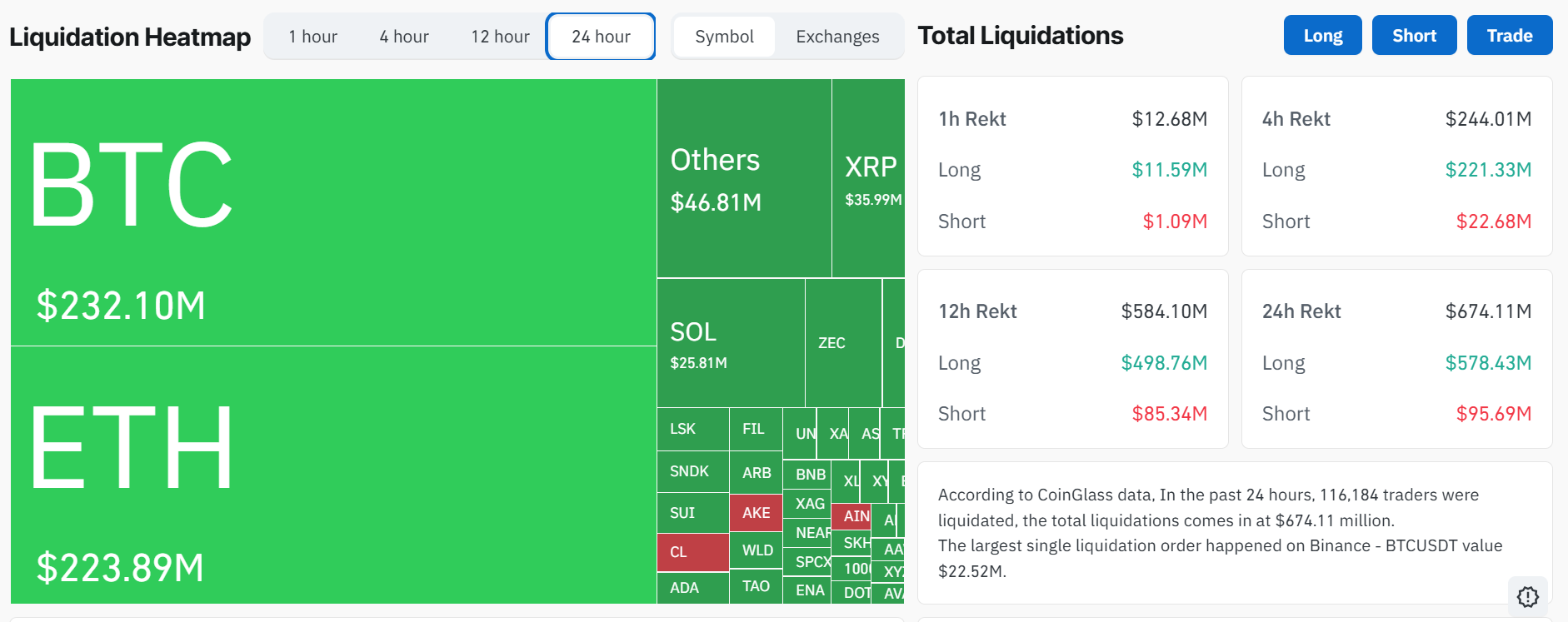
- •Approximately $674 million in crypto positions were liquidated within 24 hours, affecting 116,051 traders, with long positions accounting for roughly $579 million of the losses.
- •Bitcoin and Ethereum saw the largest liquidation totals at $232 million and $224 million respectively, including a single $22.52 million BTCUSDT position on Binance.
- •The bill's future is uncertain ahead of the November midterms, as Sen. Thom Tillis switched his vote to no to preserve a reconsideration path, while Sen. Cynthia Lummis criticized Democrats and Ripple's Brad Garlinghouse suggested the bill might be dead.
Bitcoin briefly dropped below $75,000 after the U.S. Senate failed to advance the CLARITY Act on Sept. 15, deepening a broader cryptocurrency selloff as traders turned their focus to the Federal Reserve's Sept. 16 policy decision.
Bitcoin slips under $75,000 before recovering
BTC fell to an intraday low around $74,900 before climbing back above the $75,000 level, although it remained down about 4% over the latest 24-hour period. The decline extended a broader crypto selloff as market participants reacted to the failed procedural vote and prepared for the Fed's upcoming announcement.
The move also triggered heavy liquidations across leveraged crypto markets — the forced closure of a trader's position by an exchange once losses exceed the margin backing it. CoinGlass data in the latest market snapshot showed approximately $674 million in positions liquidated over 24 hours, with long traders accounting for most of the losses. Bitcoin and Ethereum recorded the largest liquidation totals as both assets fell sharply.
Senate vote falls short of cloture threshold
The CLARITY Act, a market-structure bill that aims to establish a regulatory framework for digital assets, required 60 votes to pass the Senate's cloture rule, the procedure used to cut off debate and move a bill toward a final vote. The final tally came in at 49 to 50 votes, as most senators voted to reject the measure.
Market-structure legislation is closely watched across the crypto industry because it determines how digital assets are classified and which U.S. regulators oversee them, a long-running point of contention in American crypto policy.
Opposition to the bill was bipartisan. All Democrats present in the Senate voted against it, while Republican Sens. Susan Collins, Josh Hawley, and Jerry Moran also joined them. Several Democrats who had been initially undecided — Sens. Kirsten Gillibrand, Catherine Cortez Masto, Angela Alsobrooks, Cory Booker, and Mark Warner — ultimately voted no.
Sen. Thom Tillis voted yes before later changing his vote to no, a procedural move that allows a motion to reconsider the bill to be entered and keeps a path open for another attempt.
The failure of Tuesday's vote appears to have come down to Democratic concerns over President Trump's crypto interests. Republicans amended the bill's ethics provisions to address some of those concerns, but reports say Democrats demanded more stringent provisions, which Republicans rejected.
Path forward uncertain ahead of midterms
It is now unclear what will happen next for the CLARITY Act. With midterm elections in November, time is limited, and there are concerns that most lawmakers will now focus on their reelection campaigns.
The bill's biggest proponent, Sen. Cynthia Lummis, criticized Senate Democrats for the no vote, claiming they did not act in good faith. According to her post on X, their no vote was a vote against American leadership and consumer protection.
Opinions remain divided on whether the bill is dead or can still be saved. While crypto stakeholders such as Ripple's Brad Garlinghouse suggested on X that the bill might be dead, some believe it could eventually pass.
Nearly $700 million liquidated in 24 hours
The broad decline in the crypto market following the CLARITY Act vote left many traders with losses from liquidations. According to CoinGlass data, $674 million was liquidated in the past 24 hours, affecting 116,051 traders. Totals of that size show how much leveraged positioning was unwound during the drop.
About $579 million in long positions were liquidated, with the single largest being a BTCUSDT position valued at $22.52 million on Binance. Short traders were also affected, though only $95.38 million worth of their positions were liquidated.
Liquidations were concentrated in Bitcoin and Ethereum, which accounted for $232 million and $224 million, respectively. That was unsurprising, as ETH also fell 6% on the day.
Disclaimer: This article is for informational purposes only and does not constitute financial, investment or legal advice. Cryptocurrency investments involve risk, and political or monetary-policy developments can cause sharp market volatility. Readers should conduct their own research before making investment decisions.

